 Back
BackAnimal Diversity II: Vertebrates – Structure, Evolution, and Major Groups
Study Guide - Smart Notes
 Tailored notes based on your materials, expanded with key definitions, examples, and context.
Animal Diversity II: Vertebrates
Chordate Key Features
Chordates are a diverse group of animals that share several defining features at some stage in their development. These features are crucial for understanding the evolutionary relationships and adaptations within the phylum Chordata.
Dorsal nerve cord: A hollow, fluid-filled tube running along the dorsal (back) side of the body, which develops into the central nervous system (brain and spinal cord in vertebrates).
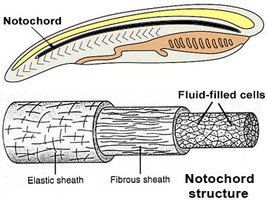
Notochord: A flexible, rod-shaped structure that provides support and serves as an anchor for muscles. In many vertebrates, it is replaced by the vertebral column during development.
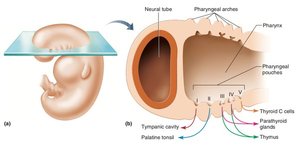
Pharyngeal gill slits: Openings in the pharynx (throat region) that function in filter-feeding or gas exchange in aquatic species; in terrestrial vertebrates, these structures are present only during embryonic development.
Post-anal tail: An extension of the body past the anal opening, containing muscle and skeletal elements.
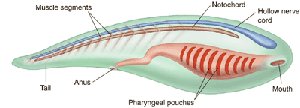
Development and Evolution of Chordate Features
The dorsal nerve cord forms above the notochord and develops a thickened anterior region that becomes the brain. The notochord is present in all chordate embryos and provides structural support, but in most vertebrates, it is replaced by the vertebral column during development.
Pharyngeal gill slits are present in all chordate embryos. In aquatic species, they develop into functional gills, while in terrestrial vertebrates, they are transient embryonic structures.
The post-anal tail is a muscular extension beyond the anus, present in all chordate embryos and retained in many adult forms.
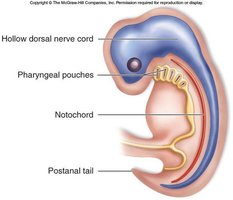
Chordate Features in Human Embryos
Human embryos display all four chordate features during early development, even though some are lost or modified in adults.
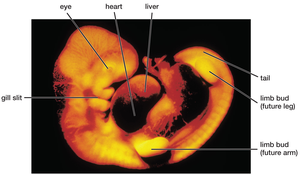
Chordate Diversity and Major Clades
Major Chordate Groups
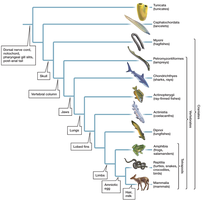
Chordates are divided into three main clades:
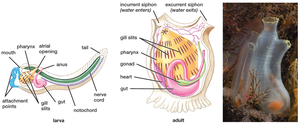
Tunicates (Urochordata): Marine invertebrates, including sea squirts. Adults are sessile filter feeders, while larvae possess all chordate features.
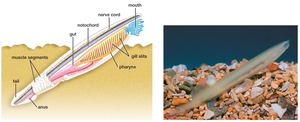
Lancelets (Cephalochordata): Small, fishlike marine animals that retain all chordate features throughout life.
Craniates: Chordates with a skull; includes hagfishes and vertebrates.
Tunicates
Tunicates are small, mostly sessile marine animals. Adults are filter feeders with a basket-like pharynx lined with mucus. Larvae are free-swimming and display all chordate features, but adults lose most of these traits except for the pharyngeal slits.
Lancelets
Lancelets are small, fishlike invertebrates that retain all four chordate features as adults. They live buried in sand and filter feed using cilia in the pharynx to draw water through gill slits.
Craniates
Craniates are chordates with a skull. This group includes hagfishes and vertebrates. The skull protects the brain and may be made of bone or cartilage.
Hagfishes: Jawless, marine animals with a notochord and simple cartilaginous skeleton. They produce slime as a defense mechanism.
Vertebrates: Animals in which the notochord is replaced by a vertebral column (backbone) during development.
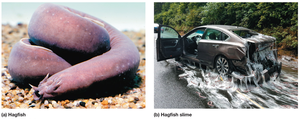
Comparison of Craniate Groups
The following table summarizes key differences among major craniate groups:
Group | Skeleton | Jaws | Fertilization | Heart Chambers | Thermoregulation |
|---|---|---|---|---|---|
Hagfishes | Cartilage | No | External | 2 | Ectothermic |
Lampreys | Cartilage | No | External | 2 | Ectothermic |
Cartilaginous Fishes | Cartilage | Yes | Internal | 2 | Ectothermic |
Ray-finned Fishes | Bone | Yes | External1 | 2 | Ectothermic |
Amphibians | Bone | Yes | External2 | 3 | Ectothermic |
Reptiles | Bone | Yes | Internal | 3 or 43 | Ectothermic4 |
Birds | Bone | Yes | Internal | 4 | Endothermic |
Mammals | Bone | Yes | Internal | 4 | Endothermic |
1. Some ray-finned fish have internal fertilization. 2. External in most frogs and toads; internal in caecilians and most salamanders. 3. Four chambers in birds and crocodilians. 4. Birds are endothermic.
Major Groups of Vertebrates
Lampreys
Lampreys are jawless vertebrates with a sucker-like mouth and rasping teeth. Some are parasitic, attaching to other fish to feed on blood and body fluids. Their nerve cord is protected by cartilaginous segments.
Cartilaginous Fishes (Chondrichthyes)
This group includes sharks, skates, and rays. They have jaws, a cartilaginous skeleton, and leathery skin with tiny scales. Most are marine predators, and fertilization is internal.
Ray-finned Fishes (Actinopterygii)
Ray-finned fishes are the most diverse vertebrates, with about 32,000 species. Their fins are supported by bony spines, and they possess a swim bladder for buoyancy. They are a major food source for humans.
Lobed-finned Fishes: Coelacanths and Lungfishes
These fishes have fleshy, lobed fins with rod-shaped bones. Lungfishes can breathe air using lungs and survive in oxygen-poor environments. Some can aestivate in mud during dry periods.
Tetrapods: Amphibians, Reptiles, Birds, and Mammals
Tetrapods are vertebrates with limbs adapted for life on land. They include amphibians, reptiles (including birds), and mammals.
Amphibians
First tetrapods to invade land; about 6,500 species.
Three-chambered heart; skin serves as a respiratory organ and must remain moist.
Eggs and larvae are aquatic; adults are semi-terrestrial.
Major groups: frogs and toads (leaping, smooth or bumpy skin), salamanders (lizard-like, can regenerate limbs), caecilians (limbless, burrowing).
Reptiles
Adapted for terrestrial life with scaly skin and amniotic eggs.
Efficient lungs and circulatory systems; internal fertilization.
Major groups: lizards and snakes, tuatara, turtles/tortoises, crocodilians, and birds.
Birds
Feathered reptiles; adaptations for flight include lightweight bones, feathers, and high metabolic rates.
Four-chambered heart; endothermic (maintain constant body temperature).
Mammals
Produce milk via mammary glands; have hair or fur; endothermic.
Three main groups: monotremes (egg-laying), marsupials (pouched), placentals (complex placenta).
Placental mammals are the most diverse, including rodents, bats, primates, and whales.
Summary Table: Major Vertebrate Groups and Key Features
Group | Key Features | Examples |
|---|---|---|
Lampreys | Jawless, sucker mouth, cartilaginous skeleton | Sea lamprey |
Cartilaginous Fishes | Jaws, cartilaginous skeleton, internal fertilization | Sharks, rays |
Ray-finned Fishes | Bony skeleton, swim bladder, diverse forms | Trout, salmon |
Lobed-finned Fishes | Lobed fins, lungs (in lungfish) | Coelacanth, lungfish |
Amphibians | Moist skin, aquatic larvae, metamorphosis | Frogs, salamanders |
Reptiles | Scaly skin, amniotic eggs, efficient lungs | Lizards, snakes, turtles |
Birds | Feathers, flight adaptations, endothermy | Eagle, sparrow |
Mammals | Hair/fur, mammary glands, endothermy | Human, bat, whale |
Additional info: The evolutionary relationships among chordates are often depicted as a phylogenetic tree, showing the acquisition of key features such as the skull, vertebral column, jaws, lungs, lobed fins, and limbs. This helps clarify the sequence of evolutionary innovations that led to the diversity of modern vertebrates.
