 Back
Animal Diversity, Internal Environment, Nutrition, Circulation, and Immunity: Study Guide for General Biology
Study Guide - Smart Notes
 Tailored notes based on your materials, expanded with key definitions, examples, and context.
Animal Diversity and Evolution
Origin and Early Evolution of Animals
The origin of animals is traced to a common ancestor, with evidence from fossil records and molecular data. Early-diverging animal lineages include sponges, cnidarians, and bilaterians, each characterized by distinct traits.
Sponges: Lack true tissues; simplest animals.
Cnidarians (e.g., jellyfish): Have tissues but lack bilateral symmetry.
Bilaterians: Exhibit bilateral symmetry and three germ layers (ectoderm, mesoderm, endoderm).
Body plan refers to the integrated set of morphological and developmental traits in multicellular eukaryotes. Tissues are groups of cells with common structure and function. 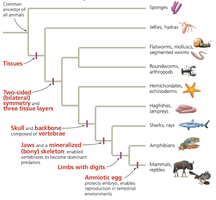
Cambrian Explosion and Animal Evolution
The Cambrian explosion (535–525 million years ago) marked a rapid diversification of animal body plans, including the emergence of hard-bodied animals and most present-day phyla.
Major milestones: Development of tissues, bilateral symmetry, vertebrate backbone, jaws, limbs with digits, and amniotic egg.
Major Animal Groups and Traits
Invertebrates: Animals without a backbone; comprise 95% of animal species.
Chordates: Possess notochord, dorsal hollow nerve cord, pharyngeal slits, and post-anal tail.
Vertebrates: Chordates with a backbone.
Tetrapods: Vertebrates with limbs and digits (includes amphibians, reptiles, mammals).
Amniotes: Tetrapods with amniotic eggs (includes mammals, birds, reptiles).
Colonization of Land
Arthropods: First major animal group to colonize land; adaptations include exoskeleton and jointed appendages.
Tetrapods: Adapted to terrestrial life with limbs and digits.
Adaptations in Amniotes
Amniotic egg: Protects embryo, enables reproduction on land.
Mammals: Hair and mammary glands.
Reptiles: Scaly skin, eggs with leathery shells.
The Internal Environment of Animals: Organization and Regulation
Levels of Organization in Animal Bodies
Animals are organized into five hierarchical levels:
Cell: Basic unit of life.
Tissue: Group of cells with common function.
Organ: Structure composed of multiple tissues.
Organ system: Group of organs working together.
Organism: Complete living entity.
Major Categories of Animal Tissue
Epithelial tissue: Lines surfaces and cavities; protection and absorption.
Connective tissue: Supports and binds other tissues; includes bone, blood, cartilage.
Muscle tissue: Contracts for movement; includes skeletal, cardiac, and smooth muscle.
Nervous tissue: Conducts electrical signals; includes neurons and glial cells.
Coordination and Control: Endocrine vs Nervous System
Endocrine system: Uses hormones for slow, long-lasting regulation.
Nervous system: Uses electrical signals for rapid, short-term responses.
Negative feedback counteracts changes to maintain homeostasis; positive feedback amplifies changes.
Regulators vs Conformers
Regulators: Maintain internal conditions despite external changes.
Conformers: Internal conditions change with the environment.
Thermoregulation
Endothermic: Generate heat internally (e.g., mammals).
Ectothermic: Rely on external heat sources (e.g., reptiles).
Circulatory adaptations: Vasoconstriction, vasodilation, countercurrent exchange.
Osmoregulation and Excretion
Osmoregulation: Regulation of solute and water balance.
Excretion: Removal of nitrogenous wastes (ammonia, urea, uric acid).
Excretory process: Filtration, reabsorption, secretion, elimination.
Animal Nutrition
Major Nutritional Needs
Animals require:
Fuel for cellular work
Organic raw materials for biosynthesis
Essential nutrients (cannot be synthesized)
Classes of Essential Nutrients
Essential amino acids
Essential fatty acids
Vitamins
Minerals
Food Processing Stages
Ingestion: Eating
Digestion: Mechanical and chemical breakdown
Absorption: Uptake of nutrients
Elimination: Removal of undigested material
Digestive System Structures
Mouth, esophagus, stomach, small intestine, large intestine, gall bladder, rectum/anus
Glucose Homeostasis
Insulin: Lowers blood glucose
Glucagon: Raises blood glucose
Circulation and Gas Exchange
Structure and Function of Circulatory Systems
Circulatory systems transport nutrients, gases, and wastes.
Open circulatory system: Hemolymph bathes tissues directly (invertebrates).
Closed circulatory system: Blood confined to vessels (vertebrates).
Blood Vessels
Arteries: Carry blood away from heart.
Veins: Carry blood toward heart.
Capillaries: Exchange substances with tissues.
Single vs Double Circulation
Single circulation: Blood passes through heart once per cycle (fish).
Double circulation: Blood passes through heart twice (mammals, birds).
Cardiac Cycle
The cardiac cycle consists of alternating contractions (systole) and relaxations (diastole) of the heart. 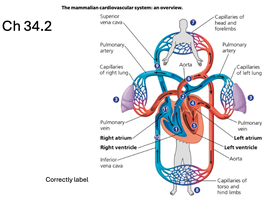
Gas Exchange
Gills: Use countercurrent exchange for efficient oxygen uptake.
Tracheal system: Air-filled tubes in insects.
Lungs: Infolded respiratory surfaces in vertebrates.
The Immune System
Innate and Adaptive Immunity
Innate immunity: Immediate, non-specific defense (all animals).
Adaptive immunity: Specific, memory-based defense (vertebrates).
Barrier and Cellular Defenses
Barrier defenses: Skin, mucous membranes, lysozyme.
Phagocytic cells: Neutrophils, macrophages, dendritic cells.
Natural killer cells: Destroy infected or abnormal cells.
Inflammatory Response
Triggered by injury or infection; involves histamine release, swelling, and recruitment of immune cells.
Adaptive Immune Response
B cells: Produce antibodies (humoral response).
T cells: Helper T cells activate other cells; cytotoxic T cells kill infected cells (cell-mediated response).
MHC molecules: Present antigens to T cells.
Characteristics: Diversity, self-tolerance, proliferation, memory.
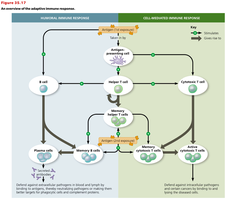
Humoral vs Cell-Mediated Responses
Humoral response: B cells and antibodies defend against pathogens in body fluids.
Cell-mediated response: Cytotoxic T cells defend against infected cells.
Immunization induces immunity by exposure to antigens. Autoimmune diseases occur when the immune system attacks self tissues. Allergens trigger exaggerated immune responses. ----------------------------------------
