 Back
Animal Diversity, Internal Regulation, Nutrition, Circulation, and Immunity: Study Guide for General Biology
Study Guide - Smart Notes
 Tailored notes based on your materials, expanded with key definitions, examples, and context.
Animal Diversity and Evolution
Origin and Early Evolution of Animals
The origin of animals is traced to a common ancestor, with evidence from fossil records and molecular data. Early-diverging animal lineages exhibit key traits that distinguish them from other life forms.
Tissues: Most animals possess specialized tissues, except for sponges.
Bilateral Symmetry and Three Tissue Layers: Bilaterians have two-sided symmetry and three germ layers (ectoderm, mesoderm, endoderm).
Major Milestones: The Cambrian explosion (~535–525 million years ago) marked the rapid emergence of most animal phyla, including the first large, hard-bodied animals.
Example: Sponges lack true tissues, while jellyfish and flatworms possess them. 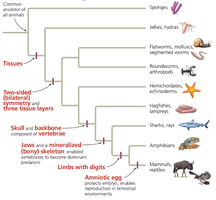
Animal Body Plans and Major Lineages
Animal body plans are defined by morphological and developmental traits.
Invertebrates: Animals without a backbone; comprise 95% of animal species.
Chordates: Possess a notochord, dorsal hollow nerve cord, pharyngeal slits, and post-anal tail at some stage.
Vertebrates: Chordates with a backbone.
Tetrapods: Vertebrates with limbs and digits.
Amniotes: Tetrapods with amniotic eggs, including mammals, birds, and reptiles.
Example: Mammals have hair and mammary glands; reptiles include birds, lizards, and crocodilians.
Colonization of Land
Arthropods and tetrapods were among the first animals to colonize land.
Arthropods: Segmented animals with exoskeletons and jointed appendages (e.g., insects, spiders).
Tetrapods: Adapted to terrestrial life with limbs and digits.
Amniotes: Developed amniotic eggs for reproduction on land.
Example: The amniotic egg protects the embryo and enables reproduction in terrestrial environments.
Internal Environment of Animals: Organization and Regulation
Levels of Organization in the Animal Body
Animal bodies are organized into hierarchical levels:
Cell
Tissue
Organ
Organ System
Organism
Major Categories of Animal Tissue
Four main tissue types are found in animals:
Epithelial Tissue: Sheets of tightly packed cells lining surfaces and cavities.
Connective Tissue: Supports and binds other tissues; includes bone, blood, and cartilage.
Muscle Tissue: Contracts to produce movement.
Nervous Tissue: Conducts electrical signals; includes neurons and glial cells.
Example: Muscle tissue enables movement; nervous tissue transmits signals.
Coordination and Control: Endocrine vs Nervous System
Animals coordinate responses using two main systems:
Endocrine System: Uses hormones for long-distance signaling; slower but longer-lasting effects.
Nervous System: Uses electrical impulses; fast-acting and short-term responses.
Example: Hormones regulate growth; nerves control reflexes.
Feedback Regulation
Negative Feedback: Accumulation of an end product slows the process (e.g., body temperature regulation).
Positive Feedback: End product speeds up the process (e.g., blood clotting).
Regulators vs Conformers
Regulators: Maintain internal conditions despite external changes.
Conformers: Internal conditions change with the environment.
Thermoregulation
Endothermic: Generate heat internally (e.g., mammals).
Ectothermic: Rely on external heat sources (e.g., reptiles).
Circulatory Adaptations: Include vasoconstriction, vasodilation, and countercurrent exchange.
Osmoregulation and Excretion
Osmoregulation: Regulation of solute concentrations and water balance.
Excretion: Removal of nitrogenous wastes (ammonia, urea, uric acid).
Osmoconformers: Match internal osmolarity to environment.
Osmoregulators: Maintain constant internal osmolarity.
Excretory Process: Filtration, reabsorption, secretion, elimination.
Animal Nutrition
Major Nutritional Needs and Essential Nutrients
Animals require nutrients for energy, growth, and cellular function.
Essential Nutrients: Amino acids, fatty acids, vitamins, minerals.
Malnutrition: Deficiency or excess of essential nutrients.
Stages of Food Processing
Ingestion: Eating food.
Digestion: Mechanical and chemical breakdown.
Absorption: Uptake of nutrients.
Elimination: Removal of undigested material.
Example: Digestion occurs in the stomach and small intestine; absorption mainly in the small intestine.
Modes of Resource Extraction
Herbivores: Eat plants.
Carnivores: Eat animals.
Omnivores: Eat both plants and animals.
Glucose Homeostasis
Insulin: Lowers blood glucose.
Glucagon: Raises blood glucose.
Circulation and Gas Exchange
Structure and Function of Circulatory Systems
Circulatory systems transport nutrients, gases, and wastes.
Open Circulatory System: Hemolymph bathes tissues directly.
Closed Circulatory System: Blood confined to vessels.
Blood Vessels
Arteries: Carry blood away from heart.
Veins: Carry blood toward heart.
Capillaries: Exchange substances with tissues.
Single vs Double Circulation
Single Circulation: Blood passes through heart once per cycle (e.g., fish).
Double Circulation: Blood passes through heart twice (e.g., mammals).
Cardiac Cycle
The heart alternates between contraction (systole) and relaxation (diastole). 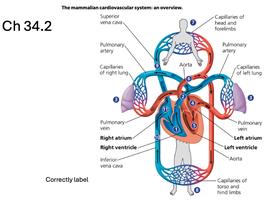
Gas Exchange
Gills: Use countercurrent exchange for efficient oxygen uptake.
Tracheal System: In insects, delivers oxygen directly to cells.
Lungs: In vertebrates, facilitate gas exchange via alveoli.
The Immune System
Innate and Adaptive Immunity
Animals defend against pathogens using innate and adaptive immunity.
Innate Immunity: Immediate, non-specific defense (e.g., skin, phagocytes).
Adaptive Immunity: Specific, memory-based defense (B cells, T cells).
Phagocytic Cells and Barrier Defenses
Neutrophils and Macrophages: Engulf pathogens via phagocytosis.
Barrier Defenses: Skin, mucous membranes, lysozyme.
Cellular Innate Defenses
TLRs: Recognize pathogen molecules.
Natural Killer Cells: Destroy infected or abnormal cells.
Peptides and Proteins: Interferons, complement proteins.
Inflammatory Response
Purpose: Promote healing, recruit immune cells.
Steps: Release of histamine, increased blood flow, migration of phagocytes.
Adaptive Immune Response
B Cells: Produce antibodies (humoral response).
T Cells: Helper T cells activate other cells; cytotoxic T cells kill infected cells (cell-mediated response).
MHC Molecules: Present antigens to T cells.
Characteristics: Diversity, self-tolerance, proliferation, memory.
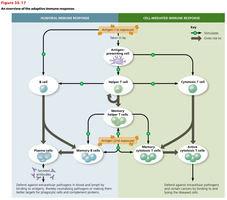
Humoral and Cell-Mediated Responses
Humoral Response: Antibodies defend against pathogens in body fluids.
Cell-Mediated Response: Cytotoxic T cells defend against infected cells.
Example: Immunization induces adaptive immunity and memory.
