 Back
Animal Diversity: Invertebrate Phyla and Body Plans
Study Guide - Smart Notes
 Tailored notes based on your materials, expanded with key definitions, examples, and context.
Animal Diversity and Body Plans
Introduction to Animal Diversity
Animals are multicellular, heterotrophic organisms that share a common ancestor with protists. They exhibit a wide range of body plans, organizational grades, and adaptations to various environments. The evolution of animals is marked by the emergence of distinct phyla, each with unique structural and functional characteristics.
Multicellularity: Animals are composed of multiple cells with specialized functions.
Heterotrophy: Animals obtain energy by consuming other organisms.
Body Plans: Determined by evolutionary origins, including symmetry, presence of body cavities, and segmentation.
Adaptations: Structural, physiological, and biochemical features that enhance survival in specific environments.
Grades of Organization in Animals
Levels of Organization
Animal complexity is described by the grade of organization, ranging from simple cell aggregates to complex organ systems.
Protoplasmic (Unicellular): Single-celled organisms (e.g., Amoeba).
Cellular (Cell-aggregate): Groups of cells with minimal specialization (e.g., sponges).
Cell-Tissue: Cells organized into tissues (e.g., Hydra).
Tissue-Organ: Tissues form organs (e.g., flatworms).
Organ-System: Organs form systems (e.g., earthworms).
Symmetry and Body Cavities
Types of Symmetry
Symmetry refers to the arrangement of body parts around a central axis.
Spherical Symmetry: Any plane through the center divides the organism into similar halves (rare in animals).
Radial Symmetry: Body parts arranged around a central axis (e.g., Hydra, jellyfish).
Bilateral Symmetry: Single plane divides the body into left and right halves (e.g., flatworms, vertebrates).
Body Cavities
Acoelomate: No body cavity (e.g., flatworms).
Pseudocoelomate: Body cavity between mesoderm and endoderm (e.g., nematodes).
Coelomate: True body cavity within mesoderm (e.g., annelids, molluscs, arthropods).
Phylum Porifera (Sponges)
General Characteristics
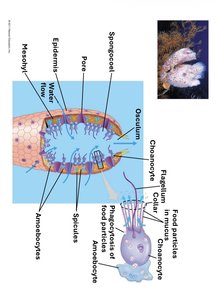
Sponges are simple, aquatic animals with a cell-aggregate body plan. They lack true tissues and organs but have specialized cells for various functions.
Habitat: All aquatic, mostly marine.
Feeding: Suspension feeders; water flows through pores, and choanocytes filter food particles.
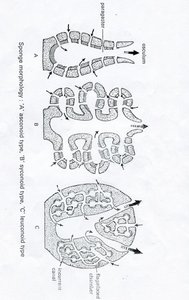
Structure: Body supported by spicules and spongin; three main types: asconoid, syconoid, leuconoid.
Reproduction: Both sexual (hermaphroditic) and asexual (budding).
Phylum Cnidaria
General Characteristics
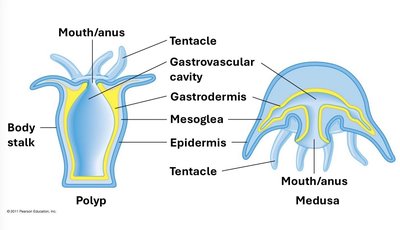
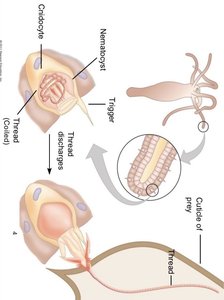
Cnidarians are diploblastic animals with radial symmetry and a tissue level of organization. They possess specialized stinging cells called cnidocytes.
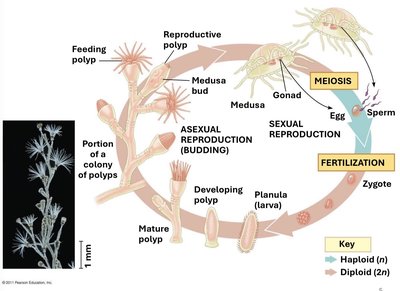
Body Forms: Polyp (sessile) and medusa (motile).
Body Layers: Epidermis, gastrodermis, and mesoglea (non-cellular layer).
Feeding: Carnivorous; use tentacles and nematocysts to capture prey.
Reproduction: Both sexual and asexual; alternation of generations in some species.
Phylum Platyhelminthes (Flatworms)
General Characteristics
Flatworms are triploblastic, acoelomate animals with bilateral symmetry. They exhibit cephalization and have a tissue-organ level of organization.
Body Plan: Flattened body increases surface area for diffusion.
Feeding: Carnivorous or parasitic; branched gut for distribution of nutrients.
Reproduction: Hermaphroditic; capable of regeneration.
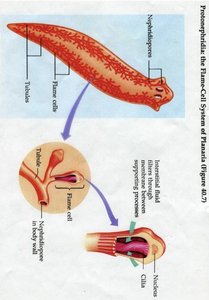
Excretion: Protonephridia (flame cells) for osmoregulation and waste removal.
Phylum Nematoda (Roundworms)
General Characteristics
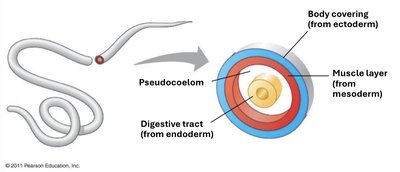
Nematodes are triploblastic, pseudocoelomate animals with a tube-within-a-tube body plan. They are found in diverse environments and include many parasitic species.
Body Structure: Cylindrical, unsegmented, covered by a tough cuticle.
Locomotion: Longitudinal muscles produce undulatory movement.
Digestive System: Complete gut with regional specialization.
Reproduction: Separate sexes; internal fertilization.
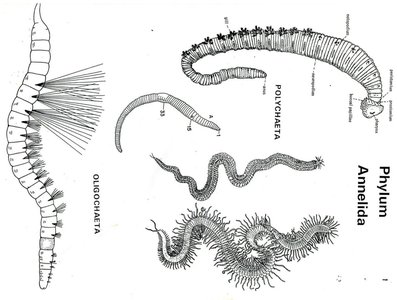
Phylum Annelida (Segmented Worms)
General Characteristics
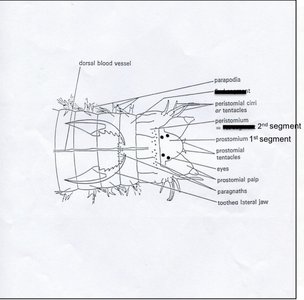
Annelids are coelomate, segmented worms with a well-developed organ system. Segmentation (metamerism) allows for specialization and efficient movement.
Body Plan: Segmented with repeated organs and structures in each segment.
Locomotion: Coordinated muscle contractions and hydrostatic skeleton enable burrowing and crawling.
Circulatory System: Closed system with dorsal and ventral blood vessels.
Reproduction: Sexual; some are hermaphroditic.
Phylum Arthropoda
General Characteristics
Arthropods are the most diverse animal phylum, characterized by jointed appendages, a segmented body, and an exoskeleton made of chitin.
Body Segmentation: Head, thorax, and abdomen (insects); cephalothorax and abdomen (arachnids, crustaceans).
Exoskeleton: Provides protection and support; must be molted for growth.
Open Circulatory System: Hemocoel filled with blood.
Specialized Appendages: Adapted for feeding, locomotion, and sensory functions.
Phylum Mollusca
General Characteristics
Molluscs are coelomate animals with a soft body, often protected by a calcareous shell. They exhibit a wide range of body forms and ecological roles.
Body Plan: Head, muscular foot, and visceral mass.
Shell: Secreted by the mantle; provides protection.
Feeding: Radula used for scraping or cutting food (except bivalves).
Circulatory System: Open in most, closed in cephalopods.
Phylum Echinodermata
General Characteristics
Echinoderms are marine deuterostomes with pentaradial symmetry in adults and a unique water-vascular system for locomotion and feeding.
Body Plan: Internal skeleton of calcareous plates; tube feet for movement.
Water-Vascular System: Network of hydraulic canals for locomotion, feeding, and gas exchange.
Regeneration: Capable of regenerating lost body parts.
Phylum Chordata
Chordate Characteristics
Chordates are defined by four key features present at some stage of development:
Notochord: Flexible rod providing support.
Dorsal, Hollow Nerve Cord: Develops into the central nervous system.
Pharyngeal Slits: Openings in the pharynx for filter feeding or gas exchange.
Post-Anal Tail: Muscular tail extending beyond the anus.
Theme: Parasitism
Types of Parasitism
Ectoparasites: Live on the surface of the host (e.g., ticks, lice).
Endoparasites: Live inside the host (e.g., tapeworms, malaria parasites).
Adaptations: Specialized structures for attachment, high reproductive output, complex life cycles.
Synthesis: Segmentation
Definition and Significance
Segmentation (metamerism) is the serial repetition of similar body segments along the longitudinal axis. It allows for independent movement of segments, specialization of body regions, and increased evolutionary potential.
Examples: Annelida, Arthropoda, Chordata.
Function: Independent muscle contraction, efficient locomotion, and organ specialization.
