 Back
BackAnimal Diversity: Invertebrate Phyla and Their Characteristics
Study Guide - Smart Notes
 Tailored notes based on your materials, expanded with key definitions, examples, and context.
Animal Diversity
General Characteristics of Animals
Animals are a diverse group of organisms distinguished by several key features. Understanding these characteristics is fundamental to the study of animal biology.
Eukaryotic: Animals have cells with a nucleus and membrane-bound organelles.
Multicellular: Composed of multiple cells that form tissues and organs.
Heterotrophic: Obtain energy by ingesting other organisms.
No Cell Walls: Animal cells lack rigid cell walls, unlike plants and fungi.
Invertebrates are animals without a backbone and constitute about 97% of all animal species. Most are ectothermic, relying on external sources for body heat. Insects are the most numerous group among invertebrates.
Symmetry in Animals
Animal body plans are classified based on symmetry, which influences movement and organ placement.
Asymmetry: No symmetry; seen in sponges.
Radial Symmetry: Body parts arranged around a central axis; common in cnidarians.
Bilateral Symmetry: Body divided into mirror-image halves; typical of most animal phyla.
Major Invertebrate Phyla
Porifera (Sponges)
Sponges are the simplest animals, lacking true tissues and organs. They are sessile and asymmetrical.
No true tissues or organs
Sessile: Attached to a substrate, do not move
Regeneration: Can regrow lost parts
Body Structure: Two cell layers with pores; water enters pores, food is trapped and transported by specialized cells, and exits through the osculum.
Cnidaria (Jellyfish, Sea Anemones, Corals)
Cnidarians exhibit radial symmetry and possess specialized stinging cells called cnidocytes for capturing prey.
Tentacles with cnidocytes: Used to paralyze and capture prey
Gastrovascular cavity: Central digestive sac; mouth serves as both entry and exit for food and waste
Life forms: Some are free-swimming (e.g., jellyfish), others are sessile (e.g., corals)
Coral reefs: Formed by colonies of cnidarians; colors come from symbiotic algae
Platyhelminthes (Flatworms)
Flatworms are bilaterally symmetrical and have a simple body plan.
Bilateral symmetry
Thin, flat body
Gastrovascular cavity: One opening
Diffusion: Used instead of complex organ systems
Parasitism: About 80% are parasitic (e.g., tapeworms)
Nematoda (Roundworms)
Roundworms have a smooth, unsegmented body and a complete digestive tract.
No segments
Protective cuticle
Complete digestive tract
Parasitism: Many are plant or animal parasites (e.g., elephantiasis-causing nematodes)
Annelida (Segmented Worms)
Annelids are the most complex worms, with segmented bodies and a true coelom.
Segmented body
True coelom: Allows for complex organ development
Ecological role: Loosen and aerate soil, aid decomposition
Mollusca (Mollusks)
Groups of Mollusks
Mollusks are classified into three main groups based on shell structure and body plan.
Gastropods: Single, spiral shell (e.g., snails)
Bivalves: Two shells (e.g., clams, oysters, scallops)
Cephalopods: Internal shell or no shell (e.g., squid, octopus)
The mantle secretes the shell, gills extract oxygen, and the radula scrapes food. Mollusks have an open circulatory system.
Arthropoda (Arthropods)
General Characteristics
Arthropods are the most diverse animal phylum, characterized by jointed appendages, segmented bodies, and an exoskeleton.
Jointed appendages
Segmented bodies
Exoskeleton: External skeleton made of chitin
Major Groups of Arthropods
Crustaceans: Cephalothorax, carapace, two pairs of antennae (e.g., crab, lobster, shrimp)
Arachnids: Cephalothorax and abdomen, four pairs of legs, no antennae, chelicerae (e.g., spiders, scorpions)
Insects: Head, thorax, abdomen; three pairs of legs, one pair of antennae, usually one or two pairs of wings
Insects are the largest group of arthropods, with over 500,000 species of beetles alone. The field of entomology studies insects.
Echinodermata (Echinoderms)
Echinoderms are marine animals with spiny skin and a unique water vascular system.
No circulatory system
Regeneration: Many can regrow lost parts
Tube feet: Used for locomotion, feeding, and respiration
Examples: Sea urchins, sea stars, sea cucumbers, sand dollars
Chordata (Chordates)
Chordates are defined by four general characteristics, some of which are only present during embryonic development.
Notochord: Flexible rod that becomes vertebral discs
Dorsal, hollow nerve cord: Develops into brain and spinal cord
Pharyngeal gill slits: May develop into gills or jaw/ear structures
Post-anal tail: Extends beyond the anus
Summary Table: Major Invertebrate Phyla
Phylum | Key Characteristics | Examples |
|---|---|---|
Porifera | No true tissues, asymmetrical, sessile | Sponges |
Cnidaria | Radial symmetry, cnidocytes, gastrovascular cavity | Jellyfish, corals, sea anemones |
Platyhelminthes | Bilateral symmetry, flat body, parasitic | Planarian, tapeworm |
Nematoda | Round, unsegmented, complete digestive tract | Hookworm, trichinella |
Annelida | Segmented, true coelom, complex organs | Earthworm, leech |
Mollusca | Soft body, shell, radula | Snail, clam, octopus |
Arthropoda | Jointed appendages, exoskeleton, segmented | Crab, spider, insect |
Echinodermata | Spiny skin, tube feet, regeneration | Sea star, sea urchin |
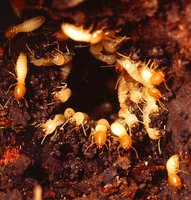
Additional info: The notes above expand on brief points from the original material, providing academic context and examples for each phylum. The included image shows a colony of insects, directly relevant to the discussion of insect diversity and their ecological roles.
