 Back
BackAnimal Diversity: Invertebrates and Vertebrates (Echinoderms & Chordates)
Study Guide - Smart Notes
 Tailored notes based on your materials, expanded with key definitions, examples, and context.
Introduction to Animal Diversity
This section explores the diversity of animals, focusing on the major groups of invertebrates and vertebrates, with an emphasis on the phyla Echinodermata and Chordata. These groups are essential for understanding evolutionary relationships and the development of complex body plans in the animal kingdom.
Deuterostomes
Definition and Major Groups
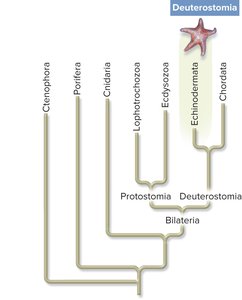
Deuterostomes are animals in which the anus develops from the blastopore during embryonic development, with the mouth forming secondarily. This group includes the phyla Echinodermata and Chordata.
Key feature: Deuterostome development pattern
Major groups: Echinoderms and Chordates
Phylum Echinodermata
General Characteristics
Echinoderms are exclusively marine animals known for their unique body plan and physiology. They exhibit secondary radial symmetry as adults and possess a water vascular system for movement and feeding.
Symmetry: Modified (secondary) radial symmetry in adults; larvae are bilaterally symmetrical
Nervous system: Simple, with no cephalization
Endoskeleton: Covered with spines
Excretion and respiration: By diffusion; no specialized excretory organs
Autotomy: Ability to intentionally detach and regenerate body parts
Reproduction: Sexual, with separate sexes and external fertilization
Body Structure and Water Vascular System
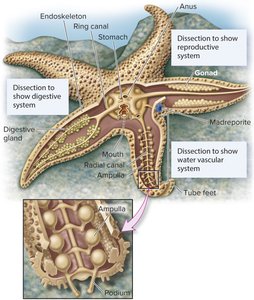
The water vascular system is a network of hydraulic canals unique to echinoderms, used for locomotion, feeding, and gas exchange. Tube feet, connected to this system, allow movement and manipulation of food.
Five-part body plan: Most echinoderms have pentaradial symmetry
Larval stage: Bilateral symmetry
Main Classes of Echinoderms
Echinoderms are divided into several classes, each with distinct characteristics and representative species.
Class | Examples | Key Characteristics |
|---|---|---|
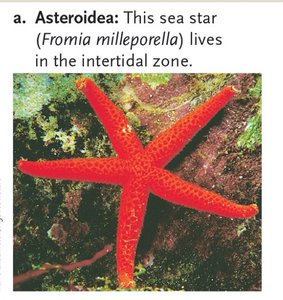
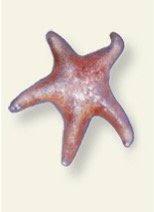
Asteroidea | Sea stars | Five arms, tube feet, predatory, eversible stomach |
Ophiuroidea | Brittle stars | Long, slender arms, tube feet not used for locomotion, filter feeders |
Echinoidea | Sea urchins, sand dollars | Spherical or disc-shaped, no arms, movable spines, feed on seaweeds |
Crinoidea | Sea lilies, feather stars | Cup-shaped, stalked, feathery arms, filter feeders |
Holothuroidea | Sea cucumbers | Cucumber-shaped, no arms, reduced skeleton, browse on sea bottom |

Feeding and Regeneration
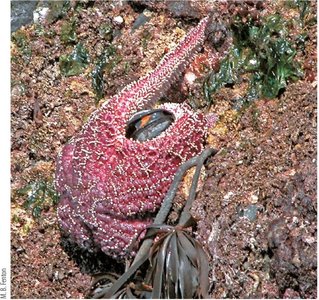
Many echinoderms, such as sea stars, are predators and can evert their stomachs to digest prey externally. They are also known for their remarkable regenerative abilities.
Example: Sea stars feeding on mussels by prying open shells and everting their stomachs
Phylum Chordata
Key Characteristics
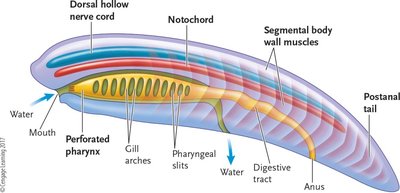
Chordates are defined by four key features present at some stage in their life cycle:
Notochord: Flexible, supportive rod running along the back
Dorsal hollow nerve cord: Develops into the central nervous system
Pharyngeal slits: Openings in the pharynx, used for filter feeding or gas exchange
Postanal tail: Tail extending beyond the anus
Subphyla of Chordata
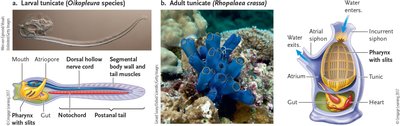
Urochordata (Tunicates): Marine filter feeders; larvae show all chordate features, adults are sessile and lose most chordate traits except pharyngeal slits
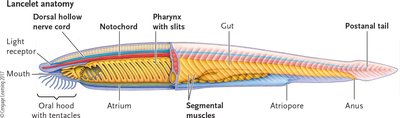
Cephalochordata (Lancelets): Small, fish-like marine animals; retain all chordate features throughout life; filter feeders
Vertebrata: Animals with a backbone; includes fishes, amphibians, reptiles, birds, and mammals
Summary Table: Major Invertebrate Phyla
The following table summarizes the main features of major invertebrate phyla, including digestive, circulatory, respiratory, excretory, and nervous systems, as well as reproductive strategies and support structures.
Phylum | Digestive System | Circulatory System | Respiratory System | Excretory System | Nervous System | Reproduction | Support |
|---|---|---|---|---|---|---|---|
Ctenophora | Complete gut | Absent | Absent | Absent | Nerve net | Sexual (hermaphrodite) | Mesoglea |
Porifera | Absent | Absent | Absent | Absent | Absent | Sexual/asexual | Endoskeleton of spicules/collagen |
Cnidaria | Gastrovascular cavity | Absent | Absent | Absent | Nerve net | Sexual/asexual | Mesoglea |
Platyhelminthes | Gastrovascular cavity | Absent | Absent | Protonephridia | Brain/ganglia | Sexual/asexual | Parenchyma tissue |
Rotifera | Complete gut | Absent | Absent | Protonephridia | Brain/nerve cords | Parthenogenetic | Hydrostatic skeleton |
Bryozoa/Brachiopoda | Complete gut | Absent/open/closed | Absent | Metanephridia | No brain/nerve ring | Sexual/asexual | Exoskeleton |
Mollusca | Complete gut | Open/closed | Gills | Metanephridia | Ganglia/nerve cords | Sexual/asexual | Hydrostatic skeleton/shell |
Annelida | Complete gut | Closed | Absent | Metanephridia | Brain/ventral nerve cord | Sexual/asexual | Hydrostatic skeleton |
Nematoda | Complete gut | Absent | Absent | Excretory tubules | Brain/nerve cords | Sexual/asexual | Fluid skeleton |
Arthropoda | Complete gut | Open | Trachae/gills/book lungs | Excretory glands | Brain/ventral nerve cord | Sexual/asexual | Exoskeleton |
Echinodermata | Usually complete gut | Absent | Tube feet/respiratory tree | Absent | No brain/nerve ring | Sexual/asexual | Endoskeleton of plates |
Chordata | Complete gut | Closed | Gills/lungs | Kidneys | Well-developed brain | Sexual | Endoskeleton of cartilage/bone |
Subphylum Vertebrata (Craniata)
General Features
Vertebrates are chordates with a backbone and a high degree of cephalization. They possess a bony or cartilaginous endoskeleton, a cranium, and complex organ systems.
Key features: Vertebral column, cranium, endoskeleton, neural crest-derived structures
Brain regions: Forebrain, midbrain, hindbrain
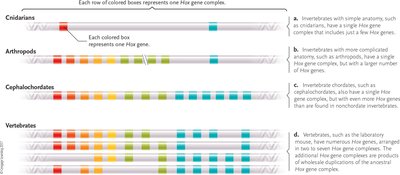
Evolution: Originated from cephalochordate-like ancestors; gene duplications (Hox genes) enabled complex body plans
Main Clades of Living Vertebrates
Vertebrates are classified into several major clades, each with unique adaptations and evolutionary significance.
Clade | Examples | Main Characteristics |
|---|---|---|
Cyclostomata | Lampreys, hagfish | Jawless, no appendages, cartilaginous skeleton |
Chondrichthyes | Sharks, skates, rays | Cartilaginous skeleton, no swim bladder, internal fertilization |
Actinopterygii | Ray-finned fishes | Ossified skeleton, fins supported by rays, swim bladder |
Sarcopterygii | Lobe-finned fishes, coelacanths, lungfishes | Ossified skeleton, fleshy fins with bony extensions |
Amphibia | Frogs, toads, salamanders | Adults terrestrial, aquatic larvae, metamorphosis, moist skin |
Testudines | Turtles | Body encased in shell, no teeth, eggs laid on land |
Squamata | Lizards, snakes | Lower jaw not attached to skull, scales |
Crocodilia | Crocodiles, alligators | Four-chambered heart, aquatic predators, parental care |
Aves | Birds | Feathers, hollow bones, endothermic, four-chambered heart |
Mammalia | Mammals | Mammary glands, hair, specialized teeth, endothermic |
Cyclostomata: Jawless Fishes
Cyclostomes include hagfish and lampreys, which are primitive, jawless vertebrates. They lack paired fins and have a simple cartilaginous skeleton.
Hagfish: Lack eyes, jaws, and vertebrae; produce slime as a defense mechanism
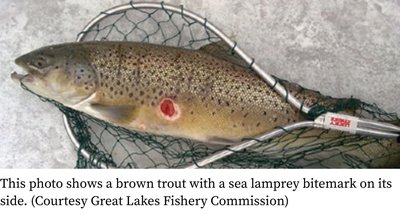
Lampreys: Have a notochord and rudimentary vertebral column; some are parasitic as adults
Chondrichthyes: Cartilaginous Fishes
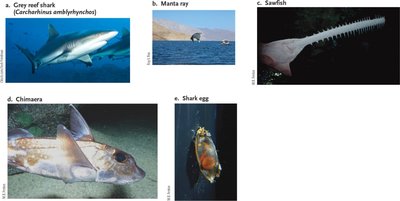
This class includes sharks, skates, and rays. Their skeletons are made of cartilage rather than bone, and they possess several unique adaptations for predation and survival.
Key features: Cartilaginous skeleton, electroreceptors, claspers (in males), squalene in liver for buoyancy
Reproduction: Internal fertilization
Osteichthyes: Bony Fishes
Bony fishes are divided into two main classes: Actinopterygii (ray-finned fishes) and Sarcopterygii (lobe-finned fishes). They have skeletons made of bone and possess a swim bladder for buoyancy.
Actinopterygii: Fins supported by bony rays, includes most modern fish
Sarcopterygii: Fleshy, lobed fins with bony extensions; includes coelacanths and lungfishes
Additional info: The evolutionary transition from lobe-finned fishes to tetrapods marks a significant event in vertebrate history, leading to the colonization of land by vertebrates.
