 Back
Animal Diversity: Structure, Development, and Evolution
Study Guide - Smart Notes
 Tailored notes based on your materials, expanded with key definitions, examples, and context.
Animal Diversity and Adaptations
General Characteristics of Animals
Animals are a diverse group of multicellular, heterotrophic eukaryotes that share several defining features. They are distinguished from other life forms by their mode of nutrition, cellular structure, and developmental patterns.
Heterotrophic: Animals obtain energy by consuming other organisms.
Multicellularity: Animals are composed of multiple cells that form tissues and organs.
Tissues: Most animals have specialized tissues that develop from embryonic layers.
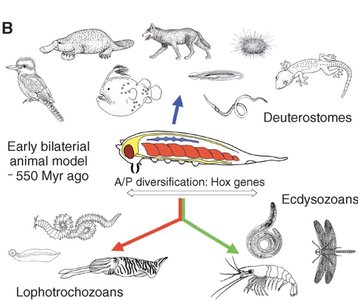
Developmental Genes: All animals possess developmental genes, such as Hox genes, which regulate the expression of other genes and control body plan development.
A Kingdom of Consumers
Animals are efficient consumers, often possessing adaptations for detecting, capturing, and digesting prey. These adaptations contribute to their ecological roles as consumers in various environments.
Adaptations: Examples include specialized feeding structures, sensory organs, and digestive systems.
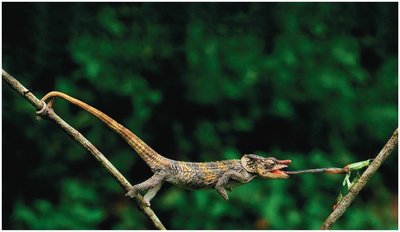
Example: The chameleon uses its long, sticky tongue to capture insect prey efficiently.
Cell Structure and Specialization
Animal cells are unique in their structure and function, lacking cell walls but being supported by proteins such as collagen. Two tissue types—nervous and muscle tissue—are unique to animals.
Structural Proteins: Collagen provides support and flexibility.
Tissues: Groups of similar cells that perform specific functions.
Unique Tissues: Nervous and muscle tissues are defining features of animals.
Reproduction and Development
Most animals reproduce sexually, with the diploid stage dominating the life cycle. Early development involves a series of highly regulated steps that lead to the formation of complex body structures.
Fertilization: Sperm fertilizes egg to form a zygote.
Cleavage: Rapid cell division without growth, forming a multicellular blastula.
Gastrulation: The blastula folds inward to form a gastrula with distinct embryonic layers.


Developmental Genes and Hox Genes
Developmental genes, especially Hox genes, play a crucial role in regulating animal body plans. These genes are highly conserved but allow for a wide diversity of morphologies.
Hox Genes: Control the identity and arrangement of body segments.
Evolutionary Importance: Changes in Hox gene expression contribute to the diversity of animal forms.
Animal Origins and Evolutionary History
Common Ancestor and Choanoflagellates
The closest living relatives of animals are choanoflagellates, a group of protists. The evolution of multicellularity required new mechanisms for cell adhesion and communication.
Choanoflagellates: Share genetic similarities with animals, especially in genes related to cell adhesion (e.g., cadherins).
Common Ancestor: Likely resembled modern choanoflagellates.

Major Eras in Animal Evolution
The history of animals is divided into several geological eras, each marked by significant evolutionary events.
Neoproterozoic Era (1 Billion–541 Million Years Ago): Early animal fossils, including the Ediacaran biota.
Paleozoic Era (541–252 Million Years Ago): Cambrian explosion led to rapid diversification; appearance of bilaterians.
Mesozoic Era (252–66 Million Years Ago): Dominance of dinosaurs, emergence of mammals, diversification of flowering plants and insects.
Cenozoic Era (66 Million Years Ago–Present): Mammals diversified after mass extinctions.



Animal Body Plans and Classification
Body Plans and Symmetry
Animals are classified based on their body plans, which include symmetry, tissue organization, and body cavities.
Radial Symmetry: Body parts arranged around a central axis (e.g., cnidarians).
Bilateral Symmetry: Distinct left and right sides, with anterior, posterior, dorsal, and ventral regions (e.g., annelids, arthropods).

Tissues and Germ Layers
During embryonic development, animals form distinct tissue layers called germ layers, which give rise to all tissues and organs.
Ectoderm: Outermost layer; forms skin and nervous system.
Endoderm: Innermost layer; forms the digestive tract.
Mesoderm: Middle layer; forms muscles, circulatory system, and other organs (present in triploblastic animals).
Diploblastic: Animals with two germ layers (ectoderm and endoderm).
Triploblastic: Animals with three germ layers (all bilaterians).

Body Cavities
Triploblastic animals may possess a body cavity, which is important for organ development and function.
Coelom: A true body cavity derived from mesoderm.
Coelomate: Animal with a true coelom (e.g., annelids).
Pseudocoelomate: Body cavity not entirely lined by mesoderm (e.g., nematodes).
Acoelomate: Lacks a body cavity (e.g., flatworms).

Functions of the Body Cavity
Provides cushioning for internal organs.
Acts as a hydrostatic skeleton for muscle action.
Allows organs to grow and move independently of the body wall.
Protostome and Deuterostome Development
Animals are further classified based on their embryonic development, particularly cleavage patterns, coelom formation, and the fate of the blastopore.
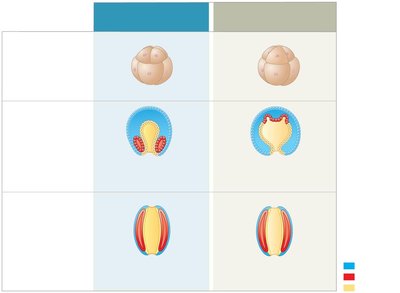
Protostomes: Spiral, determinate cleavage; coelom forms from solid masses of mesoderm; blastopore becomes mouth.
Deuterostomes: Radial, indeterminate cleavage; coelom forms from folds of archenteron; blastopore becomes anus.
Diversification and Phylogeny of Animals
Major Animal Clades
Modern phylogenies use genetic and morphological data to classify animals into major clades.
Metazoa: All animals.
Eumetazoa: Animals with true tissues.
Bilateria: Most animals with bilateral symmetry and three germ layers.
Lophotrochozoa, Ecdysozoa, Deuterostomia: Major clades within Bilateria, distinguished by developmental and genetic features.

Summary Table: Major Animal Phyla and Their Characteristics
Phylum | Description |
|---|---|
Porifera | Lack true tissues; have choanocytes (collar cells) |
Cnidaria | Unique stinging structures (nematocytes); diploblastic; radial symmetry; gastrovascular cavity |
Platyhelminthes | Dorsoventrally flattened acoelomates; gastrovascular cavity or no digestive tract |
Rotifera | Pseudocoelomates with alimentary canal; jaws (trophi); ciliated crown |
Lophophorates | Coelomates with lophophores (ciliated feeding structures) |
Mollusca | Coelomates with muscular foot, visceral mass, mantle; most have shells |
Annelida | Coelomates with segmented bodies |
Nematoda | Cylindrical pseudocoelomates; no circulatory system; undergo ecdysis |
Arthropoda | Coelomates with segmented bodies, jointed appendages, exoskeleton |
Echinodermata | Coelomates with bilaterally symmetrical larvae, five-part adult body, water vascular system |
Chordata | Coelomates with notochord, dorsal hollow nerve cord, pharyngeal slits, post-anal tail |
Key Points in Animal Phylogeny
All animals share a common ancestor.
Sponges are the sister group to all other animals.
Eumetazoa is a clade of animals with true tissues.
Most animal phyla belong to Bilateria.
Three major clades of bilaterians: Lophotrochozoa, Ecdysozoa, Deuterostomia.
Examples of Major Animal Groups
Porifera: Sponges
Cnidaria: Jellies, hydras, corals
Platyhelminthes: Flatworms
Rotifera: Rotifers
Mollusca: Snails, clams, squids
Annelida: Segmented worms
Nematoda: Roundworms
Arthropoda: Insects, spiders, crustaceans
Echinodermata: Sea stars, sea urchins
Chordata: Vertebrates and their relatives
Additional info: This guide covers the foundational concepts of animal diversity, structure, development, and evolutionary history, as outlined in General Biology courses (Chapters 32–34).
