 Back
Animal Diversity: Structure, Development, and Evolutionary Relationships
Study Guide - Smart Notes
 Tailored notes based on your materials, expanded with key definitions, examples, and context.
Animal Diversity and Adaptations
General Characteristics of Animals
Animals are a diverse kingdom of multicellular, heterotrophic eukaryotes that exhibit unique adaptations for survival. They are distinguished by their ability to consume other organisms, specialized cell structures, and complex developmental processes.
Heterotrophic eukaryotes: Animals obtain energy by ingesting other organisms.
Multicellularity: Composed of multiple cells with specialized functions.
Tissues: Most animals have tissues that develop from embryonic layers.
Sexual reproduction: Most animals reproduce sexually, with a dominant diploid stage.
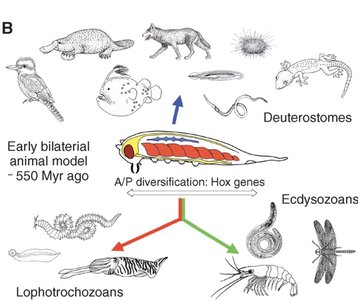
Developmental genes: All animals possess developmental genes, such as Hox genes, which regulate the expression of other genes and body form.
A Kingdom of Consumers
Animals are efficient consumers, often possessing adaptations for detecting, capturing, and digesting prey. These adaptations contribute to their ecological success.
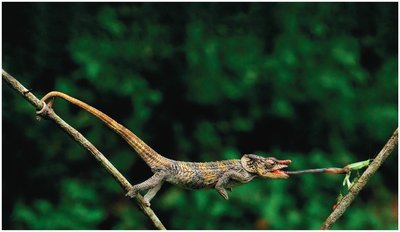
Adaptations: Examples include the chameleon's long, sticky tongue for capturing insects.
Cell Structure and Specialization
Animal cells are supported by structural proteins, such as collagen, rather than cell walls. Unique to animals are nervous and muscle tissues, which enable rapid response and movement.
Structural proteins: Collagen provides support.
Nervous and muscle tissue: Key features distinguishing animals from other eukaryotes.
Tissues: Groups of similar cells functioning together.
Reproduction and Development
Animal development typically involves sexual reproduction, with a series of embryonic stages leading to tissue differentiation.
Cleavage: Rapid cell division following fertilization, forming a multicellular blastula.
Gastrulation: The blastula reorganizes into a gastrula with distinct embryonic layers.


Developmental Genes and Hox Genes
Developmental genes, especially Hox genes, play a crucial role in regulating animal body plans. These genes are highly conserved but allow for significant morphological diversity.
Hox genes: Control the development of body form and segmentation.
Animal Origins and Evolutionary History
Common Ancestor and Early History
The common ancestor of animals likely resembled modern choanoflagellates, a group of protists. The evolution of multicellularity required new mechanisms for cell adhesion and communication.
Choanoflagellates: Closest living relatives to animals; share genes for cell adhesion and signaling.


Major Eras in Animal Evolution
Neoproterozoic Era (1 Billion–541 Million Years Ago): Early animal fossils (Ediacaran biota) and microscopic embryos.
Paleozoic Era (541–252 Million Years Ago): Cambrian explosion led to rapid diversification; appearance of bilaterians with bilateral symmetry and complete digestive tracts.
Mesozoic Era (252–66 Million Years Ago): Dominance of dinosaurs, emergence of mammals, diversification of flowering plants and insects.
Cenozoic Era (66 Million Years Ago–Present): Mammals diversified after mass extinctions.



Animal Body Plans and Classification
Body Plans and Symmetry
Animals are classified by their body plans, which include symmetry, tissue organization, and body cavities.
Radial symmetry: Body parts arranged around a central axis (e.g., cnidarians).
Bilateral symmetry: Distinct dorsal, ventral, anterior, and posterior sides; associated with active movement and central nervous systems (e.g., annelids, arthropods).

Tissues and Germ Layers
During development, animals form distinct germ layers that give rise to tissues and organs.
Ectoderm: Outer layer; forms skin and nervous system.
Endoderm: Inner layer; forms digestive tract lining.
Mesoderm: Middle layer; forms muscles and other organs (present in triploblastic animals).
Diploblastic: Two germ layers (ectoderm and endoderm; e.g., cnidarians).
Triploblastic: Three germ layers (all bilaterians).

Body Cavities
Most triploblastic animals possess a body cavity, which can be classified as a coelom, pseudocoelom, or absent (acoelomate).
Coelom: True body cavity derived from mesoderm (coelomates).
Pseudocoelom: Body cavity derived from mesoderm and endoderm (pseudocoelomates).
Acoelomate: No body cavity; solid body (e.g., flatworms).

Functions of the Body Cavity
Fluid cushions organs.
Acts as a hydrostatic skeleton for muscle action.
Allows internal organs to grow and move independently of the body wall.
Protostome and Deuterostome Development
Animals are further classified based on embryonic development patterns: protostome or deuterostome.
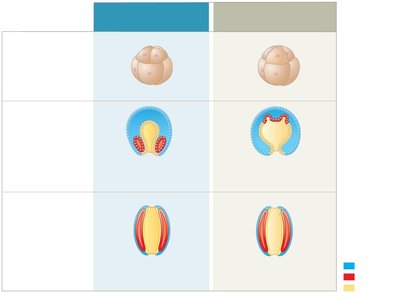
Protostome: Spiral, determinate cleavage; coelom forms from solid mesoderm masses; blastopore becomes mouth.
Deuterostome: Radial, indeterminate cleavage; coelom forms from archenteron folds; blastopore becomes anus.
Diversification and Phylogeny of Animals
Animal Phylogeny and Major Clades
Modern phylogenies use genetic and morphological data to classify animals into major clades.
All animals share a common ancestor.
Sponges (Porifera) are the sister group to all other animals.
Eumetazoa includes all animals with true tissues.
Bilateria is the largest clade, containing most animal phyla.
Three major bilaterian clades: Deuterostomia, Lophotrochozoa, Ecdysozoa.


Summary Table: Major Animal Phyla and Characteristics
Phylum | Description |
|---|---|
Porifera (sponges) | Lack true tissues; have choanocytes (collar cells) |
Cnidaria (hydras, jellies, corals) | Unique stinging structures (nematocytes); diploblastic; radial symmetry; gastrovascular cavity |
Platyhelminthes (flatworms) | Dorsoventrally flattened acoelomates; gastrovascular cavity or no digestive tract |
Rotifera (rotifers) | Pseudocoelomates with alimentary canal; jaws (trophi); ciliated crown |
Lophophorates (Ectoprocta, Brachiopoda) | Coelomates with lophophores (ciliated feeding structures) |
Mollusca (clams, snails, squids) | Coelomates with muscular foot, visceral mass, mantle; most have calcium carbonate shell |
Annelida (segmented worms) | Coelomates with segmented body wall and organs |
Nematoda (roundworms) | Cylindrical pseudocoelomates; no circulatory system; undergo ecdysis |
Arthropoda (insects, spiders, crustaceans) | Coelomates with segmented body, jointed appendages, exoskeleton |
Echinodermata (sea stars, sea urchins) | Coelomates with bilaterally symmetrical larvae, five-part adult body, water vascular system |
Chordata (vertebrates, tunicates, lancelets) | Coelomates with notochord, dorsal hollow nerve cord, pharyngeal slits, post-anal tail |
Example: Nematoda (roundworms) are pseudocoelomates and undergo molting (ecdysis), while Annelida (segmented worms) are true coelomates with segmented bodies.
Additional info: This summary integrates foundational concepts from animal diversity, structure, development, and evolutionary relationships, as covered in General Biology courses (Chapters 32–34).
