 Back
BackAnimal Diversity: Structure, Development, and Major Invertebrate Groups
Study Guide - Smart Notes
 Tailored notes based on your materials, expanded with key definitions, examples, and context.
Animal Characteristics and Development
Defining Features of Animals
Animals are multicellular, heterotrophic eukaryotes distinguished by unique structural proteins, nervous and muscle tissues, and developmental processes. While exceptions exist, several characteristics collectively define the animal kingdom:
Multicellularity: Animals are composed of multiple cells with specialized functions.
Heterotrophy: Animals ingest their food, unlike plants (autotrophic) and fungi (absorptive heterotrophs).
Structural Proteins: Collagen provides support outside the cell membrane.
Nervous and Muscle Tissues: Unique to animals, enabling rapid response and movement.
Reproduction and Development
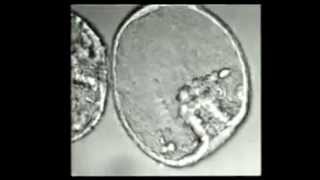
Most animals reproduce sexually, with the diploid stage dominating the life cycle. Sperm and egg cells are produced directly by meiosis. Animal zygotes undergo cleavage, a series of rapid cell divisions without growth, leading to the formation of a blastula (a hollow ball of cells). The blastula then undergoes gastrulation, forming a gastrula with distinct embryonic tissue layers.
Cleavage: Rapid cell division after fertilization.
Blastula: Hollow ball of cells formed after cleavage.
Gastrulation: Formation of embryonic tissue layers.
Developmental Genes
All animals possess developmental genes that regulate the expression of other genes. Most share a unique family called Hox genes, which control body plan and morphology.
Hox Genes: Regulatory genes influencing animal body structure.
Origin of Multicellularity
Evidence suggests that protists called choanoflagellates are the closest living relatives to animals. Multicellularity required new mechanisms for cell adhesion and communication, with animal genes for these functions showing similarities to those in choanoflagellates.
Cadherin Proteins: Domains found in both animals and choanoflagellates, important for cell adhesion.
Major Events in Animal Evolution
Paleozoic Era and Cambrian Explosion
The Cambrian explosion (535–525 million years ago) marked a period of rapid animal diversification, with the first large fossils of animals possessing hard skeletons. Most Cambrian fossils are bilaterians—organisms with bilateral symmetry and a complete digestive tract.
Bilaterians: Animals with bilateral symmetry, a mouth, and an anus.
Hypotheses for Cambrian Diversity: New predator-prey relationships, increased oxygen, evolution of Hox genes and microRNAs.
Animal Body Plans
Symmetry
Animal body plans are characterized by symmetry:
Radial Symmetry: Body parts arranged around a central axis; common in sessile or planktonic animals.
Bilateral Symmetry: Body parts arranged along two axes (head-tail, dorsal-ventral); typical of active animals with a central nervous system.
Tissues and Germ Layers
Animals vary in tissue organization. Most have specialized tissues derived from embryonic germ layers:
Diploblastic: Two germ layers (ectoderm and endoderm); e.g., cnidarians.
Triploblastic: Three germ layers (ectoderm, mesoderm, endoderm); includes all bilaterians.
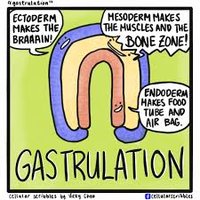
Ectoderm: Forms outer covering and nervous system. Endoderm: Forms lining of digestive tract and organs. Mesoderm: Forms muscles and most organs.
Body Cavities
Coelom: Fluid-filled cavity surrounded by mesoderm; suspends internal organs.
Hemocoel: Cavity formed between mesoderm and endoderm, filled with hemolymph.
Acoelomates: Triploblastic animals without a body cavity; typically flat-bodied.
Protostome vs. Deuterostome Development
Animals are categorized by developmental modes:
Protostome: Spiral, determinate cleavage; blastopore becomes mouth.
Deuterostome: Radial, indeterminate cleavage; blastopore becomes anus.
Cleavage: Pattern of cell division. Blastopore: Opening in gastrula; fate differs between protostomes and deuterostomes.
Animal Phylogeny and Major Clades
Phylogenetic Relationships
Animal evolutionary relationships are inferred from genomic, morphological, and molecular data. Key points:
All animals share a common ancestor.
Sponges are the sister group to all other animals.
Eumetazoa is a clade of animals with tissues.
Most animal phyla belong to the clade Bilateria.
Chordata is the only phylum with vertebrates.
Invertebrate Diversity
Overview of Invertebrates
Invertebrates, animals lacking a backbone, account for over 95% of known animal species and occupy nearly every habitat. They are morphologically diverse, ranging from microscopic to large forms.
Porifera (Sponges): Basal animals lacking tissues; filter feeders.
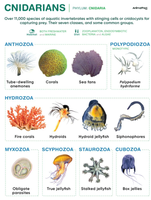
Cnidaria: Radially symmetrical, diploblastic animals with a gastrovascular cavity; includes corals, jellies, hydras.
Lophotrochozoa
Lophotrochozoans are a diverse clade identified by molecular data, including flatworms, molluscs, and annelids. Some possess a lophophore (feeding structure), others a trochophore larval stage.
Molluscs: Largest number of documented extinctions among animals; includes chitons, snails, bivalves, cephalopods.
Annelids: Segmented worms with a coelom.
Ecdysozoa
Ecdysozoans are animals with a cuticle that is shed during molting (ecdysis). Includes nematodes and arthropods.
Nematoda: Many are parasites of plants and animals.
Arthropoda: Most species-rich animal group; includes insects, crustaceans, myriapods, chelicerates.
Arthropod Diversity
Arthropods have jointed appendages, an open circulatory system, and diverse sensory organs. Major lineages include chelicerates, myriapods, and pancrustaceans.
Chelicerates: Sea spiders, horseshoe crabs, scorpions, ticks, mites, spiders.
Myriapods: Centipedes and millipedes.
Pancrustaceans: Insects, lobsters, shrimp, barnacles.
Insect Diversity
Insects are the most diverse group of arthropods, with complex organ systems and various modes of development (incomplete and complete metamorphosis). They play roles as predators, prey, pollinators, and pests.
Deuterostomia: Echinoderms and Chordates
Echinoderms
Echinoderms are slow-moving or sessile marine animals with a coelom and endoskeleton. Their water vascular system aids in locomotion and feeding. Most adults exhibit radial symmetry, but larvae are bilaterally symmetrical.

Five Clades: Asteroidea (sea stars), Ophiuroidea (brittle stars), Echinoidea (sea urchins), Crinoidea (sea lilies), Holothuroidea (sea cucumbers).
Chordates
Phylum Chordata includes vertebrates and two groups of invertebrates (lancelets and tunicates). Chordates are bilaterally symmetrical coelomates with segmented bodies, closely related to echinoderms.
Key Features: Notochord, dorsal nerve cord, pharyngeal slits, post-anal tail (at some stage).
----------------------------------------
