 Back
CHAPTER 40 ANIMAL FORM AND FUNCTION
Study Guide - Smart Notes
 Tailored notes based on your materials, expanded with key definitions, examples, and context.
Chapter 40: Animal Form & Function
Introduction to Animal Physiology
Animals must maintain internal stability while interacting with changing environments. The study of animal form (anatomy) and function (physiology) reveals how evolutionary adaptations allow survival, growth, and reproduction under diverse conditions.
Form and Function: Anatomy provides clues to physiological roles; structure and function are closely linked.
Body Plan: Determined by the genome, shaped by millions of years of evolution.
Environmental Interaction: Size and shape influence how animals exchange materials, move, and regulate heat.
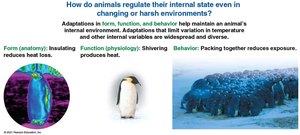
Evolution of Animal Size and Shape
Physical and Evolutionary Constraints
Animal size and shape are limited by physical laws (e.g., diffusion, strength, heat exchange) and environmental factors. Convergent evolution leads to similar adaptations in unrelated species facing similar challenges.
Water Properties: Limit shapes for fast-swimming animals (e.g., streamlined bodies in fish and marine mammals).
Support Structures: Larger animals require thicker skeletons and more muscle mass for movement.
Mobility: As size increases, mobility may become restricted due to energetic and structural demands.
Exchange with the Environment
Surface Area, Volume, and Adaptations
Animals must exchange nutrients, gases, and wastes with their environment. The efficiency of exchange depends on the ratio of surface area to volume.
Single-celled Organisms: Sufficient surface area for direct exchange.
Multicellular Animals: Require specialized structures (e.g., lungs, intestines) to increase surface area for exchange.
Interstitial Fluid: Fills spaces between cells, linking exchange surfaces to body cells.
Complex Body Plans: Allow animals to maintain stable internal conditions in variable environments.
Hierarchical Organization of Body Plans
From Cells to Organ Systems
Animal bodies are organized into hierarchical levels: cells, tissues, organs, and organ systems. Each level has specialized roles.
Tissues: Groups of similar cells with a common function.
Organs: Structures composed of multiple tissue types.
Organ Systems: Groups of organs working together to perform major functions.
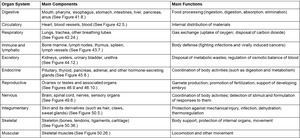
Organ System | Main Components | Main Functions |
|---|---|---|
Digestive | Mouth, pharynx, esophagus, stomach, intestines, liver, pancreas, anus | Food processing (ingestion, digestion, absorption, elimination) |
Circulatory | Heart, blood vessels, blood | Internal distribution of materials |
Respiratory | Lungs, trachea, other breathing tubes | Gas exchange (uptake of O2, disposal of CO2) |
Immune and Lymphatic | Bone marrow, lymph nodes, thymus, spleen | Body defense (fighting infections and cancer) |
Excretory | Kidneys, ureters, urinary bladder, urethra | Disposal of metabolic wastes, regulation of osmotic balance |
Endocrine | Pituitary, thyroid, pancreas, adrenal, other hormone-secreting glands | Coordination of body activities (digestion, metabolism) |
Reproductive | Ovaries or testes and associated organs | Gamete production, fertilization, support of developing embryo |
Nervous | Brain, spinal cord, nerves, sensory organs | Coordination of body activities, detection of stimuli, response |
Integumentary | Skin and derivatives (hair, claws, glands) | Protection against mechanical injury, infection, dehydration |
Skeletal | Skeleton (bones, tendons, ligaments, cartilage) | Body support, protection of internal organs, movement |
Muscular | Skeletal muscles | Locomotion and other movement |
Animal Tissues
Epithelial Tissue
Epithelial tissue covers body surfaces and lines internal organs and cavities. It serves as a barrier and interface for exchange.
Cell Shapes: Cuboidal, columnar, squamous.
Arrangements: Simple (single layer), stratified (multiple layers), pseudostratified (single layer of varying length).
Connective Tissue
Connective tissue supports, binds, and protects other tissues and organs. It consists of cells scattered in an extracellular matrix.
Major Cell Types: Fibroblasts (secrete fibers), macrophages (phagocytosis).
Fiber Types: Collagenous (strength), reticular (connection), elastic (stretch).
Types: Loose, fibrous, bone, adipose, blood, cartilage.
Muscle Tissue
Muscle tissue enables movement through contraction. It contains actin and myosin filaments.
Skeletal Muscle: Voluntary movement.
Smooth Muscle: Involuntary activities (e.g., digestion).
Cardiac Muscle: Heart contraction.
Nervous Tissue
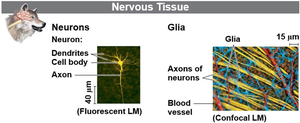
Nervous tissue is specialized for communication, processing, and response to stimuli.
Neurons: Transmit nerve impulses.
Glial Cells: Support, nourish, and protect neurons.
Coordination and Control
Endocrine and Nervous Systems
Animals coordinate responses to stimuli using the endocrine and nervous systems.
Endocrine System: Releases hormones into the bloodstream for gradual, widespread effects.
Nervous System: Transmits fast, targeted electrical signals (nerve impulses).
Integration: Both systems often work together to maintain homeostasis.
Feedback Control and Homeostasis
Regulation and Conformity
Animals maintain internal balance (homeostasis) by regulating or conforming to environmental changes.
Regulators: Use internal mechanisms to maintain stable conditions (e.g., humans regulate body temperature).
Conformers: Allow internal conditions to change with the environment (e.g., many fish conform to water temperature).
Mechanisms of Homeostasis
Homeostatic control systems maintain variables near a set point using feedback mechanisms.
Negative Feedback: Reduces deviations from the set point (e.g., temperature regulation).
Positive Feedback: Amplifies changes, driving processes to completion (e.g., childbirth).
Alterations in Homeostasis
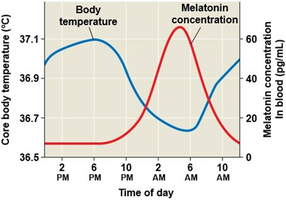
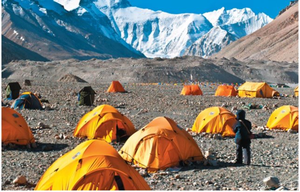
Set points and normal ranges can change due to age, circadian rhythms, or acclimatization (physiological adjustment to new environments).
Thermoregulation
Endothermy vs. Ectothermy
Thermoregulation is the maintenance of internal temperature within a tolerable range.
Endotherms: Generate heat metabolically (e.g., birds, mammals).
Ectotherms: Gain heat from the environment (e.g., reptiles, amphibians, most fish).
Poikilotherms: Body temperature varies with environment.
Homeotherms: Maintain relatively constant body temperature.
Balancing Heat Loss and Gain
Animals exchange heat with the environment via radiation, evaporation, convection, and conduction. Adaptations include insulation, circulatory changes, evaporative cooling, behavioral responses, and metabolic adjustments.
Insulation: Fur, feathers, blubber reduce heat loss.
Circulatory Adaptations: Vasodilation and vasoconstriction regulate blood flow; countercurrent exchange conserves heat.
Evaporative Cooling: Sweating, panting, and bathing dissipate heat.
Behavioral Responses: Seeking sun or shade, huddling, or changing orientation.
Metabolic Adjustments: Shivering, nonshivering thermogenesis (e.g., brown fat), and social behaviors (e.g., penguin huddling).
Acclimatization and Physiological Thermostats
Animals can acclimatize to seasonal changes by adjusting insulation or producing antifreeze compounds. The hypothalamus acts as the body's thermostat, triggering heat loss or gain mechanisms. Fever is a regulated rise in set point during infection.
Bioenergetics and Energy Use
Energy Flow and Metabolic Rate
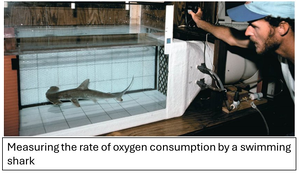
Bioenergetics studies how animals acquire, transform, and use energy. Metabolic rate is the total energy used per unit time and can be measured by heat loss, oxygen consumption, or food intake versus waste output.
BMR (Basal Metabolic Rate): Endotherms at rest, fasting, non-stressed, at comfortable temperature.
SMR (Standard Metabolic Rate): Ectotherms at rest, fasting, non-stressed, at a specific temperature.
Influences: Age, sex, size, activity, temperature, nutrition.
Size, Activity, and Energy Conservation
Metabolic rate scales with body mass to the 3/4 power (). Smaller animals have higher metabolic rates per gram than larger animals. Activity level and environmental conditions also affect energy use.
Torpor: State of decreased activity and metabolism for energy conservation.
Hibernation: Long-term torpor for surviving cold and food scarcity.
Estivation: Summer torpor for surviving heat and drought.
