 Back
Animal Form and Function: Structure, Physiology, and Homeostasis
Study Guide - Smart Notes
 Tailored notes based on your materials, expanded with key definitions, examples, and context.
Animal Form and Function
Overview of Animal Structure and Function
Animal bodies are composed of specialized tissues, organs, and organ systems that work together to maintain life. The relationship between form (structure) and function is a central theme in biology, as the physical characteristics of tissues and organs are closely linked to their roles in the organism.
Tissue: A group of similar cells that perform a specific function.
Organ: A structure composed of multiple tissue types working together for a specialized function.
Organ system: A group of organs and tissues that perform one or more functions in coordination.
Types of Animal Tissues
Connective Tissue
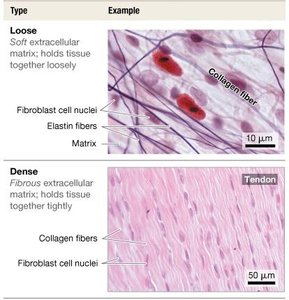
Connective tissue provides structural support, connects other tissues, and plays roles in storage and transport. It consists of cells embedded in an extracellular matrix (ECM) of fibers and ground substance.
Loose Connective Tissue: Contains loosely arranged fibers (collagen, elastin) and acts as packing material and padding.
Dense Connective Tissue: Contains densely packed collagen fibers, providing strength and support in tendons and ligaments.
Supporting Connective Tissue: Has a firm ECM, as seen in bone and cartilage.
Fluid Connective Tissue: Cells are suspended in a liquid ECM, such as blood (plasma).
Nervous Tissue
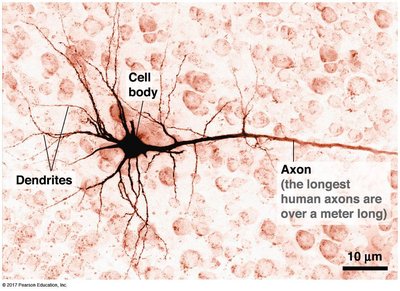
Nervous tissue is specialized for the conduction of electrical signals. It is composed of neurons and supporting glial cells.
Neurons: Transmit electrical impulses. Each neuron has a cell body, dendrites (receive signals), and an axon (sends signals).
Glia: Support, insulate, and protect neurons (e.g., oligodendrocytes in the CNS, Schwann cells in the PNS).
Muscle Tissue
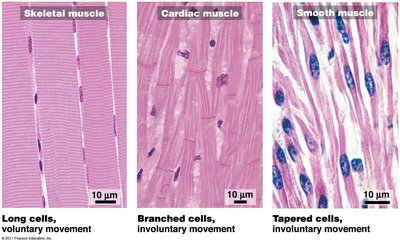
Muscle tissue is responsible for movement, including locomotion, pumping blood, and moving food through the digestive tract. It is unique to animals and is classified into three types:
Skeletal Muscle: Long, striated cells; voluntary movement; attached to bones.
Cardiac Muscle: Branched, striated cells; involuntary movement; found in the heart.
Smooth Muscle: Tapered, non-striated cells; involuntary movement; found in walls of digestive tract, blood vessels, etc.
Epithelial Tissue
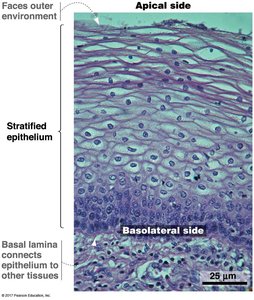
Epithelial tissue covers the body surface, lines internal organs, and forms glands. It acts as a barrier and is involved in absorption, secretion, and protection.
Apical side: Faces the external environment or lumen.
Basolateral side: Faces the interior and connects to underlying connective tissue.
Cells are short-lived and rapidly replaced.
Relationship Between Body Size, Surface Area, and Physiology
Surface Area to Volume Ratio
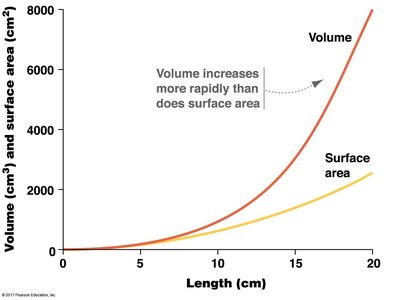
The surface area-to-volume ratio is a key factor in determining how efficiently cells and organisms exchange materials with their environment. As size increases, volume grows faster than surface area, affecting diffusion rates and metabolic demands.
Surface area: Determines the rate of exchange (e.g., nutrients, gases).
Volume: Determines the rate of resource use and waste production.
Large animals have lower surface area-to-volume ratios, impacting their physiology and metabolic rates.
Metabolic Rate and Body Size
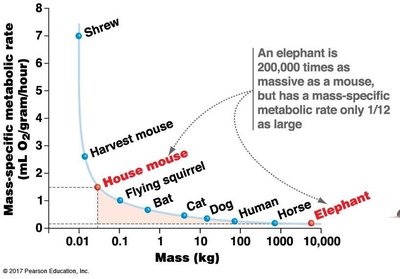
Metabolic rate is the rate of energy consumption, often measured by oxygen use. The basal metabolic rate (BMR) is the energy used at rest. Mass-specific BMR (per gram of tissue) decreases as body size increases.
Small animals have higher mass-specific BMRs than large animals.
Large animals are more energy-efficient per gram but require more total energy.
Homeostasis in Animals
Definition and Importance
Homeostasis is the maintenance of stable internal conditions (temperature, pH, etc.) necessary for optimal enzyme and cellular function. Animals use various strategies to maintain homeostasis despite environmental fluctuations.
Mechanisms of Homeostasis
Conformation: Internal state matches the environment (e.g., body temperature of some fish).
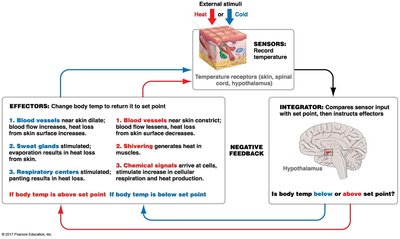
Physiological Regulation: Active processes maintain internal stability (e.g., sweating, shivering).
Behavioral Regulation: Changing behavior to regulate internal state (e.g., basking in the sun).
Homeostasis is often maintained by negative feedback loops, where effectors counteract changes from a set point.
Thermoregulation
Mechanisms of Heat Exchange
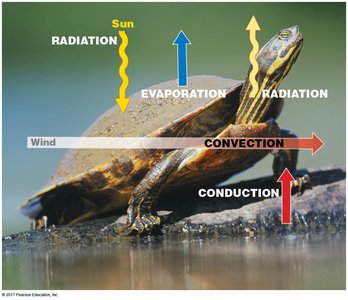
Animals exchange heat with their environment through several physical processes:
Conduction: Direct transfer of heat between objects in contact.
Convection: Transfer of heat by movement of air or liquid.
Radiation: Emission of electromagnetic waves (e.g., sunlight).
Evaporation: Loss of heat as water changes from liquid to vapor.
Metabolism: Internal heat production from biochemical reactions.
Thermoregulatory Strategies
Endotherms: Generate sufficient metabolic heat to maintain body temperature (e.g., birds, mammals).
Ectotherms: Rely mainly on environmental heat sources (e.g., reptiles, amphibians).
Homeotherms: Maintain a relatively constant body temperature.
Poikilotherms: Allow body temperature to fluctuate with the environment.
Endotherms are more active but require more energy. Ectotherms are less energetically costly but have limited activity in cold environments.
Adaptations for Thermoregulation
Insulation (fur, feathers, fat)
Reducing surface area to minimize heat loss
Behavioral changes (seeking shade, basking)
Physiological states (torpor, hibernation)
Countercurrent heat exchange in extremities
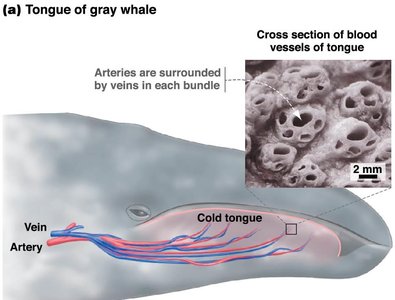
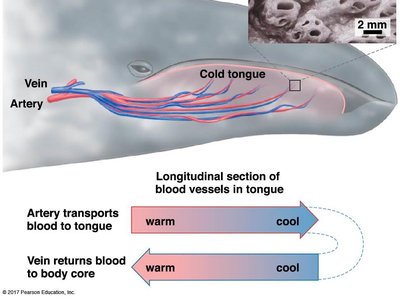
Countercurrent Exchange
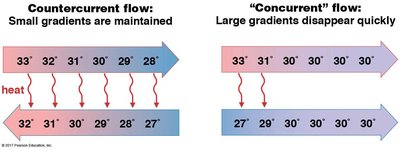
Countercurrent exchange is a mechanism where fluids flow in opposite directions in adjacent vessels, maximizing heat transfer and minimizing heat loss. This is seen in the limbs of marine mammals and birds, where arteries carrying warm blood are surrounded by veins carrying cool blood.
Maintains small temperature gradients along the length of the exchanger.
Prevents rapid loss of heat to the environment.
