 Back
Animal Form and Function: Structure, Physiology, and Thermoregulation
Study Guide - Smart Notes
 Tailored notes based on your materials, expanded with key definitions, examples, and context.
Animal Form and Function
Relationship Between Form and Function
The structure of animal tissues, organs, and systems is closely linked to their function. Adaptations in form allow animals to perform essential physiological tasks efficiently, contributing to their fitness and survival. Natural selection favors traits that optimize this relationship, though trade-offs may occur when one adaptation limits another.
Adaptation: A heritable trait that increases an organism's fitness in a particular environment.
Fitness: The ability of an organism to survive and reproduce.
Trade-off: A compromise between two traits that cannot be optimized simultaneously.
Example: Thick fur increases insulation but may reduce mobility.
Animal Tissue Types
Overview of Animal Tissues
Animals are multicellular organisms with specialized tissues. Each tissue type is composed of similar cells working together to perform a specific function. The four main tissue types are connective, nervous, muscle, and epithelial.
Connective Tissue: Provides structural support and connects other tissues.
Nervous Tissue: Facilitates communication via electrical signals.
Muscle Tissue: Enables movement and force generation.
Epithelial Tissue: Covers surfaces and lines organs.
Connective Tissue
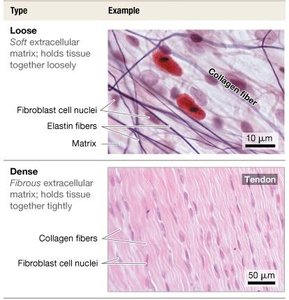
Connective tissue consists of cells dispersed in an extracellular matrix. The matrix composition determines the tissue's properties and function.
Loose Connective Tissue: Soft matrix with fibrous proteins; acts as packing material and padding.
Dense Connective Tissue: Matrix rich in collagen; forms tendons and ligaments for strong connections.
Supporting Connective Tissue: Firm matrix; includes bone and cartilage.
Fluid Connective Tissue: Matrix is liquid; blood is the main example (ECM = plasma).
Nervous Tissue
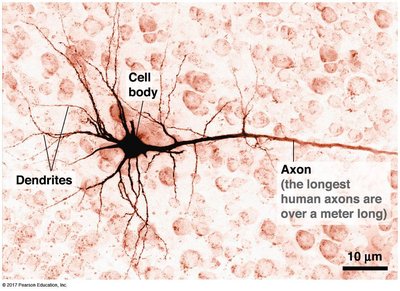
Nervous tissue is unique to animals and consists of neurons and supporting glial cells. Neurons transmit electrical signals, enabling rapid communication and response.
Neuron Structure: Cell body, dendrites (receive signals), and axon (transmits signals).
Glia: Support neurons; oligodendrocytes in CNS, Schwann cells in PNS.
Muscle Tissue
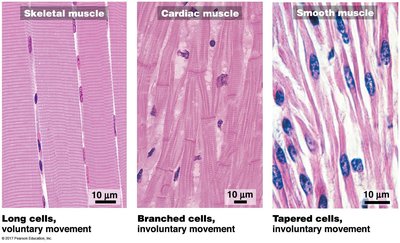
Muscle tissue is responsible for movement, blood pumping, and food mixing. It is composed of cells capable of contraction.
Skeletal Muscle: Voluntary movement; attached to bones.
Cardiac Muscle: Involuntary movement; forms heart walls.
Smooth Muscle: Involuntary movement; lines digestive tract and blood vessels.
Epithelial Tissue
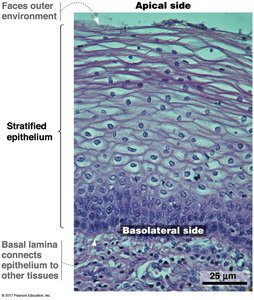
Epithelial tissue covers the body and lines internal organs. It forms glands and is involved in protection, secretion, and absorption.
Apical Side: Faces the environment.
Basolateral Side: Faces the interior and connects to connective tissue.
Short-lived Cells: Rapid turnover, especially in digestive tract.
Cell Size and Animal Physiology
Surface Area to Volume Ratio
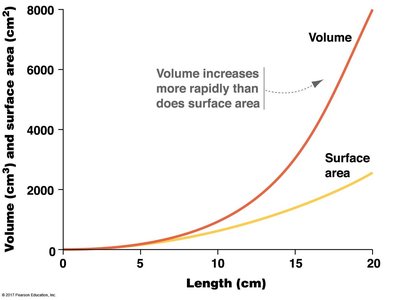
Cell surface area determines the rate of diffusion, while cell volume affects nutrient use and waste production. As animals increase in size, their surface area to volume ratio decreases, impacting physiological processes.
Surface Area: Controls exchange of materials.
Volume: Determines metabolic demand.
Implication: Larger animals have lower surface area relative to volume, affecting heat and nutrient exchange.
Metabolic Rate and Body Size
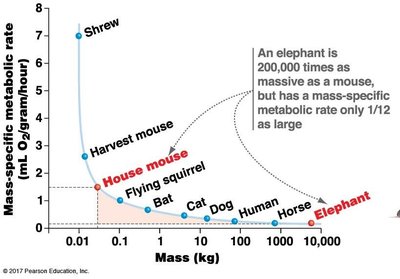
Metabolic rate is the rate of energy consumption, often measured by oxygen use. Basal metabolic rate (BMR) is the rate at rest. Mass-specific BMR decreases as body size increases, meaning small animals have higher metabolic rates per gram than large animals.
Equation:
Mass-specific BMR:
Example: Shrews have much higher mass-specific BMR than elephants.
Homeostasis in Animals
Definition and Importance
Homeostasis is the maintenance of stable internal conditions. Enzymes and cellular processes function optimally within specific ranges of temperature, pH, and other variables.
Regulation: Balancing influx and efflux to maintain constant levels.
Conformation: Internal state matches environment.
Physiological Regulation: Energy expended to maintain internal state.
Behavioral Regulation: Adjusting behavior to regulate internal state.
Regulation Mechanisms
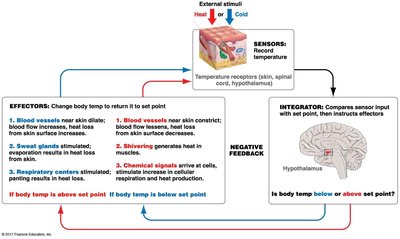
Homeostasis is maintained by negative feedback loops. Key components include set point, sensor, integrator, and effector.
Set Point: Normal range for a variable.
Sensor: Detects changes in environment.
Integrator: Compares sensor input to set point.
Effector: Restores internal condition.
Negative Feedback: Effectors oppose changes from set point.
Thermoregulation
Mechanisms of Heat Exchange
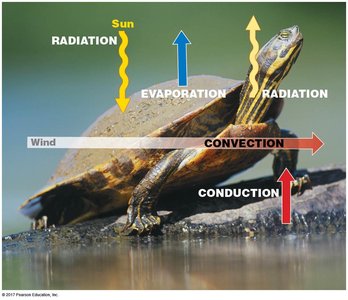
Animals exchange heat with their environment through conduction, convection, radiation, evaporation, and metabolism. These mechanisms are essential for maintaining body temperature.
Conduction: Direct transfer of heat between contacting bodies.
Convection: Heat transfer between solid and fluid.
Radiation: Heat transfer without direct contact.
Evaporation: Heat loss as water changes to vapor.
Metabolism: Heat produced by biochemical activity.
Thermoregulatory Strategies
Animals use different strategies to regulate body temperature. These include endothermy, ectothermy, homeothermy, and poikilothermy.
Endotherm: Generates heat internally.
Ectotherm: Relies on environmental heat.
Homeotherm: Maintains constant body temperature.
Poikilotherm: Body temperature varies with environment.
Adaptations for Thermoregulation
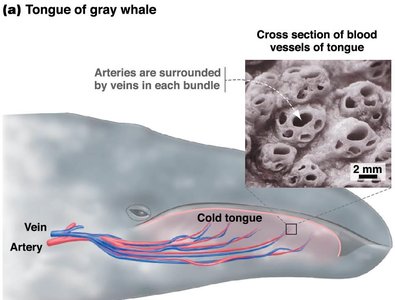
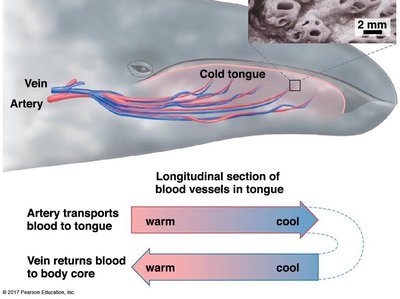
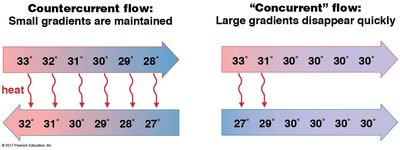
Endotherms have high metabolic rates and insulation (fur, feathers). Ectotherms require less food and can allocate more energy to reproduction. Adaptations to reduce heat loss include insulation, reduced surface area, and countercurrent exchange.
Torpor: Temporary drop in body temperature.
Hibernation: Extended drop in body temperature.
Countercurrent Exchange: Heat transfer between fluids flowing in opposite directions.
Summary Table: Thermoregulatory Strategies
Strategy | Heat Source | Temperature Regulation | Examples |
|---|---|---|---|
Endotherm | Internal metabolism | Usually constant (homeotherm) | Birds, mammals |
Ectotherm | Environment | Variable (poikilotherm) | Reptiles, amphibians, fish |
Homeotherm | Internal or external | Constant | Polar marine fish, mammals |
Poikilotherm | Internal or external | Variable | Most invertebrates, amphibians |
