Back
Biology Exam 3. Ch. 41 Animal Nutrition
Study Guide - Smart Notes
 Tailored notes based on your materials, expanded with key definitions, examples, and context.
Animal Nutrition
Major Groups of Nutritional Strategies
Animals are classified based on their dietary habits, which reflect their adaptations for obtaining nutrients from different sources.
Herbivores: Consume plants and algae. Example: cows, deer.
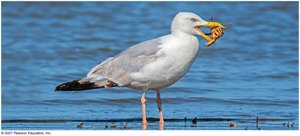
Carnivores: Consume other animals. Example: lions, herring gulls.
Omnivores: Consume both plants/algae and animals. Example: humans, bears.
Example: The herring gull is a carnivore, feeding on crabs and other animals.
Essential Nutrients
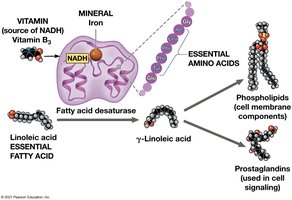
Essential nutrients are materials that animals cannot synthesize from simpler molecules and must obtain from their diet. There are four main classes:
Essential amino acids: Nine amino acids must be obtained from food (e.g., histidine, isoleucine, leucine, lysine, methionine, phenylalanine, threonine, tryptophan, valine).
Essential fatty acids: Certain unsaturated fatty acids (e.g., linoleic acid) must be obtained from the diet.
Vitamins: Organic molecules required in small amounts for various metabolic functions.
Minerals: Inorganic nutrients required for structural and regulatory roles.
Example: Meat, eggs, and cheese provide all essential amino acids and are considered "complete" proteins.
Mineral Requirements of Humans
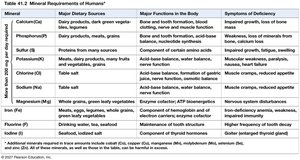
Minerals are inorganic elements required for various physiological functions. Deficiency in minerals can lead to specific symptoms and diseases.
Mineral | Major Dietary Sources | Major Functions in the Body | Symptoms of Deficiency |
|---|---|---|---|
Calcium (Ca) | Dairy products, dark green vegetables, legumes | Bone and tooth formation, blood clotting, nerve and muscle function | Impaired growth, loss of bone mass |
Phosphorus (P) | Dairy products, meats, grains | Bone and tooth formation, acid-base balance | Weakness, loss of minerals from bone, calcium loss |
Sulfur (S) | Proteins from many sources | Component of certain amino acids | Symptoms: fatigue, swelling |
Potassium (K) | Meats, dairy products, fruits, vegetables, grains | Acid-base balance, nerve function | Muscle weakness, reduced appetite |
Chlorine (Cl) | Table salt | Acid-base balance, formation of gastric juice | Muscle cramps, reduced appetite |
Sodium (Na) | Table salt | Acid-base balance, nerve function | Muscle cramps, reduced appetite |
Magnesium (Mg) | Whole grains, green leafy vegetables | Enzyme cofactor, ATP bioenergetics | Nervous system disturbances |
Iron (Fe) | Meats, eggs, legumes, whole grains, green leafy vegetables | Component of hemoglobin and electron carriers | Anemia, weakness |
Fluorine (F) | Drinking water, tea, seafood | Maintenance of tooth structure | Higher frequency of tooth decay |
Iodine (I) | Seafood, iodized salt | Component of thyroid hormones | Goiter (enlarged thyroid gland) |
Consequences of Nutrient Deficiency
Insufficient intake of essential nutrients can lead to deformities, disease, and death. Undernourished individuals use up stored fat and carbohydrates, break down their own proteins, lose muscle mass, suffer brain protein deficiency, and may die or suffer irreversible damage.
Food Processing and Digestion
Overview of Food Processing
Food processing in animals involves four main steps:
Ingestion: Intake of food into the body.
Digestion: Breakdown of food into smaller molecules by mechanical and chemical means.
Absorption: Uptake of nutrients by body cells.
Elimination: Removal of undigested material from the body.
Mechanical digestion includes chewing and grinding, while chemical digestion involves enzymatic hydrolysis.
Compartmentalization of Digestion
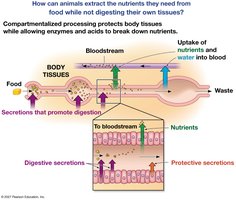
Animals protect their own tissues from digestive enzymes and acids by compartmentalizing digestion. Specialized structures and secretions ensure that only food is digested, not body tissues.
Digestion in Simple Organisms
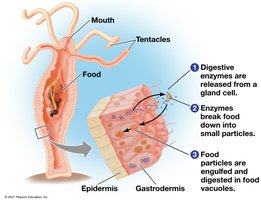
Single-celled organisms and sponges rely on intracellular digestion, while most multicellular animals use extracellular digestion. For example, hydra release digestive enzymes into their gastrovascular cavity to break down food.
Variation in Alimentary Canals
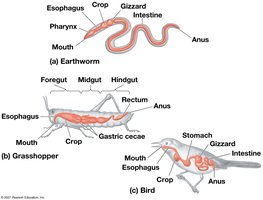
Different animals have specialized alimentary canals adapted to their diets. Earthworms, grasshoppers, and birds have unique digestive structures such as crops, gizzards, and gastric cecae.
The Human Digestive System
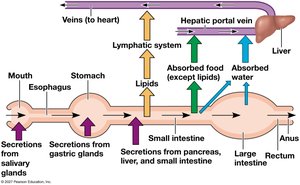
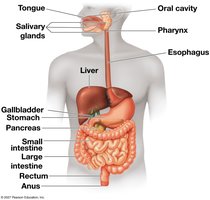
The human digestive system consists of the oral cavity, pharynx, esophagus, stomach, small intestine, large intestine, rectum, and anus. Accessory organs include the liver, gallbladder, and pancreas.
Intersection of Airway and Digestive Tract
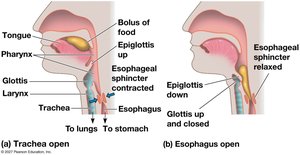
The pharynx is a shared passage for food and air. The epiglottis prevents food from entering the trachea during swallowing.
Chemical Digestion in Humans
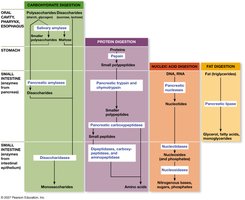
Chemical digestion involves the breakdown of carbohydrates, proteins, nucleic acids, and fats by specific enzymes in different regions of the digestive tract.
Carbohydrate digestion: Begins in the mouth with salivary amylase.
Protein digestion: Begins in the stomach with pepsin.
Nucleic acid digestion: Occurs in the small intestine with pancreatic nucleases.
Fat digestion: Occurs in the small intestine with pancreatic lipase and bile from the gallbladder.
Stomach and Its Secretions
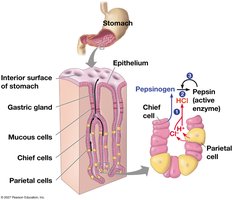
The stomach secretes gastric juices containing hydrochloric acid and pepsinogen. Pepsinogen is activated to pepsin, which digests proteins. Mucous cells protect the stomach lining from acid.
Nutrient Absorption in the Small Intestine
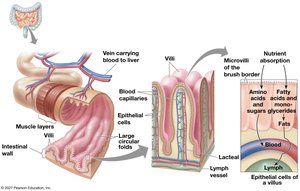
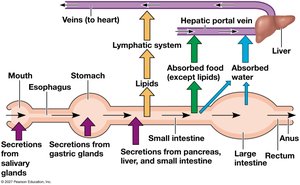
The small intestine is the primary site for digestion and absorption. Its lining contains villi and microvilli, increasing surface area for efficient nutrient uptake. Nutrients enter the bloodstream or lymphatic system.
Villi: Finger-like projections that increase surface area.
Microvilli: Microscopic extensions of epithelial cells.
Lacteals: Specialized lymphatic vessels for fat absorption.
Fat Digestion and Absorption
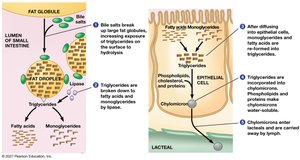
Fats are emulsified by bile salts, digested by lipase, and absorbed as fatty acids and monoglycerides. They are reassembled into triglycerides and transported via chylomicrons in the lymphatic system.
Variation in Digestive Systems: Herbivores vs. Carnivores
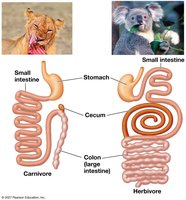
Herbivores and carnivores have distinct digestive adaptations. Herbivores often have longer alimentary canals and specialized structures for fermenting plant material, while carnivores have shorter tracts suited for protein digestion.
Regulation of Digestion and Energy Storage
Hormonal Regulation of Digestion
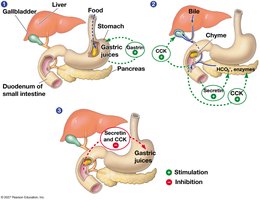
The digestive system is regulated by the enteric nervous system and hormones. Gastrin stimulates gastric juice production, while cholecystokinin (CCK) and secretin regulate enzyme and bile release, and inhibit gastric activity.
Gastrin: Stimulates gastric juice secretion.
CCK: Stimulates release of digestive enzymes and bile.
Secretin: Stimulates pancreas to release bicarbonate.
Regulation of Blood Glucose Levels
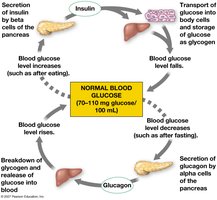
Blood glucose is regulated by pancreatic hormones insulin and glucagon. Insulin lowers blood glucose by promoting uptake and storage, while glucagon raises it by stimulating glycogen breakdown.
Insulin: Secreted by beta cells; promotes glucose uptake and storage as glycogen.
Glucagon: Secreted by alpha cells; promotes breakdown of glycogen to glucose.
Normal blood glucose: 70–110 mg glucose/100 mL
Hepatic Portal System
The hepatic portal vein transports absorbed nutrients from the small intestine directly to the liver, where they are processed before entering general circulation. This system helps regulate nutrient and glucose levels.
Mutualistic Adaptations and the Microbiome
Gut Microbiome
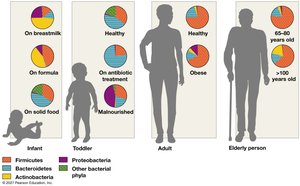
The gut microbiome consists of diverse bacterial species that aid digestion, synthesize vitamins, and protect against pathogens. Disruption of the microbiome can lead to health issues such as ulcers and diarrhea.
Helicobacter pylori: Acid-tolerant bacterium causing stomach ulcers.
Fecal microbial transplantation: Used to restore healthy microbiome in patients with Clostridium difficile infection.
Example: The composition of the gut microbiome varies with age, diet, and health status.
Summary of Digestive System Concepts
The mammalian digestive system is a complex, regulated system that ensures efficient nutrient extraction, protection of body tissues, and homeostasis of energy and glucose levels.