 Back
Chapter 16: Animal Nutrition and Digestive System: Structure and Function
Study Guide - Smart Notes
 Tailored notes based on your materials, expanded with key definitions, examples, and context.
Animal Nutrition
Main Stages of Food Processing
Animal nutrition involves four main stages of food processing, each requiring specialized adaptations and physiological mechanisms.
Ingestion: The process of bringing food into the animal's body. Animals have evolved multiple strategies for ingestion, including:
Filter feeders: Animals such as whales use baleen to filter small food particles from water.
Substrate feeders: Caterpillars eat their way through plant tissues as they move.
Fluid feeders: Mosquitoes and other insects extract liquid nutrients from hosts.
Bulk feeders: Animals like snakes and humans consume large pieces of food at once.
Digestion: The breakdown of food into molecules small enough for absorption. This includes:
Mechanical digestion: Physical breakdown (e.g., chewing) increases surface area.
Chemical digestion: Enzymatic hydrolysis splits food into absorbable molecules.
Intracellular digestion: Food is engulfed by phagocytosis and broken down by lysosomal enzymes (e.g., white blood cells digesting pathogens).
Extracellular digestion: Enzymes are secreted outside cells to break down food particles.
Absorption: Nutrient molecules are transported into body cells for use.
Elimination: Removal of undigested, unnecessary, or unusable material from the body.
Digestive System Structure
The digestive system is composed of organs specialized for sequential food processing, including the alimentary canal and accessory glands that secrete digestive juices.
Oral cavity: Site of mechanical digestion and introduction of saliva.
Salivary glands: Secrete saliva containing amylase (enzyme for starch breakdown) and mucus (lubricates food).
Crop and gizzard: Storage and grinding organs found in birds and many invertebrates.
Stomach: Mammalian stomach has low pH (1.5–3) for short-term storage and processing; secretes gastric juices (hydrochloric acid and pepsin).
Peristalsis: Coordinated smooth muscle contractions move food through the digestive tract.
Sphincters: Smooth muscle gates that regulate flow between digestive compartments.
Chyme: Mixture of food and gastric juices formed in the stomach, moves to the duodenum (first segment of small intestine).
Accessory organs: Pancreas (releases bicarbonate to neutralize pH), Liver and Gallbladder (produce and store bile for fat digestion).
Absorption in the Small Intestine
Absorption of nutrients primarily occurs in the small intestine, which is highly adapted for efficient uptake.
Evaginations: Outward folds of the epithelium increase surface area.
Villi: Large tissue evaginations that maximize absorption.
Microvilli: Cell membrane extensions further increase surface area for nutrient uptake.
Absorption in the Large Intestine
The large intestine is responsible for water recovery and houses beneficial bacteria.
Cecum: Aids in fermentation of plant material; reduced in humans as the appendix.
Colon: Recovers water and hosts bacteria that produce vitamins.
Feces: Undigested material and bacteria, solidified by water absorption in the colon, stored in the rectum until elimination.
Adaptations in Animal Dentition
Types of Teeth and Their Functions
Different animals possess specialized teeth adapted to their dietary habits. The structure and function of teeth reflect the type of food consumed and the method of processing.
Incisors: Used for cutting food.
Canines: Used for holding and tearing food.
Premolars: Transitional teeth used for chewing.
Molars: Used for grinding food.
Three main dietary categories are reflected in dentition:
Carnivores: Sharp canines and incisors for cutting and tearing meat.
Herbivores: Broad molars and premolars for grinding plant material.
Omnivores: Combination of all tooth types for a varied diet.
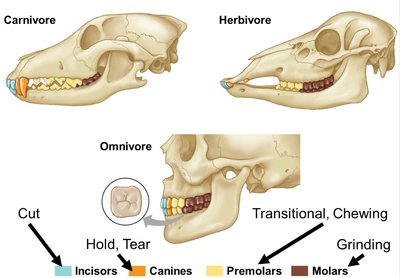
Example: Human dentition includes incisors for cutting, canines for tearing, premolars for chewing, and molars for grinding, reflecting an omnivorous diet.
