 Back
BackAnimal Nutrition: Essential Nutrients and Dietary Requirements
Study Guide - Smart Notes
 Tailored notes based on your materials, expanded with key definitions, examples, and context.
Animal Nutrition: Essential Nutrients and Dietary Requirements
Overview of Animal Nutritional Needs
Animals must obtain food to supply energy, organic building blocks, and essential nutrients. Unlike plants, animals cannot synthesize all the molecules they need and must acquire them from their diet. Nutrition is the process by which animals take in and utilize food to meet these requirements.
Chemical energy is required for cellular processes and is primarily derived from carbohydrates, proteins, and lipids.
Organic building blocks (such as carbon and nitrogen sources) are necessary for biosynthesis of macromolecules.
Essential nutrients are substances that animals cannot synthesize and must obtain from their diet.
Essential Nutrients
Essential nutrients include certain amino acids, fatty acids, vitamins, and minerals. These nutrients serve as substrates, coenzymes, and cofactors in various biosynthetic reactions.
Essential amino acids: Required for protein synthesis; must be obtained from the diet if the animal cannot synthesize them.
Essential fatty acids: Required for membrane phospholipids and signaling molecules; must be obtained from the diet.
Vitamins: Organic molecules required in small amounts for enzyme function and other roles.
Minerals: Inorganic nutrients with diverse physiological functions.
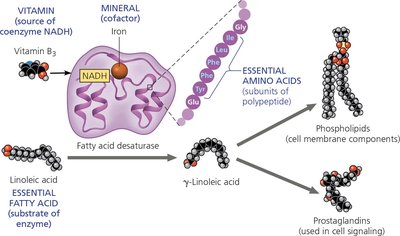
Essential Amino Acids
Animals require 20 amino acids to synthesize proteins. Most animals can synthesize about half of these if their diet contains sulfur and organic nitrogen; the rest are essential amino acids and must be obtained from food.
Humans require eight essential amino acids in their diet: isoleucine, leucine, lysine, methionine, phenylalanine, threonine, tryptophan, and valine. Infants also require histidine.
Animal products (meat, eggs, cheese) provide all essential amino acids ("complete" proteins).
Most plant proteins are "incomplete" but can be combined in a varied diet to provide all essential amino acids.
Essential Fatty Acids
Fatty acids are needed for the synthesis of membrane phospholipids, signaling molecules, and storage fats. Animals cannot synthesize certain fatty acids with specific double bonds and must obtain them from their diet.
Linoleic acid is an example of an essential fatty acid in mammals.
Seeds, grains, and vegetables are common dietary sources.
Vitamins
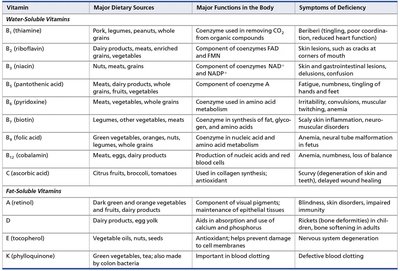
Vitamins are organic compounds required in small amounts for normal metabolism. They function mainly as coenzymes or parts of coenzymes. Humans require 13 vitamins, which are classified as water-soluble or fat-soluble.
Water-soluble vitamins (e.g., B vitamins, vitamin C): Excess is usually excreted in urine.
Fat-soluble vitamins (e.g., vitamins A, D, E, K): Excess can accumulate in body fat and may become toxic.
Minerals
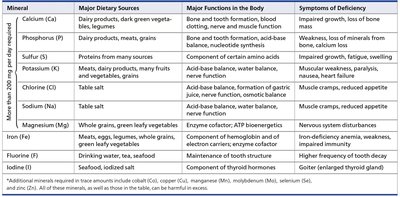
Minerals are inorganic nutrients required in small to moderate amounts. They play roles in structural support, enzyme function, nerve and muscle activity, and maintaining osmotic balance.
Examples include calcium, phosphorus, sulfur, potassium, chlorine, sodium, magnesium, iron, fluorine, and iodine.
Excess intake of some minerals (e.g., sodium) can cause health problems such as high blood pressure.
Variation in Animal Diets
Animals are classified by their typical diet:
Herbivores: Eat mainly plants or algae.
Carnivores: Eat other animals.
Omnivores: Eat both plants/algae and animals.
Most animals are opportunistic feeders and may broaden their diet when usual foods are unavailable. Microorganisms are an unavoidable supplement in all animal diets.
Dietary Deficiencies and Malnutrition
Malnutrition results from a diet lacking one or more essential nutrients or insufficient energy intake. It can cause deformities, disease, and death. Protein deficiency is the most common form of malnutrition in humans, especially in children whose diets lack sufficient protein.
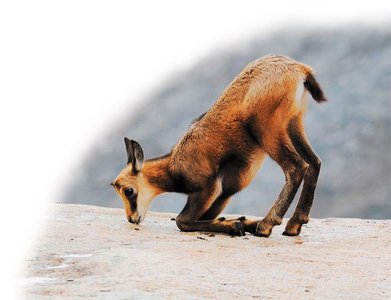
Animals may seek out unusual sources of nutrients (e.g., herbivores licking rocks for minerals).
Undernourishment
Undernourishment occurs when an animal's diet fails to provide enough chemical energy. The body first uses stored carbohydrates and fats, then breaks down its own proteins, leading to muscle loss and impaired brain function. Severe undernourishment can be fatal and may cause irreversible damage.
Assessing Nutritional Needs
Determining ideal human diets is challenging due to genetic diversity, environmental variation, and ethical considerations. Epidemiological studies have provided insights into the effects of nutrition on health. For example, vitamin supplementation (especially folic acid) has been shown to reduce the risk of neural tube defects in infants.
Case Study: Vitamin Supplementation and Neural Tube Defects
Group | Number of Infants/Fetuses Studied | Infants/Fetuses with a Neural Tube Defect |
|---|---|---|
Vitamin supplements (experimental group) | 141 | 1 |
No vitamin supplements (control group) | 204 | 12 |
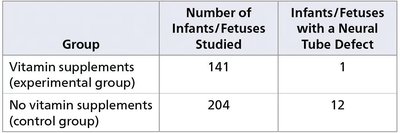
Conclusion: Vitamin supplementation, particularly with folic acid, significantly reduces the risk of neural tube defects.
Concept Check Questions
Why aren’t all 20 amino acids essential in animal diets?
Why are vitamins required in very small amounts?
If a zoo animal eating ample food shows signs of malnutrition, how might a researcher determine which nutrient is lacking?
Additional info: Epidemiological studies and controlled supplementation trials are critical tools in understanding human nutritional requirements and preventing deficiency-related diseases.
