 Back
BackAnimal Nutrition, Excretion, Circulation, and Respiration: Lecture 6
Study Guide - Smart Notes
 Tailored notes based on your materials, expanded with key definitions, examples, and context.
Nutrition, Digestion, and Waste
Overview of Animal Digestion
Animal digestion involves the breakdown of complex food molecules into absorbable units. Enzymes play a critical role in this process, with each enzyme specialized for a particular substrate.
Proteases: Enzymes that break down proteins by hydrolyzing peptide bonds.
Nucleases: Enzymes that digest nucleic acids into nucleotides.
Lipases: Enzymes that break down lipids (fats).
Carbohydrases: Enzymes that digest carbohydrates.
Example: Proteases do not break down nucleic acids; nucleases do. This is a common point of confusion in animal physiology.
Renal Function and Nitrogenous Waste
The removal of nitrogenous waste is essential for animal survival. Ammonia, a toxic byproduct of protein metabolism, must be efficiently excreted.
Ammonia (NH3): Highly toxic, excreted directly by aquatic animals or converted to less toxic forms (urea, uric acid) in terrestrial animals.
Excretory systems filter blood, reclaim useful solutes, and expel waste as urine.
Excretory System Basics
The excretory system operates through four main steps:
Filtration: Blood pressure forces water and solutes across a filter membrane.
Reabsorption: Useful solutes and water are returned to the blood.
Secretion: Additional toxins and ions are actively secreted into the excretory tubule.
Excretion: The final filtrate (urine) is expelled from the body.
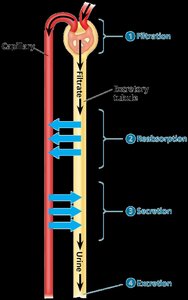
The Nephron and Kidney Structure
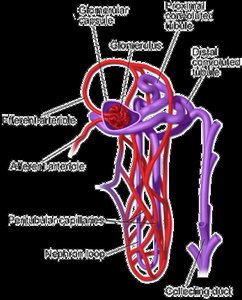
The nephron is the functional unit of the kidney, responsible for filtering blood and forming urine. Blood flows through a series of vessels and capillaries, where filtration and selective reabsorption occur.
Glomerulus: Site of pressurized filtration.
Proximal Tubule: Major site for reabsorption of water, ions, glucose, and amino acids.
Loop of Henle: Establishes a concentration gradient in the medulla, allowing for water reabsorption.
Distal Tubule and Collecting Duct: Further adjust ion and water balance; water recovery here is regulated by antidiuretic hormone (ADH/vasopressin).
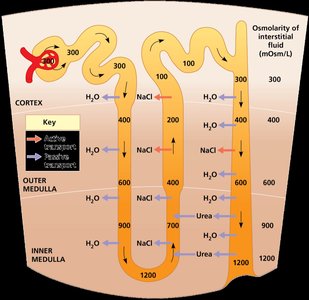
Osmolarity and Energy Use in the Kidney
Osmolarity increases from the cortex to the inner medulla of the kidney. Passive and active transport mechanisms move water and solutes according to or against their gradients. The kidney is energetically expensive due to active transport processes.
Circulation
Types of Circulatory Systems
Animals have evolved different circulatory systems to transport nutrients, gases, and wastes:
Open Circulatory System: Hemolymph bathes organs directly; found in insects and many invertebrates.
Closed Circulatory System: Blood is confined to vessels; found in vertebrates and some invertebrates. Allows for higher pressure and more efficient transport.
Evolution of the Vertebrate Heart
Vertebrate hearts have evolved from simple to complex structures:
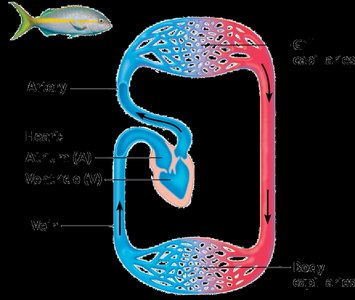
Fish: Two-chambered heart; single circuit.
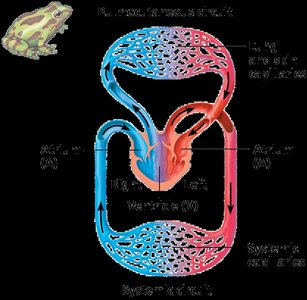
Amphibians: Three-chambered heart; double circuit with some mixing of oxygenated and deoxygenated blood.
Reptiles: Incomplete septum; less mixing.
Mammals and Birds: Four-chambered heart; complete separation of oxygenated and deoxygenated blood.
Blood Vessels and Circulatory Path
There are four main types of blood vessels:
Arteries: Carry blood away from the heart to tissues.
Veins: Return blood from tissues to the heart.
Capillaries: Microscopic vessels for exchange of substances with tissues.
Portal Vessels: Connect one capillary bed to another (e.g., hepatic portal vein).
Respiration
Types of Respiratory Systems
Animals have adapted various respiratory systems based on their environment and size:
Simple Invertebrates: Rely on diffusion; all cells are in contact with the environment.
Insects: Use a tracheal system with spiracles; open circulatory system.
Crustaceans: Gills and open circulatory system; hemolymph contains copper-based pigment (blue).
Aquatic Vertebrates: Gills and closed circulatory system; blood contains iron-based pigment (red).
Terrestrial Vertebrates: Lungs and closed circulatory system.
Mechanisms of Breathing
Positive Pressure Breathing: Amphibians and some fish "gulp" air using mouth muscles.
Negative Pressure Breathing: Mammals use the diaphragm to pull air into the lungs.
Birds: Use a system of air sacs for unidirectional airflow through the lungs.
Gas Exchange and Partial Pressures
Gas exchange occurs down partial pressure gradients. Oxygen and carbon dioxide move from areas of high to low partial pressure.
Partial Pressure of Oxygen (PO2) in air at sea level:
Partial Pressure of Oxygen in oxygenated blood:
Partial Pressure of Oxygen in deoxygenated blood:
Hemoglobin and Oxygen Transport
Hemoglobin is a protein that greatly increases the oxygen-carrying capacity of blood. It exhibits cooperativity, meaning the binding of one oxygen molecule increases the affinity for the next.
In low oxygen environments, animals may produce more hemoglobin or different isoforms with higher affinity for oxygen.
Control of Breathing in Humans
Breathing is regulated both voluntarily and involuntarily. The medulla detects changes in pH (from CO2 levels), while the aorta and carotid arteries can sense low oxygen levels.
High CO2 lowers pH, stimulating increased breathing rate.
Summary Table: Partial Pressures of Gases
Location | Total Gas Pressure (mm Hg) | PO2 (mm Hg) | PCO2 (mm Hg) |
|---|---|---|---|
Air (sea level) | 760 | 159 | 0.3 |
Oxygenated blood | 760 | 100 | 40 |
Deoxygenated blood | 760 | 40 | 45 |
Body tissues | 760 | 40 | 45 |
Additional info: These notes integrate and expand upon the provided lecture content, ensuring coverage of all major concepts relevant to animal nutrition, excretion, circulation, and respiration for college-level biology.
