 Back
Animal Origins and Porifera: Structure, Function, and Evolution
Study Guide - Smart Notes
 Tailored notes based on your materials, expanded with key definitions, examples, and context.
Animal Origins and Porifera
Introduction to Animal Origins
Animals are multicellular organisms that evolved from ancestral protists. The earliest animals, such as sponges (Porifera), lack true tissues and organs, distinguishing them from other animal groups.
Metazoa: The broad group containing all animals.
Eumetazoa: Animals with true tissues.
Bilateria: Animals with bilateral symmetry and three germ layers.
Embryonic Germ Layers
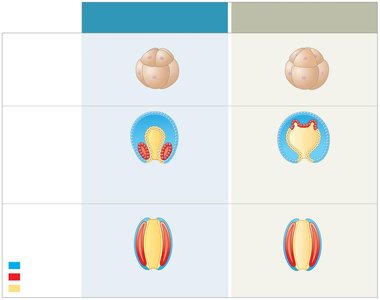
Germ layers are cell layers formed during embryonic development that give rise to tissues and organs.
No defined tissues: Sponges (Porifera) lack true tissues.
Diploblastic: Two germ layers (ectoderm and endoderm); found in radially symmetrical animals.
Triploblastic: Three germ layers (ectoderm, mesoderm, endoderm); found in bilaterally symmetrical animals.
Body Cavities
Body cavities provide space for organ development and facilitate physiological functions.
Acoelomate: No body cavity.
Pseudocoelomate: Body cavity not fully lined by mesoderm.
Coelomate: Body cavity fully lined by mesoderm.
Body cavities are only relevant to triploblastic animals.
Protostome vs. Deuterostome Development
Animal development can follow two major patterns:
Protostome: Mouth forms first from the blastopore (e.g., molluscs, annelids).
Deuterostome: Anus forms first from the blastopore (e.g., echinoderms, chordates).
Key developmental differences:
Cleavage pattern: Spiral (protostome) vs. radial (deuterostome).
Coelom formation: Splitting of mesoderm (protostome) vs. folding of archenteron (deuterostome).
Fate of blastopore: Mouth (protostome) vs. anus (deuterostome).
Porifera (Sponges)
Porifera Overview
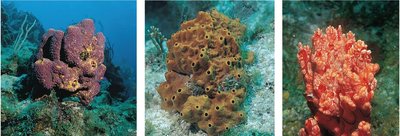
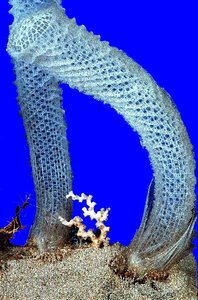
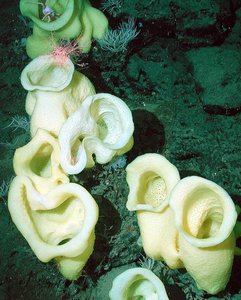
Sponges are simple, multicellular animals with a long fossil record (~700-600 million years). They are mostly marine, with some freshwater species.
Synapomorphies: Aquiferous system, spicules, sessile lifestyle, lack of mouth, anus, or tissues.
Sponges are important for nutrient cycling and can form deep sea reefs.
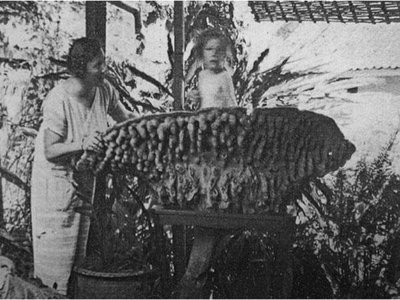
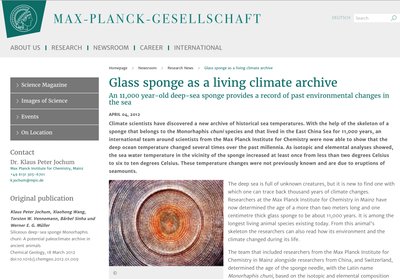
Some sponges are extremely long-lived (up to 11,000 years).
Porifera Anatomy
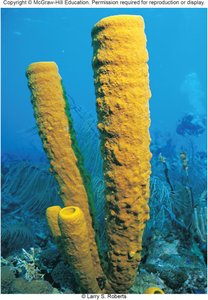
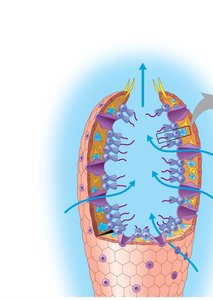
Sponges have specialized cells but lack true tissues. Their anatomy is defined by the aquiferous system and skeletal elements.
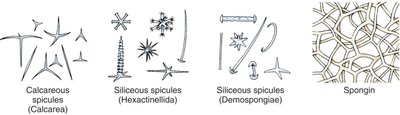
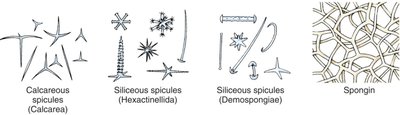
Spicules: Microscopic skeletal elements composed of calcium carbonate (CaCO3), silica (Si), or spongin (collagen).
Ostium (ostia): Incurrent openings for water entry.
Osculum (oscula): Excurrent openings for water exit.
Spongocoel: Central cavity.
Mesohyl: Gelatinous matrix between cell layers.
Choanocytes: Collar cells that circulate water and trap food.
Amoebocytes: Cells involved in digestion and structure.
Porifera Skeletal Structure
The skeleton of sponges provides support and protection.
Spicules deter predators and are used for classification.
Spicules can be calcareous, siliceous, or composed of spongin.
Porifera Feeding and Aquiferous System
Sponges feed by filtering water through their bodies.
Water enters through ostia, passes through the spongocoel, and exits via the osculum.
Choanocytes trap food particles and amoebocytes digest them.
Porifera Life Cycle and Reproduction
Sponges reproduce both sexually and asexually.
Monoecious: Individual produces both sperm and eggs.
Sequential hermaphroditism: Functions first as one sex, then the other.
Cross-fertilization occurs via water currents.
Zygote develops into flagellated larvae, which settle and grow into adults.
Porifera Ecological and Medicinal Importance
Sponges play important roles in marine ecosystems and have medicinal properties.
Compounds from sponges (e.g., cribrostatin) are anti-inflammatory, antibacterial, antifungal, anticancer, antiviral, and antimalarial.
Sponges are important for nutrient cycling and can be used for climate reconstruction.
Porifera Diversity
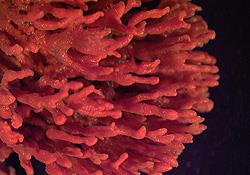
Sponges exhibit a wide range of body forms and ecological adaptations.
Some sponges bore into rocks and shells, leaving characteristic holes.
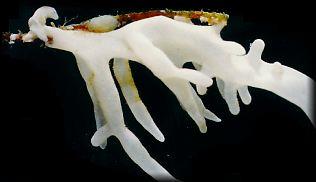
Chondrocladia lyra is a carnivorous, predatory sponge discovered in deep marine environments.
Animal Phylogeny and Evolution
The sister taxa of animals are choanoflagellates, which are unicellular or colonial protists.
Choanoflagellates are structurally similar to choanocytes in sponges.
Studies of sponges have contributed to understanding histocompatibility and self/non-self recognition in animals.
Summary Table: Sponge Anatomy and Functions
Structure | Function |
|---|---|
Ostium | Incurrent opening for water entry |
Osculum | Excurrent opening for water exit |
Spongocoel | Central cavity for water flow |
Mesohyl | Gelatinous matrix between cell layers |
Spicules | Skeletal support and protection |
Choanocytes | Circulate water and trap food |
Amoebocytes | Digestion and structural roles |
Key Terms and Definitions
Monoecious: Having both male and female reproductive organs in one individual.
Spicules: Microscopic skeletal elements in sponges.
Choanocytes: Collar cells responsible for water movement and food capture.
Amoebocytes: Cells involved in digestion and structure.
Ostium: Incurrent opening in sponges.
Osculum: Excurrent opening in sponges.
Spongocoel: Central cavity in sponges.
Mesohyl: Gelatinous matrix in sponges.
Example: Sponge Medicinal Compound
Sponges produce bioactive compounds such as spongothymidine, which have pharmaceutical applications. 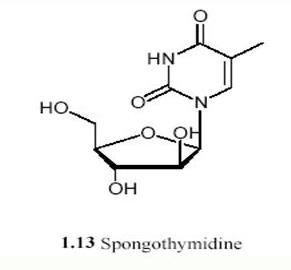
Additional info:
Sponges are used in climate reconstruction due to their longevity and ability to record environmental changes.
Sponges are important for understanding early animal evolution and the development of multicellularity.
