Back
BackAnimal Phylogeny, Body Plans, and Key Innovations: Protostomes, Deuterostomes, and Vertebrate Diversity
Study Guide - Smart Notes
 Tailored notes based on your materials, expanded with key definitions, examples, and context.
Animal Phylogeny and Major Lineages
Overview of Animal Diversity
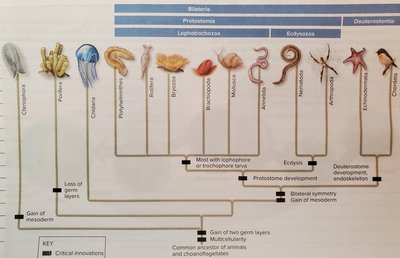
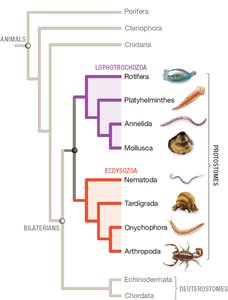
Animal diversity is organized into several major lineages based on developmental patterns, body morphology, and evolutionary innovations. The two main groups of bilaterian animals are Protostomes and Deuterostomes, each with distinct developmental characteristics.
Protostomes: Mouth forms before anus during embryonic development.
Deuterostomes: Anus forms before mouth during embryonic development.
Key Innovations in Animal Evolution
Multicellularity: All animals are multicellular, but only some have true tissues.
Germ Layers: Diploblastic animals have two germ layers (ectoderm and endoderm), while triploblastic animals have three (ectoderm, mesoderm, endoderm).
Symmetry: Radial symmetry (e.g., Cnidaria) vs. bilateral symmetry (most bilaterians).
Coelom: Body cavity present in many animals, classified as coelomate, acoelomate, or pseudocoelomate.
Segmentation: Repeated body segments allow for specialization and coordinated movement.
Protostomes: Lophotrochozoa and Ecdysozoa
Lophotrochozoa
Lophotrochozoans are a diverse group of protostomes characterized by spiral cleavage and, in many cases, a lophophore or trochophore larva.
Platyhelminthes (Flatworms): Acoelomate, flat bodies, high surface area for gas exchange.
Annelida (Segmented Worms): Coelomate, segmented bodies, tube-within-a-tube digestive tract.
Mollusca: Includes bivalves, gastropods, and cephalopods; body plan compartmentalization (muscular foot, visceral mass, mantle).
Ecdysozoa
Ecdysozoans grow by molting their exoskeleton (ecdysis).
Nematoda (Roundworms): Pseudocoelomate, unsegmented, thick cuticle, high surface area to volume ratio.
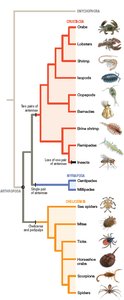
Arthropoda: Segmented bodies, jointed appendages, chitinous exoskeleton, extensive diversity.
Deuterostomes: Echinoderms and Chordates
Echinodermata
Sea Stars, Sea Urchins: Radial symmetry in adults, endoskeleton of calcium carbonate, water vascular system with tube feet.
Feeding Modes: Mass feeding, suspension feeding, deposit feeding.
Chordates
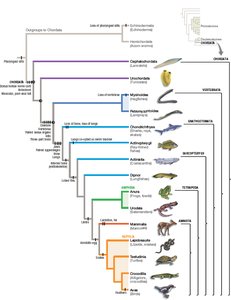
Chordates are defined by four key features: dorsal hollow nerve cord, notochord, pharyngeal slits, and post-anal tail.
Cephalochordates (Lancelets): Invertebrate chordates, fish-like, suspension feeders.
Urochordates (Tunicates): Invertebrate chordates, filter feeders, protective tunic.
Vertebrates: Possess vertebral column, cranium, paired sense organs.
Vertebrate Diversity and Evolution
Major Vertebrate Groups
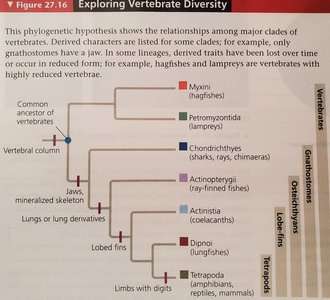
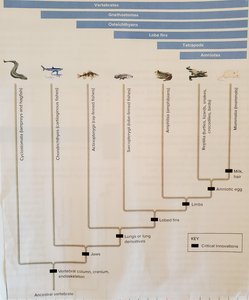
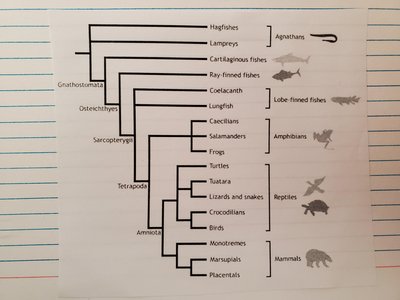
Vertebrates are further classified based on key innovations such as jaws, paired fins, lungs, limbs, and amniotic eggs.
Myxinoidea (Hagfishes): Invertebrate, cranium, no jaws or vertebrae.
Petromyzontoidea (Lampreys): Primitive vertebrate, cartilaginous skeleton, no jaws.
Chondrichthyes (Sharks, Rays): Cartilaginous skeleton, jaws, paired fins.
Actinopterygii (Ray-finned Fishes): Bony skeleton, swim bladder, protrusible jaws.
Actinistia (Coelacanths) & Dipnoi (Lungfishes): Lobe-finned fishes, lungs, four-lobed fins.
Tetrapoda: Limbs with digits, includes amphibians, reptiles, birds, mammals.
Key Innovations in Vertebrate Evolution
Vertebral Column: Structural support and protection of nerve cord.
Jaws: Allow for diverse feeding strategies.
Lungs or Lung Derivatives: Enable breathing air.
Lobed Fins: Precursor to tetrapod limbs.
Limbs with Digits: Adaptation for terrestrial locomotion.
Amniotic Egg: Protects embryo on land, prevents desiccation.
Mammary Glands and Fur: Nourishment and temperature regulation in mammals.
Summary Table: Major Animal Phyla and Key Features
Phylum | Body Plan | Habitat | Feeding Mode | Movement | Key Adaptations |
|---|---|---|---|---|---|
Porifera | No true tissues, asymmetrical | Aquatic | Filter feeding | Sessile | Multicellularity |
Cnidaria | Diploblastic, radial symmetry | Aquatic | Carnivorous, stinging tentacles | Muscular/epithelial cells | True tissues, nerve net |
Platyhelminthes | Acoelomate, bilateral | Moist, aquatic | Blind gut, absorption | Cilia, undulation | Flat body, high SA:V |
Annelida | Coelomate, segmented | Marine, freshwater, terrestrial | Deposit, suspension, mass feeding | Chaetae, hydrostatic skeleton | Segmentation |
Mollusca | Muscular foot, visceral mass | Marine, freshwater, terrestrial | Radula, gills, filter feeding | Foot, jet propulsion | Shell, mantle, radula |
Nematoda | Pseudocoelomate, unsegmented | Marine, freshwater, terrestrial | Varied, parasitic | Thrashing, hydrostatic skeleton | Molting, cuticle |
Arthropoda | Segmented, jointed appendages | All habitats | Diverse, specialized mouthparts | Walking, flying, swimming | Exoskeleton, tagmata |
Echinodermata | Radial (adult), endoskeleton | Marine | Mass, suspension, deposit feeding | Tube feet, spines | Water vascular system |
Chordata | Notochord, dorsal nerve cord | Marine, freshwater, terrestrial | Suspension, predation, varied | Muscle contractions, limbs | Vertebral column, jaws, limbs |
Conclusion
The diversity of animal life is shaped by evolutionary innovations in body plan, development, and adaptation to different environments. Understanding the phylogenetic relationships and key features of major animal phyla is essential for studying animal biology, evolution, and ecology.