Back
BackAnimal Reproduction and Development: Study Guidance
Study Guide - Smart Notes
 Tailored notes based on your materials, expanded with key definitions, examples, and context.
Q1. What structure does the male excretory system and reproductive system share?
Background
Topic: Anatomy of the Male Reproductive and Excretory Systems
This question tests your understanding of how the male reproductive and urinary systems are anatomically connected, and which structure serves both functions.
Key Terms:
Excretory system: Removes waste from the body (urine).
Reproductive system: Produces and transports gametes (sperm).
Urethra: Tube that carries urine from the bladder and also transports semen during ejaculation.
Step-by-Step Guidance
Review the functions of each structure listed: prostate, seminal vesicle, urethra, vas deferens.
Identify which structure is involved in both the removal of urine and the transport of reproductive cells.
Recall that urine exits the body through a tube, and semen also uses this tube during ejaculation.
Consider which structure is shared by both systems, rather than being exclusive to one.
Try solving on your own before revealing the answer!
Final Answer: Urethra
The urethra is the structure shared by both the male excretory and reproductive systems. It carries urine from the bladder and semen from the reproductive tract to the outside of the body.
Q2. Which of the following is not a form of asexual reproduction?
Background
Topic: Types of Reproduction
This question tests your knowledge of the different mechanisms organisms use to reproduce without the fusion of gametes (asexual reproduction).
Key Terms:
Asexual reproduction: Reproduction without the fusion of gametes; offspring are genetically identical to the parent.
Budding: New individuals form from outgrowths of the parent.
Fragmentation: Parent organism splits into fragments, each capable of growing into a new organism.
Hermaphroditism: An individual has both male and female reproductive organs (not necessarily asexual).
Step-by-Step Guidance
Review the definitions of budding, fragmentation, and hermaphroditism.
Determine which process involves reproduction without gamete fusion and produces genetically identical offspring.
Consider whether hermaphroditism is a reproductive strategy that involves asexual reproduction or sexual reproduction.
Eliminate options that do not fit the definition of asexual reproduction.
Try solving on your own before revealing the answer!
Final Answer: Hermaphroditism
Hermaphroditism is not a form of asexual reproduction; it refers to individuals with both male and female reproductive organs, but reproduction still involves gamete fusion (sexual reproduction).
Q3. Which phase of the ovarian cycle closely parallels the hormonal regulation in males?
Background
Topic: Hormonal Regulation of Reproduction
This question tests your understanding of the similarities between male and female reproductive hormonal cycles, particularly the phases of the ovarian cycle.
Key Terms:
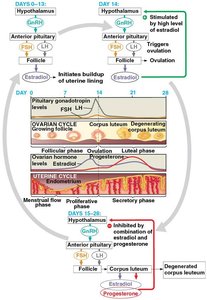
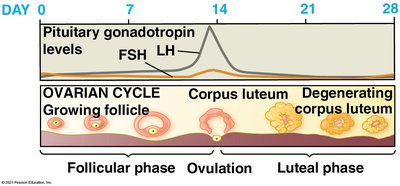
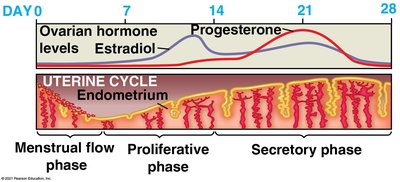
Ovarian cycle: The cycle of events in the ovary, including follicular phase, ovulation, and luteal phase.
Follicular phase: Period of follicle growth and maturation, regulated by FSH and LH.
Luteal phase: Period after ovulation when the corpus luteum secretes hormones.
Hormonal regulation in males: Continuous stimulation of spermatogenesis by FSH and LH.
Step-by-Step Guidance
Recall the phases of the ovarian cycle and their hormonal regulation.
Compare the hormonal activity during each phase to the male reproductive system, which is regulated by FSH and LH.
Identify which phase involves similar hormonal stimulation and gamete production as in males.
Focus on the phase where follicle growth and maturation occur, as this is analogous to spermatogenesis in males.
Try solving on your own before revealing the answer!
Final Answer: Follicular phase
The follicular phase of the ovarian cycle is most similar to the hormonal regulation in males, as both involve FSH and LH stimulating gamete production.