 Back
Animal Reproduction: Mechanisms, Structures, and Strategies
Study Guide - Smart Notes
 Tailored notes based on your materials, expanded with key definitions, examples, and context.
Animal Reproduction
Overview of Reproductive Modes
Animal reproduction encompasses both asexual and sexual mechanisms, each with distinct biological processes and evolutionary implications.
Asexual reproduction involves mitosis, producing offspring genetically identical to the parent (clones), without gamete fusion.
Sexual reproduction involves meiosis and the fusion of gametes, resulting in genetically diverse offspring.
Types of Asexual Reproduction
Asexual reproduction in animals can occur through several mechanisms:
Budding: Offspring form within or on the parent and break off to grow independently.
Fission: The parent splits into two or more descendants.
Parthenogenesis: Females produce offspring without male genetic contribution, via mitosis or fusion of meiotic products.
Sexual vs. Asexual Reproduction: Evolutionary Considerations
While asexual reproduction allows all individuals to produce offspring and pass 100% of their alleles, sexual reproduction persists due to its advantages in variable environments.
Genetic diversity increases the likelihood of offspring survival under changing conditions (e.g., physical environment, predator-prey dynamics, disease).
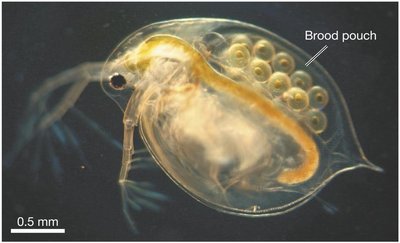
Case Study: Daphnia (water flea) switches between reproductive modes based on environmental cues.
Environmental Cues and Reproductive Mode Switching
Proximate causation: Refers to the genetic, developmental, hormonal, and neural mechanisms producing a trait.
Ultimate causation: Explains why a trait occurs, focusing on fitness effects and evolutionary history.
Daphnia switches to sexual reproduction when conditions deteriorate (low food, high crowding, onset of winter), increasing genetic diversity and fitness.
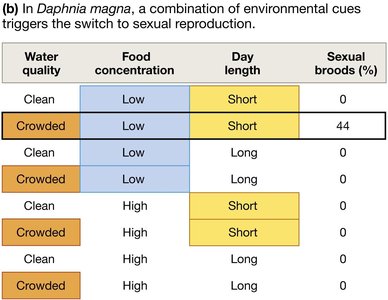
Environmental Cue Table for Daphnia magna
Environmental factors such as water quality, food concentration, and day length trigger the switch to sexual reproduction.
Water quality | Food concentration | Day length | Sexual broods (%) |
|---|---|---|---|
Clean | Low | Short | 0 |
Crowded | Low | Short | 44 |
Clean | Low | Long | 0 |
Crowded | Low | Long | 0 |
Clean | High | Short | 0 |
Crowded | High | Short | 0 |
Clean | High | Long | 0 |
Crowded | High | Long | 0 |
Gametogenesis in Animals
Oogenesis (Egg Formation)
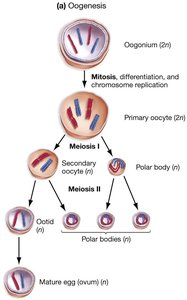
Oogenesis is the process by which eggs are produced in female animals.
A diploid oogonium undergoes mitosis to form a primary oocyte.
The primary oocyte undergoes meiosis I, producing a haploid secondary oocyte and a polar body.
The secondary oocyte undergoes meiosis II, resulting in a mature egg and additional polar bodies.
Cytoplasm and organelles are concentrated in the egg, while polar bodies are smaller and non-functional.
Egg Structure and Function
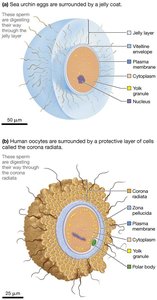
Eggs are specialized cells with unique structures to support fertilization and early development.
Contain a haploid nucleus.
Yolk provides nutrients.
Vitelline envelope and zona pellucida are protective layers.
Human eggs also have a corona radiata layer.
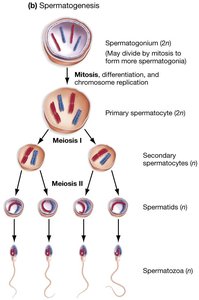
Spermatogenesis (Sperm Formation)
Spermatogenesis is the process by which sperm are produced in male animals.
A diploid spermatogonium undergoes mitosis to form a primary spermatocyte.
The primary spermatocyte undergoes meiosis I, producing two haploid secondary spermatocytes.
Secondary spermatocytes undergo meiosis II, producing four haploid spermatids.
Spermatids mature into spermatozoa.
Sperm Structure and Function
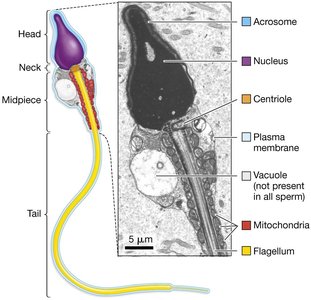
Sperm are highly specialized for motility and fertilization.
Acrosome: Contains enzymes to penetrate the egg.
Neck: Contains the centriole, which combines with the egg's centriole to form the centrosome.
Midpiece: Packed with mitochondria for energy.
Flagellum: Provides motility.
Fertilization Mechanisms
External Fertilization
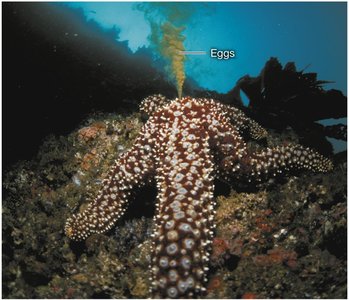
External fertilization occurs in aquatic environments, where gametes are released into the water.
Large numbers of gametes are produced.
Gametogenesis is often triggered by environmental cues.
Chemical messengers (pheromones) may coordinate gamete release.
Spawning: Selective, localized fertilization (e.g., frogs).
Broadcast fertilization: Non-selective, population-wide simultaneous release (e.g., sea urchins).
Internal Fertilization
Internal fertilization occurs in both terrestrial and aquatic animals, with sperm deposited directly or via spermatophore.
Common in terrestrial animals.
Spermatophore: Sperm packet left by male, picked up by female (e.g., salamanders).
Copulation: Direct sperm deposition (e.g., humans).
Sperm Competition
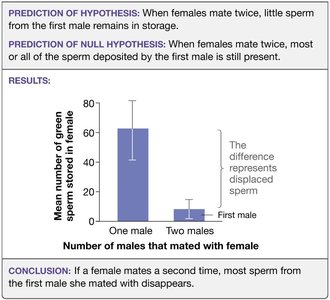
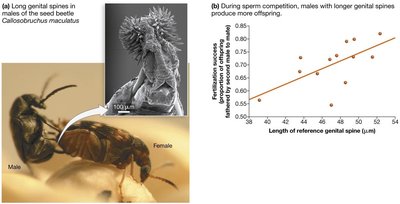
Sperm competition occurs when females mate with multiple males, leading to competition among sperm to fertilize eggs.
Sperm from later matings may displace earlier sperm (second-male advantage).
Males with larger testes produce more sperm, increasing fertilization odds.
Females may influence mate order or eject sperm from undesirable mates.
Reproductive Structures and Competition
Male genitalia structure varies among species, often shaped by sperm competition.
Genitalia shape can confer advantage in sperm competition.
Natural selection during sperm competition may explain diverse genitalia in spiders and insects.
Species identification in some spiders is based on genitalia shape.
Modes of Embryonic Development
Oviparity
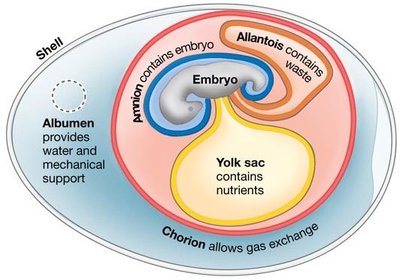
Oviparous animals lay eggs that develop externally, with either internal or external fertilization.
Birds and many reptiles are oviparous.
Amniotic eggs have four membranes: amnion, yolk sac, allantois, chorion.
These membranes provide protection, nutrients, waste management, and gas exchange.
Viviparity
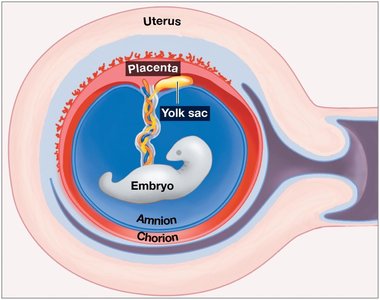
Viviparous animals develop embryos internally, with continuous exchange of materials between mother and embryo.
Most mammals are viviparous.
The placenta facilitates nutrient and waste exchange.
Ovoviviparity
Ovoviviparous animals develop embryos internally within a yolk-filled egg.
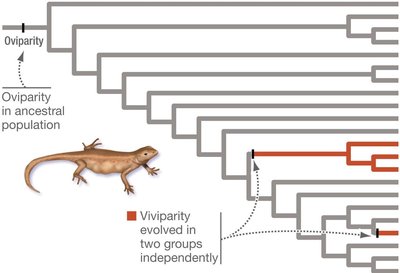
Developmental history shows fitness benefits and trade-offs.
Ovoviviparity evolved independently in some lizard groups, favored in cold habitats.
Human Reproductive Systems
Male Reproductive System and Spermatogenesis
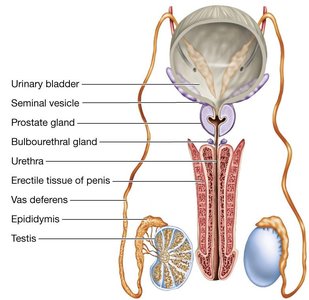
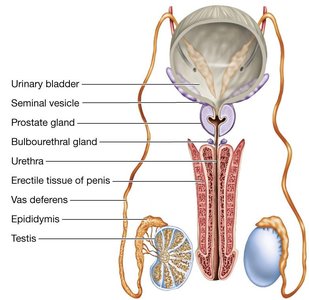
The male reproductive system produces and stores sperm, and facilitates ejaculation.
Spermatogenesis is continuous after puberty, producing millions of sperm daily.
Sperm mature in the epididymis and are stored until ejaculation.
Erection is driven by blood flow and pressure in erectile tissue.
Semen is formed in the ejaculatory duct, with contributions from seminal vesicles and prostate gland.
Female Reproductive System and Menstrual Cycle
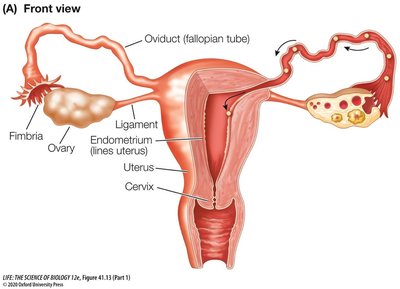
The female reproductive system produces eggs and supports fertilization and implantation.
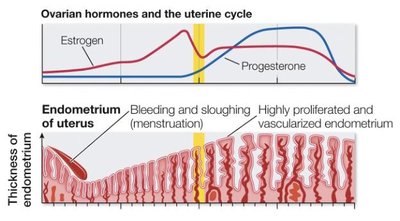
The menstrual cycle lasts ~28 days, with one oocyte released during ovulation.
The uterus prepares for implantation; if none occurs, the lining is shed (menstruation).
Day 1 of the cycle is the first day of menstruation.
Menstrual Cycle Phases
Follicular phase (Days 1-14): Oocyte develops within follicle, estrogen produced.
Ovulation (Day 14): Oocyte released due to luteinizing hormone spike.
Luteal phase (Days 15-28): Corpus luteum produces estrogen and progesterone; degenerates if no implantation.
Fertilization and Implantation in Humans
Fertilization
Fertilization requires viable egg and sperm within a narrow window.
Eggs survive 1-2 days after ovulation; sperm survive 2-3 days.
Fertilization occurs in the oviduct.
Implantation
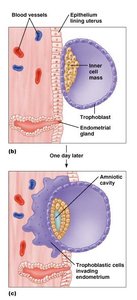
Embryo implants in the endometrium about one week after fertilization.
About half of fertilized eggs fail to implant.
Pregnancy and Placental Function
Placental Structure and Function
The placenta is essential for nutrient and waste exchange between mother and embryo.
Combines maternal and embryonic tissues.
Maintains hormone levels necessary for pregnancy.
Hormonal Regulation During Pregnancy
Estrogen and progesterone levels rise to maintain the endometrial layer and promote uterine muscle development.
Hormones inhibit uterine contractions until full term and promote breast development.
Loss of placenta at birth results in a drop in maternal hormone levels.
