 Back
Animal Segmentation: Structure, Function, and Evolutionary Significance
Study Guide - Smart Notes
 Tailored notes based on your materials, expanded with key definitions, examples, and context.
Segmentation in Animals
Definition of Segmentation
Segmentation, also known as metamerism, refers to the serial repetition of similar body segments along the longitudinal axis of an animal's body. This structural organization is a key evolutionary feature in several major animal phyla.
Key Term: Metamere or somite – an individual segment in a segmented animal.
Key Point: Both external and internal structures are often segmented, with repetition of organs such as muscles, nerves, and locomotory structures.
Exception: The gut and anterior nervous organs (e.g., brain, sense organs) are usually not segmented.
Examples of Segmentation
True metamerism is found in three major animal phyla:
Annelida: Segmented worms such as earthworms.
Arthropoda: Includes insects, crustaceans, and arachnids. Segmentation is closely related phylogenetically to annelids.
Chordata: Includes vertebrates such as humans. Segmentation arose independently in this group.
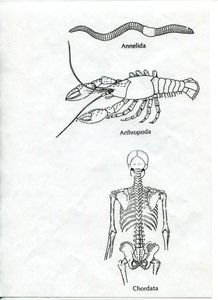
Structure of Segmented Animals
Each segment (metamere/somite) may contain repeated organs and structures.
Some segments may have specialized functions, such as reproductive organs or locomotory appendages.
In some groups, segments are highly modified (e.g., arthropod mouthparts, legs, wings).
Function of Segmentation
Segmentation allows for greater flexibility and complexity in animal movement and function:
Muscles in one segment can function independently from those in other segments, allowing for localized movement (e.g., "jack hammering" in annelids).
This independence requires a sophisticated nervous system for coordination.
Segments can be specialized for different functions, increasing efficiency and adaptability.
Evolutionary Significance of Segmentation
Segmentation enables the independence of body regions, rather than the whole body acting as a single unit.
High nervous control in each segment allows for complex behaviors and adaptations.
Leads to evolutionary innovations, such as the modification of segments in arthropods (e.g., development of specialized appendages) and the sophisticated body plans of chordates.
Summary Table: Segmentation in Major Animal Phyla
Phylum | Example Organisms | Segmentation Features |
|---|---|---|
Annelida | Earthworms, leeches | External and internal segments, repeated organs |
Arthropoda | Insects, crustaceans, spiders | Segmented body, specialized appendages |
Chordata | Vertebrates (e.g., humans, fish) | Segmented vertebral column, muscle blocks (myomeres) |
Additional info: Segmentation is a major evolutionary innovation that has contributed to the diversity and adaptability of animal life. It is a key topic in understanding animal form and function, as well as evolutionary biology.
