 Back
BackAP Biology Unit 5: Heredity – Meiosis, Mendelian & Non-Mendelian Genetics, and Chromosomal Genetics
Study Guide - Smart Notes
 Tailored notes based on your materials, expanded with key definitions, examples, and context.
Topic 1: Meiosis
Introduction to Meiosis
Meiosis is a specialized type of cell division that reduces the chromosome number by half, resulting in the formation of gametes (sperm and egg cells) in animals and spores in plants. This process is essential for sexual reproduction and ensures genetic continuity across generations.
Transmission of Chromosomes: Meiosis ensures that offspring inherit one set of chromosomes from each parent, maintaining a constant chromosome number in a species.
Phases of Meiosis: Meiosis consists of two sequential divisions: Meiosis I (reductional division) and Meiosis II (equational division).
Genetic Diversity: Genetic variation is introduced through crossing over, independent assortment, and random fertilization.
Key Events and Outcomes of Meiosis
Chromosome Number: Meiosis produces four non-identical daughter cells, each with half the chromosome number of the original cell (haploid, n).
Comparison with Mitosis: Mitosis produces two genetically identical diploid cells, while meiosis produces four genetically diverse haploid cells.
Segregation: Homologous chromosomes separate during Anaphase I, ensuring each gamete receives only one chromosome from each pair.
Crossing Over: Exchange of genetic material between homologous chromosomes during Prophase I increases genetic diversity.
Independent Assortment: Random orientation of homologous pairs during Metaphase I leads to varied combinations of chromosomes in gametes.
Example: In humans, meiosis reduces the chromosome number from 46 (diploid) to 23 (haploid) in gametes.
Additional info: Random fertilization further increases genetic variation by combining gametes from two different individuals.
Topic 2: Mendelian & Non-Mendelian Genetics
Mendelian Genetics
Mendelian genetics describes the inheritance patterns of traits controlled by single genes with clear dominant and recessive alleles, as first demonstrated by Gregor Mendel in pea plants.
Common Ancestry: Shared genetic mechanisms support the concept of common ancestry among all organisms.
Mendel’s Laws:
Law of Segregation: Each individual has two alleles for each gene, which segregate during gamete formation.
Law of Independent Assortment: Genes on different chromosomes assort independently during gamete formation.
Probability in Genetics: The rules of probability (addition and multiplication) are used to predict inheritance patterns (e.g., Punnett squares).
Example: A monohybrid cross between two heterozygotes (Aa x Aa) yields a 3:1 phenotypic ratio in the offspring.
Non-Mendelian Genetics
Deviations from Mendel: Some traits do not follow simple dominant-recessive inheritance, such as incomplete dominance, codominance, and polygenic inheritance.
Environmental Influence: The same genotype can produce different phenotypes in different environments (phenotypic plasticity).
Non-Nuclear Inheritance: Traits can also be inherited through mitochondrial or chloroplast DNA.
Human Genetic Disorders: Examples include cystic fibrosis (autosomal recessive), sickle cell disease (autosomal recessive), and Huntington’s disease (autosomal dominant).
Example: In incomplete dominance, crossing red and white snapdragons produces pink offspring.
Additional info: Polygenic traits, such as skin color, are influenced by multiple genes and show continuous variation.
Topic 3: Chromosomal Genetics
Chromosomal Basis of Inheritance
Chromosomal genetics explores how genes are arranged on chromosomes and how chromosomal behavior during meiosis leads to genetic variation and inheritance patterns.
Genetic Variation: Segregation, independent assortment, and fertilization contribute to genetic diversity in populations.
Model Organisms: Fruit flies (Drosophila melanogaster) have been instrumental in studying chromosomal inheritance.
Sex-Linked Genes: Genes located on sex chromosomes (X or Y) show unique inheritance patterns, often revealed through pedigree analysis.
Gene Linkage: Genes located close together on the same chromosome tend to be inherited together, but crossing over can separate them.
Linkage Maps: Recombination frequencies are used to construct genetic maps showing the relative positions of genes on a chromosome.
Statistical Analysis: Chi-squared tests are used to compare observed and expected phenotypic ratios to determine if inheritance follows predicted patterns.
Chromosomal Disorders: Changes in chromosome number or structure can cause genetic disorders, such as Down syndrome (Trisomy 21) due to nondisjunction.
Example: A cross involving sex-linked traits can be analyzed using a pedigree chart to determine the mode of inheritance.
Inheritance Pattern | Key Features | Example |
|---|---|---|
Autosomal Dominant | Trait appears in every generation; affected individuals have at least one affected parent | Huntington's disease |
Autosomal Recessive | Trait can skip generations; affected individuals may have unaffected parents | Cystic fibrosis, Sickle cell disease |
Sex-Linked (X-linked) | More common in males; affected sons inherit from carrier mothers | Hemophilia, Color blindness |
Chromosomal Abnormality | Caused by changes in chromosome number or structure | Down syndrome (Trisomy 21) |
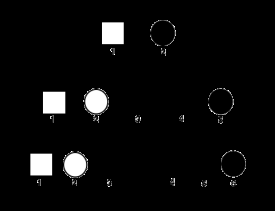
Additional info: Pedigree analysis is a key tool in human genetics for tracing inheritance patterns and predicting the likelihood of genetic disorders in offspring.
