 Back
AP Biology Unit 7: Natural Selection, Evolution, and Phylogeny Study Guide
Study Guide - Smart Notes
 Tailored notes based on your materials, expanded with key definitions, examples, and context.
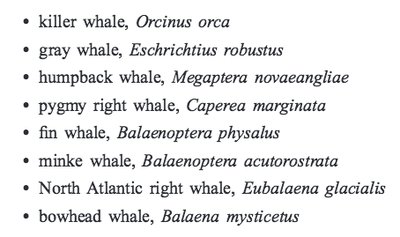
Q1. Which whales are most closely related? Provide evidence for your answer. (26.1)
Background
Topic: Phylogeny and Systematics
This question tests your understanding of how evolutionary relationships among species are determined using phylogenetic evidence, such as genetic data or morphological traits.
Key Terms and Concepts:
Phylogeny: The evolutionary history and relationships among species.
Systematics: The scientific study of classifying organisms and determining their evolutionary relationships.
Evidence: Can include DNA sequence similarity, anatomical features, and fossil records.
Step-by-Step Guidance
Review the list of whale species provided. Consider what types of evidence (such as genetic similarity or anatomical features) are commonly used to determine relatedness.
Think about how scientists use phylogenetic trees to visualize relationships. Closely related species will share a more recent common ancestor.
Consider what evidence would support close relationships: for example, similar DNA sequences or shared derived traits.
Identify which species are grouped together based on the evidence provided (such as genetic or morphological data).
Try solving on your own before revealing the answer!
Final Answer:
The most closely related whales are those that share the most recent common ancestor based on genetic evidence. For example, the North Atlantic right whale and the bowhead whale are closely related, as are the fin whale and the minke whale. This is supported by DNA sequence comparisons and phylogenetic analyses.
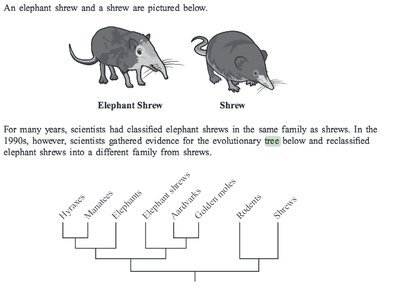
Q2. Describe the most likely reason why scientists originally classified elephant shrews with shrews. (26.2)
Background
Topic: Classification and Phylogenetic Trees
This question explores how early classification was based on observable traits, and how modern phylogenetic analysis can change our understanding of evolutionary relationships.
Key Terms:
Phylogenetic tree: Diagram showing evolutionary relationships.
Morphology: Physical appearance and structure.
Convergent evolution: When unrelated species evolve similar traits.
Step-by-Step Guidance
Consider what characteristics scientists used before genetic analysis was available. Early classification often relied on physical similarities.
Think about how convergent evolution can lead to similar appearances in unrelated species.
Review the phylogenetic tree provided and note the placement of elephant shrews relative to shrews.
Reflect on how new evidence (such as genetic data) can lead to reclassification.
Try solving on your own before revealing the answer!
Final Answer:
Scientists originally classified elephant shrews with shrews because they share similar morphological traits, such as body shape and size. However, genetic evidence revealed that elephant shrews are more closely related to other groups, leading to their reclassification.
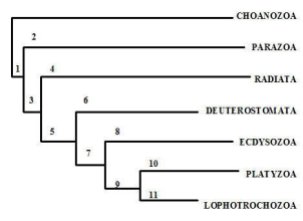
Q3. Identify the following as a clade (monophyletic group), paraphyletic group, or polyphyletic group. (26.3)
Background
Topic: Cladistics and Phylogenetic Classification
This question tests your ability to distinguish between different types of groups in a phylogenetic tree: clade (monophyletic), paraphyletic, and polyphyletic.
Key Terms:
Clade (monophyletic): Group consisting of an ancestor and all its descendants.
Paraphyletic: Group consisting of an ancestor and some, but not all, of its descendants.
Polyphyletic: Group consisting of members with different ancestors.
Step-by-Step Guidance
Examine the phylogenetic tree and locate the groups listed in the question.
Determine if each group includes all descendants of a common ancestor (monophyletic), only some descendants (paraphyletic), or members from different ancestors (polyphyletic).
Apply the definitions to each group: choanozoa, parazoa, radiata; platyzoa, lophotrochozoa; deuterostomata, platyzoa.
Identify the number representing the common ancestor of all organisms on the tree.
Try solving on your own before revealing the answer!
Final Answer:
i. Choanozoa, Parazoa, Radiata: Paraphyletic group ii. Platyzoa, Lophotrochozoa: Monophyletic group (clade) iii. Deuterostomata, Platyzoa: Polyphyletic group The number representing the common ancestor of all organisms on this tree is 1.
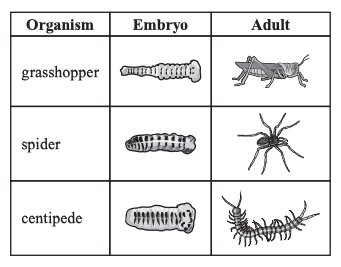
Q4. What conclusion can be drawn from the evidence that these organisms have similar embryos? (22.3)
Background
Topic: Comparative Embryology and Evolution
This question examines how similarities in embryonic development among different organisms provide evidence for common ancestry and evolutionary relationships.
Key Terms:
Comparative embryology: Study of similarities and differences in embryo development.
Homology: Similarity due to shared ancestry.
Step-by-Step Guidance
Observe the images of the embryos and adults of grasshopper, spider, and centipede.
Note the similarities in embryonic stages despite differences in adult forms.
Consider what these similarities suggest about evolutionary relationships.
Think about how embryonic homologies are used as evidence for common ancestry.
Try solving on your own before revealing the answer!
Final Answer:
The conclusion is that these organisms share a common ancestor, as evidenced by their similar embryonic development. This supports the idea that evolutionary relationships can be inferred from embryological similarities.
