 Back
BackAP Biology Unit 8: Ecology – Study Notes
Study Guide - Smart Notes
 Tailored notes based on your materials, expanded with key definitions, examples, and context.
Responses to the Environment
Behavioral and Physiological Responses
Organisms must constantly respond to changes in their internal and external environments to survive, grow, and reproduce. These responses can be behavioral (actions taken by the organism) or physiological (internal processes).
Behavioral responses include migration, hibernation, and changes in feeding or mating habits in response to environmental cues.
Physiological responses involve internal adjustments, such as sweating to cool down or shivering to generate heat.
Organisms exchange information with each other, which can alter their behavior and affect survival and reproduction.
Example: Birds migrating in response to seasonal changes in temperature and food availability.
Communication and Fitness
Communication among organisms is essential for survival and reproductive success. It can occur through various signaling mechanisms:
Visual signals (e.g., coloration, displays)
Audible signals (e.g., bird songs, insect calls)
Tactile signals (e.g., touch, vibrations)
Electrical signals (e.g., electric fish)
Chemical signals (e.g., pheromones)
These behaviors can influence dominance, territory establishment, mate selection, and cooperative behaviors, all of which impact the fitness of individuals and populations.
Additional info: Natural selection favors both innate (genetically programmed) and learned behaviors that enhance survival and reproductive success.
Energy Flow Through Ecosystems
Energy Acquisition and Use
Living systems require a constant input of energy to maintain organization, grow, and reproduce. Organisms have evolved various strategies to acquire and use energy:
Endotherms (e.g., mammals, birds) use metabolic heat to maintain a stable body temperature.
Ectotherms (e.g., reptiles, amphibians) rely on external sources of heat and may regulate temperature behaviorally.
Reproductive strategies and metabolic rates are influenced by energy availability.
Smaller organisms generally have higher metabolic rates per unit body mass than larger organisms.
A net gain of energy leads to growth and storage, while a net loss results in loss of mass and potentially death.
Energy Availability and Ecosystem Dynamics
Changes in energy availability can affect population sizes and disrupt ecosystem structure. For example, a decrease in sunlight can reduce the number of producers, impacting all higher trophic levels.
Energy flows from autotrophs (organisms that capture energy from the environment) to heterotrophs (organisms that consume other organisms).
Photosynthetic organisms use sunlight, while chemosynthetic organisms use inorganic molecules for energy.
Heterotrophs metabolize carbohydrates, lipids, and proteins for energy.
Population & Community Ecology
Population Growth Dynamics
Population growth is influenced by birth and death rates, resource availability, and environmental factors. Several mathematical models describe population growth:
Population growth equation:
Exponential growth equation:
Logistic growth equation:
Where:
N = population size
B = number of births
D = number of deaths
rmax = maximum per capita growth rate
K = carrying capacity
As populations approach carrying capacity, growth slows due to limited resources (density-dependent factors).
Community Structure and Diversity
Communities are described by their species composition and diversity. Biodiversity can be quantified using indices such as Simpson's Diversity Index:
Species composition: The identity and abundance of species present.
Species diversity: A measure of both the number of species and their relative abundance.
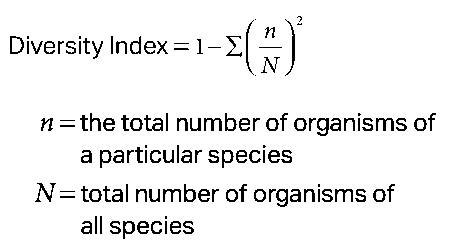
Simpson's Diversity Index:
n = total number of organisms of a particular species
N = total number of organisms of all species
This index ranges from 0 (no diversity) to 1 (infinite diversity).
Population Interactions and Community Structure
Interactions among populations, such as competition, predation, and symbiosis, shape community structure and dynamics:
Competition: Organisms vie for the same resources.
Predation: One organism consumes another.
Symbiosis: Includes mutualism (both benefit), commensalism (one benefits, one unaffected), and parasitism (one benefits, one harmed).
Cooperation can enhance access to resources and energy.
These interactions can lead to phenomena such as trophic cascades and niche partitioning.
Biodiversity & Disruptions to Ecosystems
Ecosystem Diversity and Resilience
Ecosystems with greater diversity are generally more resilient to environmental changes. Keystone species, producers, and essential abiotic and biotic factors help maintain ecosystem stability.
Low-diversity ecosystems are more vulnerable to disturbances.
Keystone species have a disproportionately large effect on ecosystem structure relative to their abundance.
Effects of Component Changes
The addition or removal of species or other components can alter ecosystem structure in both the short and long term. The loss of a keystone species can lead to ecosystem collapse.
Adaptations and Variations
Genetic variations (adaptations) that confer advantages are favored by natural selection. Mutations are random and not directed by environmental pressures.
Invasive Species and Human Impact
Invasive species can exploit new niches, outcompete native species, and cause ecological changes. Human activities, such as introducing new diseases or altering habitats, accelerate ecosystem changes at local and global scales.
Geological and Meteorological Impacts
Geological and meteorological events (e.g., volcanic eruptions, storms) can change habitats and redistribute ecosystems. Biogeographical studies help illustrate these changes.
