 Back
Atomic Structure and Chemical Bonding: Foundations for Biology
Study Guide - Smart Notes
 Tailored notes based on your materials, expanded with key definitions, examples, and context.
Atomic Structure and Chemical Bonding
Introduction
Understanding atomic structure and chemical bonding is essential for grasping the chemical context of life. The properties of elements, the organization of matter, and the interactions between atoms all underpin biological processes.
Key Terms and Concepts
Atom: The smallest unit of matter that retains the properties of an element.
Element: A substance that cannot be broken down into other substances by chemical means.
Subatomic particles: Protons (positive), neutrons (neutral), and electrons (negative).
Atomic Structure
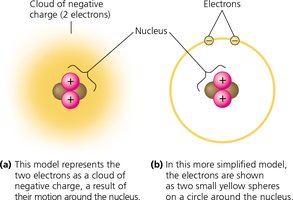
Atoms are composed of a central nucleus containing protons and neutrons, surrounded by a cloud of electrons. The arrangement and number of these subatomic particles determine the atom's identity and properties.
Nucleus: Contains protons and neutrons; responsible for most of the atom's mass.
Electrons: Form a negatively charged cloud around the nucleus and are involved in chemical bonding.
Atomic Number, Mass Number, and Isotopes
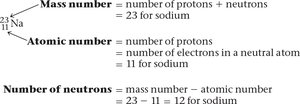
Atomic number (Z): Number of protons in the nucleus; unique to each element.
Mass number (A): Total number of protons and neutrons in the nucleus.
Number of neutrons: Calculated as mass number minus atomic number.
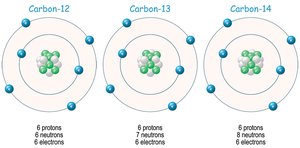
Isotopes: Atoms of the same element with different numbers of neutrons.
Radioactive Isotopes and Radiometric Dating
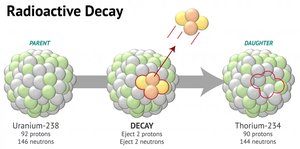
Some isotopes are unstable and undergo radioactive decay, transforming into different elements. This property is used in radiometric dating to determine the age of fossils and rocks.
Radioactive decay: The process by which an unstable atomic nucleus loses energy by emitting particles.
Half-life: The time required for half of the radioactive atoms in a sample to decay.
Electron Energy Levels and Shells
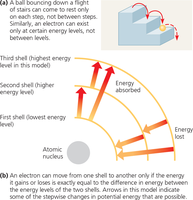
Electrons occupy specific energy levels or shells around the nucleus. The arrangement of electrons determines an atom's chemical behavior.
Potential energy: Energy possessed due to position or structure; electrons farther from the nucleus have higher potential energy.
Electron shells: Discrete energy levels where electrons reside; the first shell holds up to 2 electrons, the second up to 8, etc.
Valence shell: The outermost electron shell; determines chemical reactivity.
Electron Orbitals
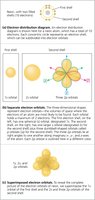
Orbitals are three-dimensional regions around the nucleus where electrons are likely to be found. Each orbital can hold up to two electrons.
s orbital: Spherical shape.
p orbital: Dumbbell-shaped; oriented along axes.
Chemical Bonds
Atoms form chemical bonds to achieve stable electron configurations, usually by filling their valence shells. The main types of bonds are covalent, ionic, and weak interactions.
Covalent Bonds
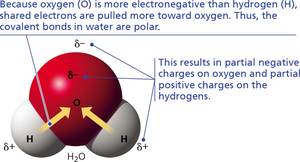
Covalent bond: Sharing of valence electrons between atoms; strongest type of bond in biological molecules.
Single bond: Sharing one pair of electrons.
Double bond: Sharing two pairs of electrons.
Electronegativity: The tendency of an atom to attract electrons in a covalent bond.
Polar covalent bond: Unequal sharing of electrons, leading to partial charges (e.g., in water).
Ionic Bonds
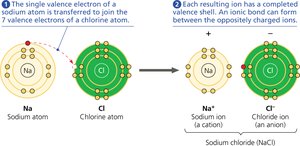
Ionic bond: Attraction between oppositely charged ions formed by electron transfer.
Cation: Positively charged ion (loss of electron).
Anion: Negatively charged ion (gain of electron).
Ionic compounds: Often form crystalline solids (e.g., NaCl).
Weak Chemical Interactions
Hydrogen bonds: Weak attraction between a hydrogen atom (covalently bonded to an electronegative atom) and another electronegative atom.
Van der Waals interactions: Weak attractions due to transient local partial charges.
Molecular Shape and Function
The three-dimensional shape of a molecule is crucial for its function in biological systems. Shape is determined by the positions of atoms' orbitals and the types of bonds formed.
Recognition and response: Molecular shape allows molecules to interact specifically with other molecules (e.g., enzyme-substrate binding).
Chemical Reactions
Chemical reactions involve the making and breaking of bonds, leading to changes in the composition of matter. Atoms are rearranged, but not created or destroyed.
Reactants: Starting materials in a reaction.
Products: Substances formed by the reaction.
Chemical equilibrium: The point at which forward and reverse reactions occur at the same rate; concentrations of reactants and products remain stable.
Example equation:
Summary Table: Atomic Structure and Bonding
Concept | Definition | Example |
|---|---|---|
Atomic Number (Z) | Number of protons in nucleus | Carbon: Z = 6 |
Mass Number (A) | Protons + Neutrons | Carbon-12: A = 12 |
Isotope | Atoms with same Z, different A | Carbon-12, Carbon-14 |
Covalent Bond | Electron sharing | H2O |
Ionic Bond | Electron transfer | NaCl |
Hydrogen Bond | Weak attraction involving H | Between water molecules |
Additional info: This guide expands on the provided notes with definitions, examples, and a summary table for clarity and exam preparation.
