 Back
BackAtomic Structure, Chemical Bonds, and Water: Foundations of Biological Chemistry
Study Guide - Smart Notes
 Tailored notes based on your materials, expanded with key definitions, examples, and context.
Atomic Structure and Electron Arrangement
Atomic Particles, Atomic Number, and Isotopes
The structure of atoms forms the basis for understanding chemical behavior in biological systems. Atoms are composed of three main subatomic particles: protons, neutrons, and electrons.
Atom: The basic unit of matter, consisting of a nucleus (protons and neutrons) and electrons in orbitals.
Proton: Positively charged particle found in the nucleus.
Neutron: Neutral particle found in the nucleus.
Electron: Negatively charged particle found in orbitals around the nucleus.
Atomic Number: The number of protons in an atom, which defines the element.
Isotope: Atoms of the same element with different numbers of neutrons, resulting in different atomic masses.
Atomic Weight (Mass Number): The sum of protons and neutrons in the nucleus.
Example: Carbon has three naturally occurring isotopes: Carbon-12 (6 protons, 6 neutrons), Carbon-13 (6 protons, 7 neutrons), and Carbon-14 (6 protons, 8 neutrons).
Energy Levels, Orbitals, and Stability
Electrons occupy specific energy levels (shells) and orbitals around the nucleus. The arrangement of electrons determines the chemical properties and reactivity of an atom.
Potential Energy: Stored energy due to position; electrons farther from the nucleus have higher potential energy.
Kinetic Energy: Energy of motion; electrons can move between energy levels by absorbing or releasing energy.
Quantum: The discrete amount of energy required to move an electron from one energy level to another.
Orbital: The region in space where an electron is likely to be found 90% of the time.
Stability: Atoms are most stable when their outermost energy level (valence shell) is full.
Electron Configuration:
Level 1: 1 orbital, holds 2 electrons
Level 2: 4 orbitals, holds 8 electrons
Level 3: 4 orbitals, holds 8 electrons
Common Atomic Numbers: H = 1, He = 2, Li = 3, C = 6, N = 7, O = 8, F = 9, Ne = 10, Na = 11
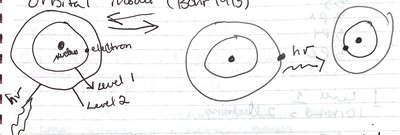
Image explanation: The diagram illustrates the Bohr model of the atom, showing electrons transitioning between energy levels by absorbing or emitting energy (hν).
Chemical Bonds, Polarity, and Water
Ionic and Covalent Bonding
Atoms form chemical bonds to achieve stable electron configurations. The main types of bonds in biological molecules are ionic and covalent bonds.
Bond Type | How It Forms | Electron Behavior | Example |
|---|---|---|---|
Ionic Bond | Attraction between oppositely charged ions | Electrons are transferred (gained or lost) | NaCl |
Nonpolar Covalent Bond | Atoms share electron pairs equally | Electrons shared equally | H2 |
Polar Covalent Bond | Atoms share electron pairs unequally | Electrons shared unequally | H2O |
Ion: An atom or molecule with a net electric charge due to the loss or gain of electrons.
Example: In NaCl, sodium (Na) loses an electron to become Na+, and chlorine (Cl) gains an electron to become Cl-.
Electronegativity, Partial Charge, and Hydrogen Bonding
Electronegativity differences between atoms in a molecule lead to partial charges and the formation of hydrogen bonds, which are critical for the properties of water.
Electronegativity: The ability of an atom to attract electrons in a covalent bond.
Partial Charges: Slight positive (δ+) or negative (δ-) charges that occur due to unequal sharing of electrons.
Hydrogen Bond: A weak attraction between a hydrogen atom with a partial positive charge and an electronegative atom (such as O or N) with a partial negative charge on another molecule.
Example: In water (H2O), oxygen is more electronegative than hydrogen, resulting in a partial negative charge on oxygen and partial positive charges on hydrogens. Hydrogen bonds form between water molecules.
Cohesion, Adhesion, Temperature, and Heat
Water's unique properties arise from hydrogen bonding, which is essential for life.
Cohesion: Attraction between molecules of the same substance (responsible for surface tension in water).
Adhesion: Attraction between different substances (e.g., water and glass).
Temperature: Measure of the average kinetic energy of molecules.
Heat: Total kinetic energy of all molecules in a substance.
Specific Heat: The amount of heat required to raise the temperature of 1 g of a substance by 1°C.
Heat of Vaporization: The amount of heat required to convert 1 g of a liquid to gas at boiling point.
Heat of Fusion: The amount of heat removed from 1 g of liquid at freezing point to solidify it.
Example: Water has a high specific heat and heat of vaporization, which helps moderate Earth's climate.
Water Ionization, Acids, Bases, and pH
Ionization of Water and Ion Product
Water can ionize to form hydronium (H3O+) and hydroxide (OH-) ions, which is fundamental to acid-base chemistry in biology.
Ionization Reaction:
Hydronium Ion (H3O+): Formed when a water molecule accepts a proton.
Hydrogen Ion (H+): A proton; often used interchangeably with H3O+ in biological contexts.
Ion Product of Water: at 25°C
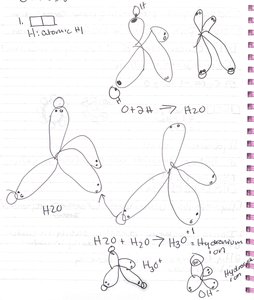
Image explanation: The diagram shows the formation of hydronium and hydroxide ions from water molecules, illustrating proton transfer and hydrogen bonding.
Acids, Bases, and pH
Acids and bases alter the concentration of hydrogen and hydroxide ions in solution, affecting pH.
Acid: Substance that increases the hydrogen ion concentration in solution (e.g., HCl).
Base: Substance that increases the hydroxide ion concentration in solution (e.g., NaOH).
pH: A measure of hydrogen ion concentration;
Neutral Solution: M; pH = 7
Acidic Solution: pH < 7
Basic Solution: pH > 7
Example: A solution with pH 6 has ten times more hydrogen ions than a solution with pH 7.
Organic Chemistry and Hydrocarbons
Hydrocarbons, Chains, and Rings
Hydrocarbons are organic molecules consisting entirely of carbon and hydrogen. They can form straight chains or rings, which serve as the backbone for more complex biological molecules.
Hydrocarbon: Molecule containing only carbon and hydrogen (e.g., methane, ethane).
Chain Hydrocarbon: Carbon atoms joined in a straight or branched line (e.g., butane, hexane).
Ring Hydrocarbon: Carbon atoms form a closed ring (e.g., cyclohexane).
Line-Angle Representation: A shorthand for drawing carbon skeletons; each vertex represents a carbon atom.
Example: Methane (CH4), ethane (C2H6), cyclohexane (C6H12).
Functional Groups and Organic Reactions
Functional groups are specific groups of atoms within molecules that determine the chemical properties and reactions of organic compounds.
Functional Group | Structure/Pattern | Example |
|---|---|---|
Alcohol | -OH group | Methyl alcohol (methanol), ethyl alcohol (ethanol) |
Carboxylic Acid | -COOH group | Acetic acid (vinegar), butyric acid |
Aldehyde | Carbonyl at chain end | Formaldehyde |
Ketone | Carbonyl within chain | Acetone |
Amine | -NH2 group | Methylamine |
Phosphate | -PO4 group | Phosphoric acid |
Example: Carboxylic acids release protons in solution, acting as acids; amines accept protons, acting as bases.
Additional info: These foundational concepts are essential for understanding the chemical basis of life, including the structure and function of biological macromolecules, cellular processes, and metabolic pathways.
