 Back
Atomic Symbols, Isotopes, and Subatomic Particles Study Guidance
Study Guide - Smart Notes
 Tailored notes based on your materials, expanded with key definitions, examples, and context.
Q1. An atom of element X contains 47 protons and 62 neutrons. Identify the element, and write the symbol for the isotope in the standard format. Express your answer as an isotope.
Background
Topic: Atomic and Isotope Symbols
This question tests your understanding of how to identify elements based on their number of protons (atomic number), and how to write isotope symbols using the number of protons and neutrons.
Key Terms and Formulas
Atomic Number (Z): Number of protons in the nucleus; determines the element.
Mass Number (A): Total number of protons and neutrons in the nucleus.
Isotope Symbol:
Step-by-Step Guidance
Find the atomic number (Z) by counting the protons. Here, .
Use a periodic table to identify which element has atomic number 47.
Calculate the mass number (A) by adding protons and neutrons: .
Write the isotope symbol in the standard format: .
Try solving on your own before revealing the answer!
Final Answer:
The element with atomic number 47 is silver (Ag). The mass number is . The isotope symbol is .
This notation shows the mass number (109) as the superscript and the atomic number (47) as the subscript, followed by the element symbol (Ag).
Q2. Specify the number of protons, neutrons, and electrons in the neutral atom copper-64. Enter your answers as integers separated by commas.
Background
Topic: Isotopes and Subatomic Particles
This question tests your ability to determine the number of protons, neutrons, and electrons in a neutral atom of a specific isotope.
Key Terms and Formulas
Protons: Equal to the atomic number (Z) of the element.
Neutrons:
Electrons: In a neutral atom, electrons = protons.
Step-by-Step Guidance
Identify the atomic number (Z) for copper (Cu) using the periodic table.
The mass number (A) is given as 64.
Calculate the number of neutrons: .
For a neutral atom, the number of electrons equals the number of protons.
Try solving on your own before revealing the answer!
Final Answer: 29, 35, 29
Copper has atomic number 29, so it has 29 protons and 29 electrons. The number of neutrons is . The answer is: 29 protons, 35 neutrons, 29 electrons.
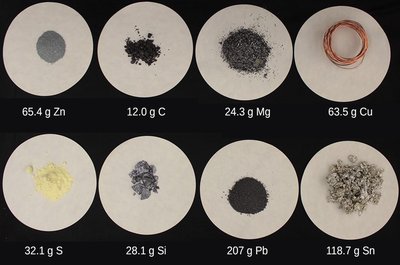
Q3. The image below shows samples of different elements with their masses. What concept does this image illustrate, and how does it relate to the mole?
Background
Topic: The Mole and Molar Mass
This question is about understanding the mole concept and how the mass of one mole of different elements relates to their atomic mass and molar mass.
Key Terms and Formulas
Mole: A unit representing particles (Avogadro's number).
Molar Mass: The mass of one mole of an element, typically in grams per mole (g/mol).
Atomic Mass: The average mass of an atom of an element, usually in atomic mass units (amu).
Step-by-Step Guidance
Observe that each sample shows a different element and a specific mass.
Note that the mass shown for each element corresponds to its molar mass (the mass of one mole of that element).
Understand that one mole of each element contains the same number of atoms (Avogadro's number), but the mass differs because each element has a different atomic mass.
Relate this to the concept that the molar mass (in grams) is numerically equal to the atomic mass (in amu) for each element.
Try solving on your own before revealing the answer!
Final Answer:
This image illustrates the concept of the mole and molar mass. Each sample shows the mass of one mole of a different element, demonstrating that one mole of any element contains the same number of atoms (Avogadro's number), but the mass varies according to the element's atomic mass.
