 Back
Atoms, Atomic Structure, and the Periodic Table: Foundations for Biology
Study Guide - Smart Notes
 Tailored notes based on your materials, expanded with key definitions, examples, and context.
Chapter 2: The Chemical Context of Life
Introduction to Atomic Structure
Understanding the structure of atoms is fundamental to biology and chemistry. Atoms are the basic units of matter, composed of subatomic particles that determine their chemical properties and behavior.
Atom: The smallest unit of an element that retains its chemical properties.
Subatomic particles: Protons (positive charge), neutrons (neutral), and electrons (negative charge).
Atomic mass unit (u): Defined as 1/12 the mass of a carbon-12 atom; 1 u = 1.66054 × 10⁻²⁷ kg.
Discovery of Subatomic Particles
By the mid-1800s, the existence of atoms was widely accepted, but their internal structure was unknown. Key experiments led to the discovery of subatomic particles:
J.J. Thomson's Cathode Ray Tube Experiment: Discovered the electron, a negatively charged particle with negligible mass (9.109 × 10⁻³¹ kg).
Models of the Atom
Early models of the atom attempted to explain the arrangement of subatomic particles:
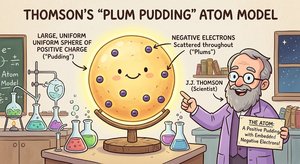
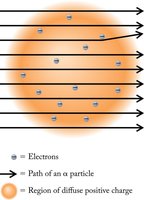
Plum Pudding Model: Proposed by J.J. Thomson, this model depicted the atom as a sphere of positive charge with embedded electrons.
Rutherford's Gold Foil Experiment
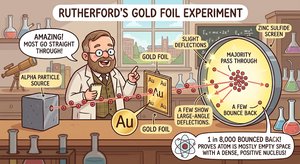
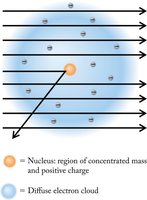
Ernest Rutherford tested the plum pudding model by bombarding gold foil with alpha particles. Most particles passed through, but some were deflected, indicating a dense, positively charged nucleus.
Nuclear Model: Atoms consist of a small, dense nucleus containing protons and neutrons, surrounded by electrons.
Atomic Composition and Isotopes
The identity of an element is determined by its number of protons. Variations in neutron number produce isotopes:
Isotopes: Atoms of the same element with different numbers of neutrons, resulting in different masses.
Nuclide: Any atom with a specific number of protons and neutrons.
Example: Neon has isotopes with mass numbers 20 u and 22 u.
Calculating Atomic Mass
The atomic mass of an element is a weighted average based on the natural abundance of its isotopes. This explains why atomic masses on the periodic table are not whole numbers.
Natural abundance: The percentage of each isotope found in nature.
The Periodic Table: Organization and Trends
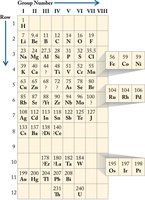
The periodic table organizes elements by increasing atomic number and groups elements with similar properties together.
Mendeleev's Table (1869): Arranged by atomic mass and predicted properties of undiscovered elements.
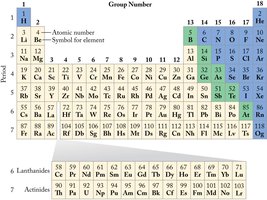
Modern Periodic Table: Arranged by atomic number. Periods are horizontal rows; groups (families) are vertical columns.
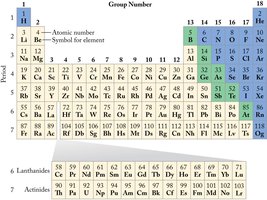
Categories of Elements
Metals: Shiny, solid, good conductors, malleable, ductile (except mercury, which is liquid).
Nonmetals: Can be solids, liquids, or gases; poor conductors.
Metalloids: Properties intermediate between metals and nonmetals; semiconductors.
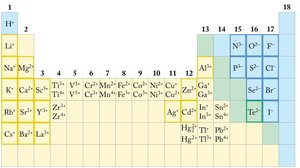
Periodic Trends in Charges of Monatomic Ions
Elements tend to form ions with characteristic charges, depending on their group in the periodic table.
Cations: Positively charged ions (typically metals).
Anions: Negatively charged ions (typically nonmetals).

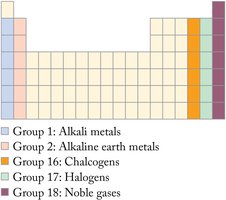
Commonly Used Names of Groups
Groups (columns) in the periodic table have specific names and similar chemical properties:
Group Number | Group Name |
|---|---|
1 | Alkali metals |
2 | Alkaline earth metals |
16 | Chalcogens |
17 | Halogens |
18 | Noble gases |
The Mole: Connecting the Atomic and Macroscopic Worlds
Because atoms are extremely small, chemists use the mole to count large numbers of particles. The mole links atomic scale measurements to laboratory quantities.
Mole (mol): The SI unit for the amount of substance; 1 mol = 6.02214076 × 10²³ entities (Avogadro's constant).
Example: 1 mol of gold contains 6.02214076 × 10²³ atoms.
Conversions: Moles, Mass, and Number of Particles
To relate the mass of a substance to the number of atoms or molecules, use the following relationships:
Molar mass: The mass of one mole of a substance (g/mol).
Conversion:
Number of particles:
Practice Example
Which of the following has the most mass?
1 mol of H2O
1 mol of N2
1 mol of CH4
Answer: 1 mol of H2O has the greatest mass because its molar mass is higher than that of N2 or CH4.
Summary Table: Subatomic Particles
Particle | Symbol | Charge | Mass (kg) |
|---|---|---|---|
Proton | p+ | +1 | 1.67262 × 10⁻²⁷ |
Neutron | n0 | 0 | 1.67493 × 10⁻²⁷ |
Electron | e- | -1 | 9.10938 × 10⁻³¹ |
Additional info: This chapter provides foundational knowledge for understanding the chemical basis of life, which is essential for all biological processes.
