 Back
Atoms, Biomolecules, and Chemical Bonds: Foundations of Life
Study Guide - Smart Notes
 Tailored notes based on your materials, expanded with key definitions, examples, and context.
Introduction to Biology
Defining Life and Its Components
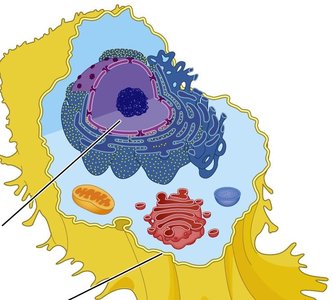
Life is defined by a set of characteristics, including organization, metabolism, growth, adaptation, response to stimuli, and reproduction. Cells are the fundamental units of life, and all living organisms are composed of one or more cells. - Living organisms exhibit complex organization and are capable of maintaining homeostasis. - Cells are the basic structural and functional units of life. - Biomolecules (lipids, nucleic acids, proteins, carbohydrates) are essential for cellular structure and function. 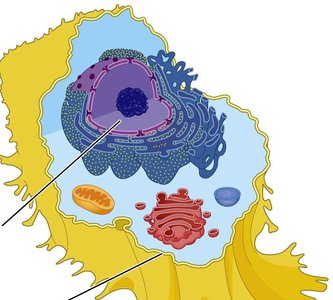
Chemistry
Elements and Atoms
All matter is composed of elements, which are made up of atoms. Atoms consist of a nucleus (containing protons and neutrons) and electron shells. - Atomic number is the number of protons and defines the element. - Electron shells surround the nucleus and hold electrons; the arrangement of electrons determines chemical properties. 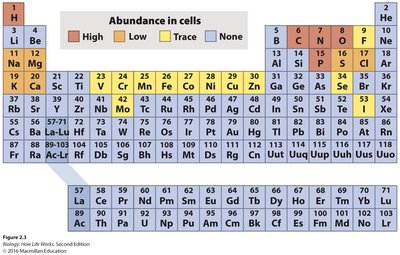
Abundance of Elements in Cells
Not all elements are equally abundant in living cells. The most common elements are hydrogen (H), carbon (C), nitrogen (N), and oxygen (O). - High abundance: H, C, N, O, P, S - Low/trace abundance: Na, Mg, K, Ca, Fe, Zn, etc. 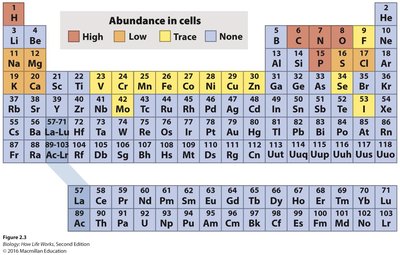
Biomolecules
Types and Roles
Biomolecules are organic compounds that play critical roles in supporting life. - Lipids: Energy storage, membrane structure - Nucleic acids: Information storage (DNA, RNA) - Proteins: Enzymes, structural support, signaling - Carbohydrates: Energy, cell structure 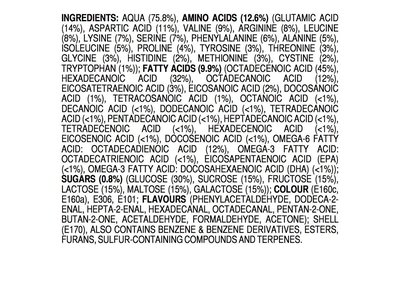
Biomolecule Composition
Biomolecules are composed of specific elements and functional groups. For example, proteins are made of amino acids, which contain C, H, O, N, and sometimes S. Lipids are primarily composed of C, H, and O. Nucleic acids contain C, H, O, N, and P. 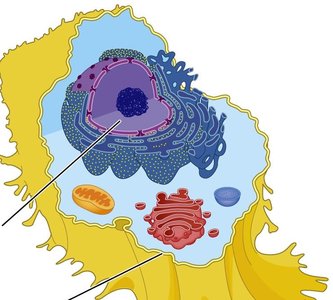
Atoms and Electron Shells
Structure of Atoms
Atoms consist of a nucleus (protons and neutrons) and electrons arranged in shells. The first shell holds up to 2 electrons, the second up to 8. - Valence electrons are in the outermost shell and determine chemical reactivity. 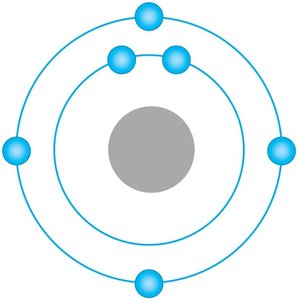
Stability and Chemical Bonds
Atoms are most stable when their valence shell is full. Atoms with incomplete shells interact to achieve stability, forming chemical bonds. - Covalent bonds: Sharing of electron pairs - Ionic bonds: Transfer of electrons - Hydrogen bonds: Attraction between partial charges 
Chemical Bonds
Covalent Bonding
Covalent bonds involve the sharing of electron pairs between atoms. The number of bonds an atom can form depends on the number of electrons needed to fill its valence shell. - HONC rule: Hydrogen (1 bond), Oxygen (2 bonds), Nitrogen (3 bonds), Carbon (4 bonds) 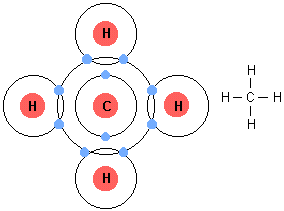
Phosphorus Bonding
Phosphorus can form three or five covalent bonds, depending on its chemical environment. This is important in biological molecules like ATP and nucleic acids. 
Types of Chemical Bonds
Polar and Non-Polar Covalent Bonds
- Non-polar covalent bonds: Electrons are shared equally; no charge difference. Example: H2 molecule.  - Polar covalent bonds: Electrons are shared unequally, resulting in partial charges (δ+ and δ-). Example: H2O molecule.

Ionic Bonds
Ionic bonds involve the transfer of electrons from one atom to another, resulting in full positive and negative charges. Example: NaCl (sodium chloride). 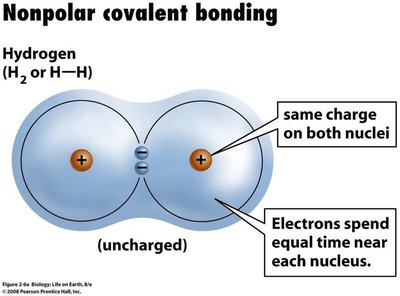
Electronegativity and Bond Type
Electronegativity
Electronegativity is the ability of an atom to attract shared electrons. Oxygen and nitrogen are highly electronegative, leading to polar bonds when paired with less electronegative atoms. - Bond type is determined by the difference in electronegativity: - Small difference: Non-polar covalent - Moderate difference: Polar covalent - Large difference: Ionic 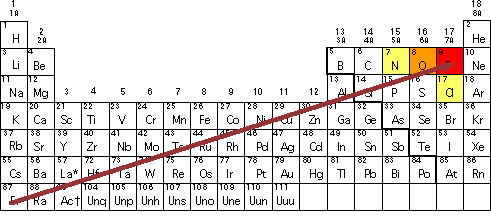
Bond Type Examples
For HCl, the difference in electronegativity (Cl = 3.0, H = 2.1) is 0.9, resulting in a polar covalent bond. 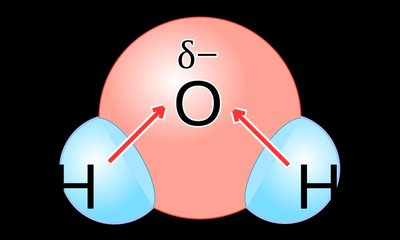
Summary Table: Types of Chemical Bonds
Bond Type | Electron Sharing | Charge Difference | Example |
|---|---|---|---|
Non-polar covalent | Equal | None | H2, C-C |
Polar covalent | Unequal | Partial (δ+ / δ-) | H2O, HCl |
Ionic | Transfer | Full (+/-) | NaCl |
Fundamental Concepts
Importance of Chemical Bonds in Biology
Atoms interact via bonds to form molecules, which are essential for the structure and function of biomolecules. The polarity and chemical properties of biomolecules impart functional capabilities necessary for life. - Biomolecules have polarity due to differences in electronegativity. - Chemical bonds are crucial for biological structure and function.
Key Equations
Electron Shell Capacity
Electronegativity Difference
Atomic Number
HONC Rule
Bond Type Determination
Example Applications
Biomolecule Structure
Proteins, nucleic acids, lipids, and carbohydrates are built from atoms bonded in specific ways, imparting unique properties and functions.
Cellular Function
The chemical properties of biomolecules, such as polarity and charge, affect their roles in cell structure, metabolism, and signaling. Additional info: Context was inferred for some diagrams and tables to ensure completeness and clarity for exam preparation.
