 Back
Atoms, Elements, and Chemical Bonds: Foundations of Biological Chemistry
Study Guide - Smart Notes
 Tailored notes based on your materials, expanded with key definitions, examples, and context.
Relationship Between Elements, Atoms, Molecules, and Compounds
Basic Concepts of Matter
Matter is anything that takes up space and has mass. All organisms are composed of matter, which is made up of chemical elements in pure form or in combinations called compounds.
Element: A substance that cannot be broken down to other substances by chemical reactions. Each element consists of similar atoms.
Atom: The basic unit of matter, retaining the properties of an element.
Molecule: Two or more atoms held together by chemical bonds.
Compound: A substance consisting of two or more elements in a fixed ratio, with properties different from its constituent elements.
Example: O2 is an element (molecule of two oxygen atoms), while H2O is a compound (hydrogen and oxygen in a fixed ratio).
The Elements of Life
Essential and Trace Elements
Of the 92 naturally occurring elements, about 20–25% are essential for life. Four elements—carbon, hydrogen, oxygen, and nitrogen—make up about 96% of living matter. Most of the remaining 4% consists of calcium, phosphorus, potassium, and sulfur. Trace elements are required in minute quantities.
Atomic Structure
Subatomic Particles
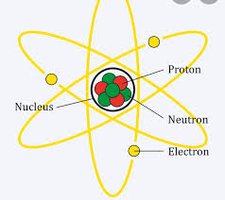
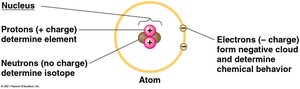
Atoms are composed of three main subatomic particles:
Protons: Positively charged particles found in the nucleus; determine the element.
Neutrons: Electrically neutral particles found in the nucleus; determine the isotope.
Electrons: Negatively charged particles that form a cloud around the nucleus; determine chemical behavior.
Atomic Number and Atomic Mass
Atomic Number: Number of protons in the nucleus (also equals the number of electrons in a neutral atom).
Mass Number: Sum of protons and neutrons in the nucleus.
Atomic Mass: Total mass of an atom, approximately equal to the mass number (measured in Daltons).
Isotopes
Isotopes are atoms of the same element with different numbers of neutrons. Some isotopes are radioactive and decay spontaneously, emitting particles and energy. The half-life of a radioactive isotope is the time it takes for half of the atoms to decay.
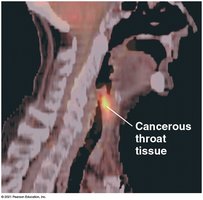
Radioactive Tracers in Biology
Radioactive isotopes are used as diagnostic tools in medicine, such as in PET scans to monitor cancer growth and metabolism.
Energy and Electron Shells
Energy in Atoms
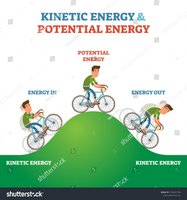
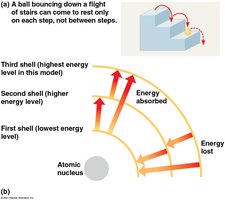
Energy is the capacity to do work. It can exist in various forms, including kinetic, potential, thermal, electrical, chemical, and nuclear energy. Potential energy is stored energy due to position or structure. Electrons in atoms have potential energy based on their position relative to the nucleus.
Electron Shells and Orbitals
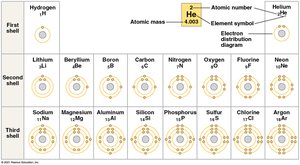
Electrons are arranged in shells around the nucleus. Each shell has a characteristic energy level and a maximum number of electrons:
First shell: 2 electrons
Second shell: 8 electrons
Third shell: 8 electrons
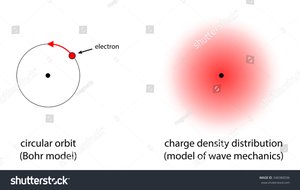
Energy Levels of Electrons
Electrons farther from the nucleus have more energy. When electrons absorb energy, they move to higher shells; when they lose energy, they fall to lower shells. Energy changes occur in fixed amounts (quantized).
Electron Distribution and the Periodic Table
The periodic table arranges elements by increasing atomic number and shows the electron distribution in shells. Elements in the same group (column) have the same number of valence electrons and similar chemical properties.
Valence Electrons and Chemical Behavior
Valence electrons are electrons in the outermost shell. The chemical behavior of an atom is largely determined by the number of valence electrons. Atoms with full valence shells are chemically inert (noble gases), while those with incomplete shells tend to form bonds.
Chemical Bonds
Covalent Bonds
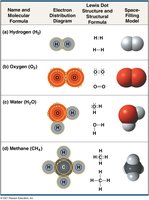
A covalent bond is formed when two atoms share one or more pairs of valence electrons. Covalent bonds can be single, double, or triple, depending on the number of shared electron pairs. Covalent bonds can form between atoms of the same element (e.g., H2, O2) or different elements (e.g., HCl, H2O).
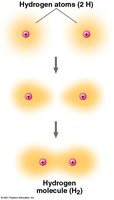
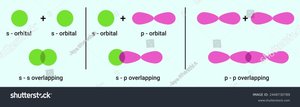
Depicting Bonds and Structural Formulas
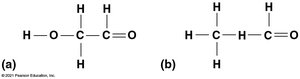
Bonds are depicted as pairs of dots or dashes between atoms. Structural formulas show the arrangement of atoms and bonds in a molecule.
Valence and Bonding Capacity
The valence of an atom is its bonding capacity, determined by the number of unpaired electrons in its outer shell.
Electronegativity, Polar and Nonpolar Bonds
Electronegativity: The tendency of an atom to attract electrons in a covalent bond. More electronegative atoms (e.g., oxygen, nitrogen) attract electrons more strongly.
Nonpolar Covalent Bond: Electrons are shared equally (e.g., H2, O2).
Polar Covalent Bond: Electrons are shared unequally, resulting in partial charges (e.g., H2O).
Ionic Bonds and Ions
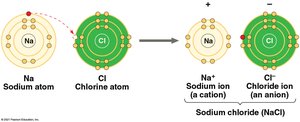
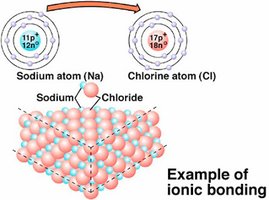
Ionic bonds form when one atom donates electrons to another, resulting in oppositely charged ions (cations and anions) that attract each other. Ionic compounds (salts) are stable in dry form but dissociate in water.
Weak Chemical Interactions
Hydrogen Bonds
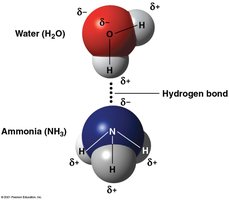
A hydrogen bond forms when a hydrogen atom covalently bonded to one electronegative atom is attracted to another electronegative atom (usually oxygen or nitrogen). Hydrogen bonds are crucial for the structure and function of biological molecules like DNA and proteins.
Chemical Reactions
Making and Breaking Bonds
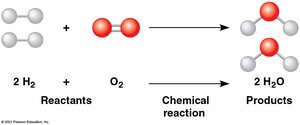
Chemical reactions involve the making and breaking of chemical bonds. The starting substances are called reactants (or substrates in biochemistry), and the resulting substances are called products.
Reversible Reactions and Equilibrium
Reversible Reaction: A reaction that can proceed in both directions. At equilibrium, the forward and reverse reactions occur at the same rate, and the concentrations of reactants and products remain constant.
Equilibrium: Determined by the relative energies of reactants and products. If the energy difference is large, the reaction may be effectively irreversible.
Summary Table: Types of Chemical Bonds
Bond Type | Description | Relative Strength | Example |
|---|---|---|---|
Covalent | Sharing of electron pairs between atoms | Strongest | H2O, O2 |
Ionic | Attraction between oppositely charged ions | Strong (in dry form) | NaCl |
Hydrogen | Attraction between a hydrogen atom and an electronegative atom | Weak | Between water molecules |
Van der Waals | Weak attractions due to transient local charges | Weakest | Interactions between nonpolar molecules |
Key Equations
Atomic Mass Calculation:
Example of a Reversible Reaction:
