 Back
Atoms, Elements, and Chemical Bonds: Foundations of Biological Chemistry
Study Guide - Smart Notes
 Tailored notes based on your materials, expanded with key definitions, examples, and context.
Atoms and Elements
Structure of the Atom
Atoms are the fundamental units of matter, composed of three types of subatomic particles: protons, neutrons, and electrons. The protons and neutrons are located in the nucleus at the center of the atom, while electrons move in orbitals around the nucleus.
Protons: Positively charged particles found in the nucleus.
Neutrons: Electrically neutral particles also found in the nucleus.
Electrons: Negatively charged particles that occupy orbitals surrounding the nucleus.
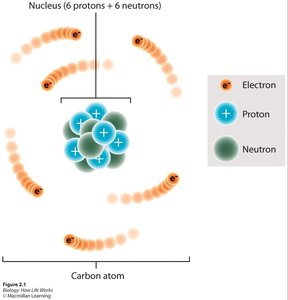
Elements are substances that consist of only one type of atom. Each element is defined by its number of protons, known as the atomic number.
Atomic Mass and Isotopes
The atomic mass of an atom is the sum of its protons and neutrons. Atoms of the same element with different numbers of neutrons are called isotopes.
For example, a carbon atom always has 6 protons, but may have 6, 7, or 8 neutrons.
Electron Orbitals and Shells
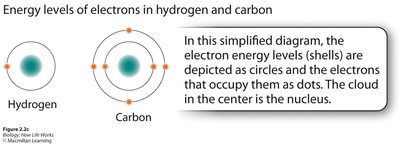
Electrons occupy regions of space called orbitals. Each orbital can hold up to two electrons. Orbitals are organized into shells based on their distance from the nucleus. Atoms with more than two electrons have multiple orbitals and shells.
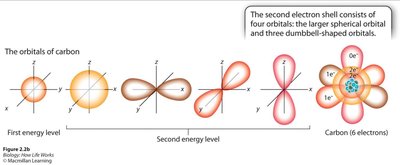
The arrangement of electrons in shells and orbitals determines the chemical properties of an atom.
Energy Levels and Valence Electrons
The electrons in the outermost shell are called valence electrons. These electrons are involved in chemical bonding and determine the reactivity of the atom.
The Periodic Table and Chemical Properties
Organization of the Periodic Table
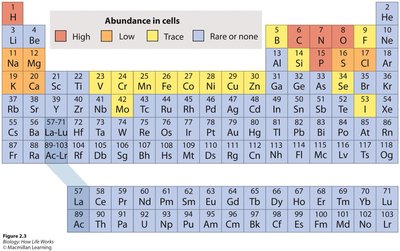
The periodic table arranges elements by increasing atomic number and groups elements with similar chemical properties together.
Elements in the same row (period) have the same number and types of orbitals.
Elements in the same column (group) have the same number of valence electrons, leading to similar chemical behavior.
Chemical Bonds
Types of Chemical Bonds
Atoms combine to form molecules through chemical bonds. The main types of bonds in biological molecules are:
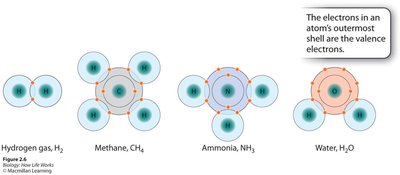
Covalent bonds: Atoms share pairs of electrons. These are strong bonds that form the backbone of most biological molecules.
Ionic bonds: One atom donates an electron to another, resulting in oppositely charged ions that attract each other.
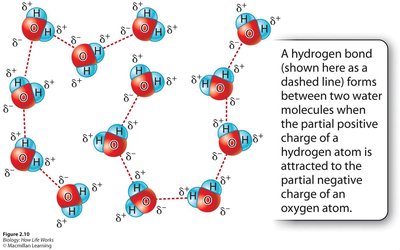
Hydrogen bonds: Weak attractions between a hydrogen atom with a partial positive charge and an electronegative atom (like oxygen or nitrogen) with a partial negative charge.
Van der Waals interactions: Weak, short-range forces due to transient shifts in electron density.
Covalent Bonds
In a covalent bond, atoms share electrons to fill their outermost shell. Covalent bonds can be single, double, or triple, depending on the number of shared electron pairs.
Nonpolar covalent bonds: Electrons are shared equally between atoms (e.g., H2, O2).
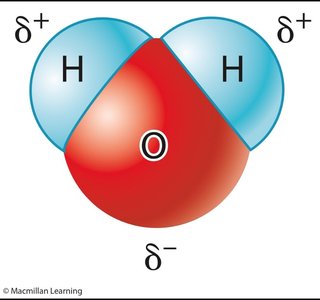
Polar covalent bonds: Electrons are shared unequally, resulting in partial charges (e.g., H2O).
Ionic Bonds
Ionic bonds form when one atom transfers an electron to another, creating ions. The resulting positive and negative ions are attracted to each other.
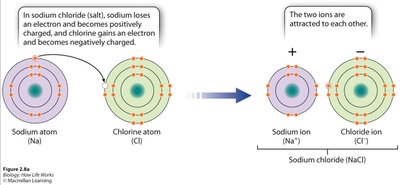
For example, in sodium chloride (NaCl), sodium loses an electron to become Na+, and chlorine gains an electron to become Cl-.
Hydrogen Bonds
Hydrogen bonds are weak interactions that occur between a hydrogen atom covalently bonded to an electronegative atom and another electronegative atom. These bonds are crucial for the structure of water, DNA, and proteins.
Water: Structure and Properties
Polarity of Water
Water (H2O) is a polar molecule due to the unequal sharing of electrons between oxygen and hydrogen. This results in a partial negative charge on oxygen and partial positive charges on the hydrogens.
Hydrogen Bonding in Water
The polarity of water allows it to form hydrogen bonds with other water molecules, giving rise to its unique properties such as high cohesion, surface tension, and the ability to dissolve many substances.
Density and Temperature Regulation
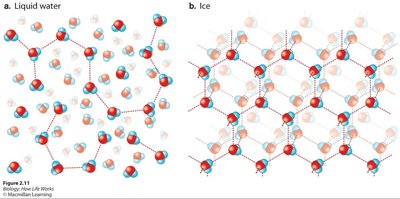
Water is less dense as a solid (ice) than as a liquid, which is why ice floats. Water also resists changes in temperature due to the energy required to break hydrogen bonds.
pH and Water
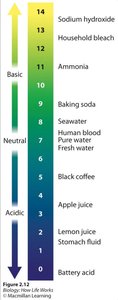
The pH of pure water is 7, which is neutral. pH is a measure of the concentration of hydrogen ions (protons) in solution. Water can act as both an acid and a base, making it an excellent solvent for many biological reactions.
Carbon: The Backbone of Life
Importance of Carbon
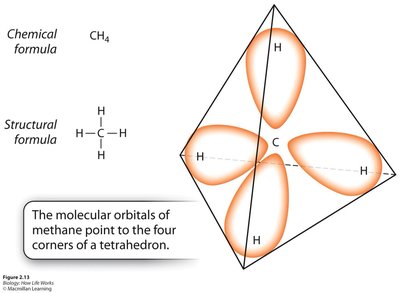
Carbon is the central element in organic molecules due to its ability to form four covalent bonds, allowing for a diversity of stable structures including chains, rings, and branches.
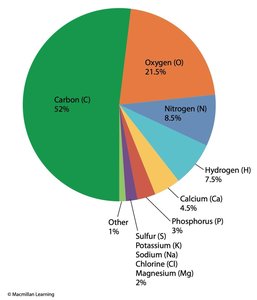
The four major elements in the human body are carbon, oxygen, hydrogen, and nitrogen.
Molecules containing carbon are called organic molecules.
Carbon Bonding and Molecular Diversity
Carbon atoms can form single, double, or triple bonds with other atoms, leading to a wide variety of molecular shapes and functions. The ability to rotate around single bonds and the presence of isomers (molecules with the same formula but different structures) further increases diversity.
Isomers
Isomers are molecules with the same chemical formula but different arrangements of atoms. Structural differences can lead to different chemical properties and biological functions.
Summary Table: Types of Chemical Bonds
Bond Type | Description | Relative Strength | Example |
|---|---|---|---|
Covalent | Atoms share electrons | Strong | H2O, CH4 |
Ionic | Electron transfer creates ions | Strong (in dry conditions) | NaCl |
Hydrogen | Attraction between partial charges | Weak | Between water molecules |
Van der Waals | Transient attractions due to electron movement | Very weak | Lipid interactions |
