 Back
Atoms, Elements, and Chemical Bonds: Foundations of Biological Chemistry
Study Guide - Smart Notes
 Tailored notes based on your materials, expanded with key definitions, examples, and context.
Atoms, Elements, and the Periodic Table
Atomic Structure and Subatomic Particles
All matter is composed of atoms, which are the smallest units of elements that retain their chemical properties. Atoms consist of three main subatomic particles:
Protons: Positively charged particles found in the nucleus; determine the atomic number and identity of the element.
Neutrons: Neutral particles in the nucleus; contribute to atomic mass and isotope formation.
Electrons: Negatively charged particles orbiting the nucleus; involved in chemical bonding and reactions.
Atoms are electrically neutral when the number of protons equals the number of electrons.
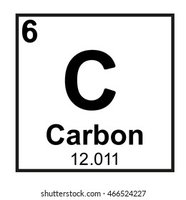
Elements, Molecules, and Compounds
An element is a substance that cannot be broken down into other substances by chemical means. A molecule consists of two or more atoms held together by covalent bonds, while a compound is a substance formed from two or more different elements combined in a fixed ratio.
Essential elements: Carbon, Oxygen, Hydrogen, Nitrogen (~96% of living matter).
Other important elements: Calcium, Phosphorus, Potassium, Sulfur, Sodium, Chlorine, Magnesium (~4%).
Trace elements: Required in minute amounts (<0.01%).
Atomic Number, Mass Number, and Isotopes
The atomic number is the number of protons in an atom's nucleus and defines the element. The mass number is the sum of protons and neutrons. Isotopes are atoms of the same element with different numbers of neutrons. Some isotopes are radioactive and decay over time, a property used in radiometric dating and medical diagnostics.
Atomic mass is measured in daltons (Da).
Radioactive decay is characterized by a half-life, the time it takes for half of the isotope to decay.
Electron Configuration and the Periodic Table
Electron Shells and Energy Levels
Electrons occupy energy levels or shells around the nucleus. The further an electron is from the nucleus, the higher its potential energy. Electrons can only exist at specific energy levels, not between them.
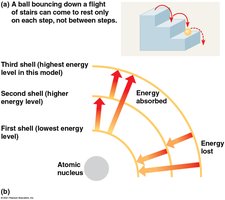
The first shell holds up to 2 electrons.
Subsequent shells can hold up to 8 electrons each (octet rule).
Valence electrons are those in the outermost shell and determine chemical reactivity.
Electron Orbitals
Electron shells are composed of orbitals, three-dimensional regions where electrons are likely to be found. Each orbital can hold up to 2 electrons.
s orbitals: Spherical, 1 per shell, hold 2 electrons.
p orbitals: Dumbbell-shaped, 3 per shell (starting from the second shell), hold 6 electrons total.
d orbitals: More complex, hold up to 10 electrons (from the third shell onward).
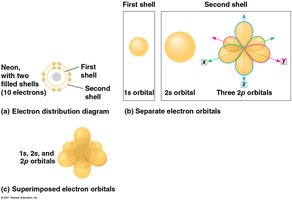
Electron configuration is written by listing orbitals and the number of electrons in each (e.g., 1s2 2s2 2p2 for carbon).
Chemical Bonds and Molecular Interactions
Covalent Bonds
Covalent bonds involve the sharing of pairs of valence electrons between atoms. These bonds can be single (one pair shared) or double (two pairs shared). The bonding capacity of an atom is called its valence.
Nonpolar covalent bonds: Electrons are shared equally (e.g., H2).
Polar covalent bonds: Electrons are shared unequally due to differences in electronegativity.
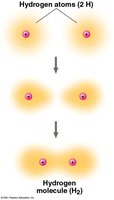
Electronegativity is an atom's attraction for shared electrons; higher electronegativity means stronger pull.
Ionic Bonds and Salts
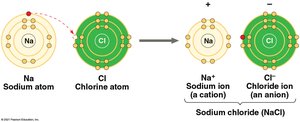
Ionic bonds form when one atom transfers electrons to another, creating charged ions. The resulting attraction between oppositely charged ions forms an ionic compound (salt).
Cation: Positively charged ion (lost electrons).
Anion: Negatively charged ion (gained electrons).
Salts are often crystalline, dissociate easily in water, and are not considered molecules.
Hydrogen Bonds
Hydrogen bonds occur when a hydrogen atom covalently bonded to an electronegative atom (like oxygen or nitrogen) is attracted to another electronegative atom. These are weaker than covalent or ionic bonds but are crucial in biological molecules (e.g., DNA, water).
Van der Waals Interactions
Van der Waals interactions are weak attractions between molecules due to temporary local charges. Though individually weak, collectively they can be significant (e.g., gecko feet adhesion).
Molecular Shape and Hybridization
Hybridization of Orbitals
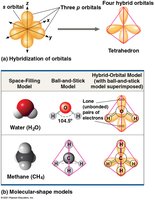
When atoms form covalent bonds, their s and p orbitals may hybridize to create new shapes, influencing molecular geometry and function. For example, carbon forms four hybrid orbitals in methane (CH4), resulting in a tetrahedral shape.
Chemical Reactions
Making and Breaking Bonds
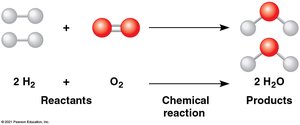
Chemical reactions involve the making and breaking of chemical bonds. The starting substances are reactants, and the resulting substances are products. All chemical reactions are reversible, and equilibrium is reached when the forward and reverse reactions occur at the same rate.
Example:
At equilibrium, the concentrations of reactants and products remain constant.
Half-Life Calculations for Radioactive Isotopes
The half-life of a radioactive isotope is the time required for half of the isotope to decay. The amount remaining after n half-lives is calculated as:
Where n is the number of half-lives elapsed.
Additional info: This guide covers foundational chemistry concepts essential for understanding biological molecules and processes, including atomic structure, chemical bonding, and the behavior of elements in biological systems.
