 Back
Atoms, Elements, and Chemical Bonds: Study Notes for General Biology
Study Guide - Smart Notes
 Tailored notes based on your materials, expanded with key definitions, examples, and context.
Atoms, Elements, and Chemical Bonds
Essential Elements and Atomic Structure
Understanding the basic structure of atoms and the elements they form is foundational to biology. Atoms are composed of subatomic particles: protons, neutrons, and electrons. The properties of elements and their behavior in chemical reactions depend on these particles.
Protons: Positively charged; determine the element's identity.
Neutrons: No charge; contribute to atomic mass and isotopes.
Electrons: Negatively charged; involved in chemical bonding.
Atomic Number: Number of protons in the nucleus.
Mass Number: Sum of protons and neutrons.
Isotopes: Atoms of the same element with different numbers of neutrons.
Essential Elements: Carbon, Oxygen, Hydrogen, Nitrogen (~96% of living matter).
Trace Elements: Required in minute amounts (e.g., iron, iodine).
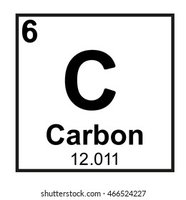
Example: Carbon-12 has 6 protons and 6 neutrons; Carbon-14 has 6 protons and 8 neutrons.
Electron Configuration and Energy Levels
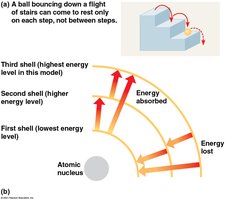
Electrons occupy specific energy levels or shells around the nucleus. The arrangement of electrons determines how atoms interact and bond with each other.
Energy Levels: Electrons closer to the nucleus have lower energy; those farther away have higher energy.
Valence Electrons: Electrons in the outermost shell; determine chemical reactivity.
Electron Shells: First shell holds 2 electrons; subsequent shells hold up to 8.
Orbitals: 3D regions where electrons are likely found; s, p, and d orbitals.
Electron Configuration: Describes the arrangement of electrons in orbitals (e.g., Carbon: 1s2 2s2 2p2).
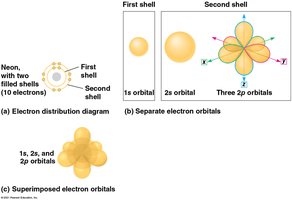
Example: Neon has 10 electrons: 1s2 2s2 2p6.
Chemical Bonds and Molecules
Atoms form chemical bonds to achieve stable electron configurations. The main types of bonds are covalent, ionic, hydrogen, and van der Waals interactions.
Covalent Bonds: Sharing of electron pairs between atoms; can be single, double, or triple bonds.
Molecule: Two or more atoms held together by covalent bonds.
Bonding Capacity (Valence): Number of bonds an atom can form.
Electronegativity: Atom's ability to attract electrons in a bond.
Polar Covalent Bond: Unequal sharing of electrons; results in partial charges.
Nonpolar Covalent Bond: Equal sharing of electrons.
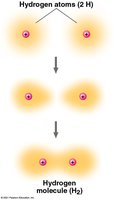
Example: H2 (hydrogen molecule) forms by sharing electrons between two hydrogen atoms.
Ionic Bonds and Salts
Ionic bonds form when atoms transfer electrons, resulting in charged ions. These ions attract each other to form ionic compounds, commonly known as salts.
Cation: Positively charged ion.
Anion: Negatively charged ion.
Ionic Compound: Formed from cations and anions; often crystalline and stable when dry.
Properties of Salts: Crystalline structure, dissociate easily in water, not considered molecules.
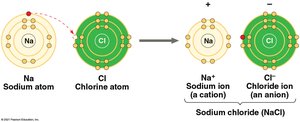
Example: Sodium (Na) transfers an electron to chlorine (Cl), forming Na+ and Cl- ions, which combine to make NaCl (table salt).
Hydrogen Bonds and Van der Waals Interactions
Hydrogen bonds and van der Waals interactions are weaker than covalent and ionic bonds but are crucial for biological molecules' structure and function.
Hydrogen Bond: Attraction between a hydrogen atom covalently bonded to an electronegative atom and another electronegative atom.
Van der Waals Interactions: Weak attractions due to temporary charge imbalances.
Collective Strength: Many weak interactions can stabilize large biological structures.
Molecular Shape and Hybridization
The shape of a molecule is determined by the arrangement of its atoms and the hybridization of orbitals. Hybridization involves the mixing of s and p orbitals to form new shapes, which are essential for the function of biological molecules.
Hybridization: Combination of s and p orbitals to form new, hybrid orbitals.
Molecular Shape: Determines how molecules interact and their biological function.
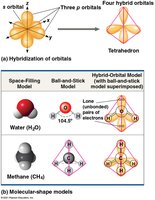
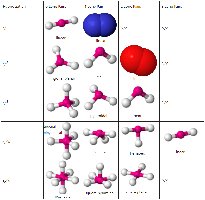
Example: Water (H2O) has a bent shape due to hybridization; methane (CH4) is tetrahedral.
Chemical Reactions and Equilibrium
Chemical reactions involve the making and breaking of bonds, transforming reactants into products. Reactions are reversible, and equilibrium is reached when the rates of forward and reverse reactions are equal.
Reactants: Starting substances in a reaction.
Products: Resulting substances after the reaction.
Chemical Equilibrium: State where reactant and product concentrations remain constant.
Reversible Reactions: Indicated by double arrows ().
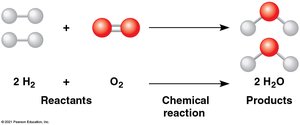
Example:
Half-Life and Radioactive Isotopes
Radioactive isotopes decay at a predictable rate, known as the half-life. This property is used in radiometric dating and medical diagnostics.
Half-Life: Time required for half the quantity of a radioactive isotope to decay.
Calculation: Amount remaining = initial amount ×
Applications: Dating fossils, medical imaging.
Example: If 60 grams of Np-240 (half-life = 1 hour) are present, after 4 hours: grams remain.
Additional info: These notes expand on brief points from the original material, providing definitions, examples, and context for General Biology students.
