 Back
Atoms, Elements, and Chemical Bonds: Study Notes for General Biology
Study Guide - Smart Notes
 Tailored notes based on your materials, expanded with key definitions, examples, and context.
Atoms, Elements, and Chemical Bonds
Essential Elements and Atomic Structure
Understanding the basic structure of atoms and the elements they form is foundational to biology. Atoms are composed of three subatomic particles: protons (positive charge), neutrons (no charge), and electrons (negative charge). The properties of an element depend on the arrangement and number of these particles.
Essential elements for life include carbon, oxygen, hydrogen, and nitrogen (~96% of living matter).
Other important elements: calcium, phosphorus, potassium, sulfur, sodium, chlorine, magnesium (~4%).
Trace elements are required in very small amounts (<0.01%).
An atom is the smallest unit of matter that retains the properties of an element.
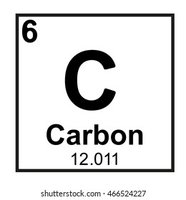
Atomic number: Number of protons in the nucleus (defines the element).
Atomic mass: Sum of protons and neutrons (measured in daltons).
Isotopes and Radioactivity
Isotopes are variants of elements with different numbers of neutrons. Some isotopes are radioactive and decay over time, which is useful in medicine and dating fossils.
Isotope: Atoms of the same element with different neutron numbers.
Radioactive isotopes: Unstable, decay spontaneously, emitting energy.
Half-life: Time required for half the atoms of a radioactive isotope to decay.
Electron Configuration and Energy Levels
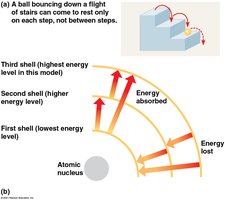
Electrons occupy specific energy levels or shells around the nucleus. The arrangement of electrons determines how atoms interact and bond.
Energy levels: Electrons farther from the nucleus have higher potential energy.
Electrons can only occupy discrete energy levels, not positions in between.
Valence electrons: Electrons in the outermost shell; determine chemical reactivity.
First shell holds 2 electrons; subsequent shells hold up to 8 electrons.
Electron Orbitals and Configuration
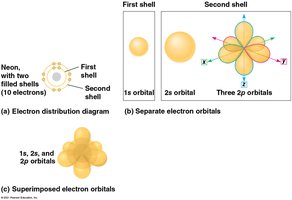
Electron shells are made up of orbitals, which are three-dimensional regions where electrons are likely to be found. The configuration of these orbitals is key to understanding chemical bonding.
Orbital: 3D space where an electron is found 90% of the time.
S orbitals hold 2 electrons; P orbitals hold 6; D orbitals hold 10.
Electron configuration notation (e.g., 1s2, 2s2, 2p6) shows how electrons fill orbitals.
Chemical Bonds: Types and Properties
Atoms form chemical bonds to achieve stable electron configurations. The main types of bonds are covalent, ionic, hydrogen, and van der Waals interactions.
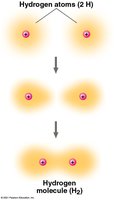
Covalent bonds: Sharing of electron pairs between atoms.
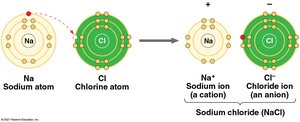
Ionic bonds: Transfer of electrons, resulting in charged ions (cations and anions).
Hydrogen bonds: Attraction between a hydrogen atom and an electronegative atom (usually oxygen or nitrogen).
Van der Waals interactions: Weak attractions due to transient charge differences.
Covalent Bonds
Covalent bonds involve the sharing of electrons. They can be single (one pair shared) or double (two pairs shared). The shape and function of molecules depend on these bonds.
Nonpolar covalent bond: Electrons shared equally.
Polar covalent bond: Electrons shared unequally, creating partial charges.
Ionic Bonds and Salts
Ionic bonds form when electrons are transferred, creating ions that attract each other. Ionic compounds (salts) have distinct properties.
Often form crystals in nature.
Stable when dry, dissociate easily in water.
Not considered molecules; formula indicates ratio of elements.
Hydrogen Bonds and Van der Waals Interactions
Hydrogen bonds are important in biological molecules, such as water and DNA. Van der Waals interactions are weak but can be significant collectively.
Hydrogen bonds: Form between hydrogen and electronegative atoms (O, N, S, F).
Van der Waals: Result from uneven electron distribution, causing temporary charges.
Molecular Shape and Hybridization
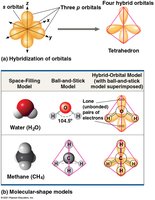
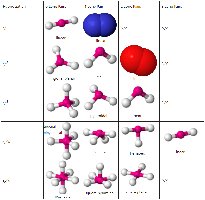
The shape of a molecule is determined by the arrangement of its orbitals. Hybridization occurs when orbitals combine to form new shapes, affecting molecular function.
Hybridization: Combination of s and p orbitals to form new structures.
Molecular shape is crucial for biological function (e.g., enzyme activity).
Chemical Reactions and Equilibrium
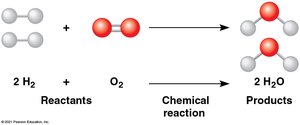
Chemical reactions involve making and breaking bonds. Reactants are transformed into products, and reactions can be reversible, reaching equilibrium when forward and reverse rates are equal.
Reactants: Starting molecules.
Products: Resulting molecules.
Chemical equilibrium: Forward and reverse reactions occur at the same rate.
Half-Life Calculations
Radioactive decay follows predictable patterns. The amount remaining after a given time can be calculated using the number of half-lives.
Formula:
Example: If 60 grams of Np-240 (half-life = 1 hour) are present, after 4 hours (4 half-lives), grams remain.
Summary Table: Types of Chemical Bonds
Bond Type | Mechanism | Strength | Example |
|---|---|---|---|
Covalent | Electron sharing | Strong | H2, O2 |
Ionic | Electron transfer | Strong (in dry state) | NaCl |
Hydrogen | Attraction between H and electronegative atom | Weak | Water (H2O) |
Van der Waals | Transient charge differences | Very weak | Gecko toe hairs |
Additional info: These notes expand on brief points from the original material, providing definitions, examples, and context for General Biology students.
