 Back
Atoms, Molecules, and Biomolecules: Foundations of Life Chemistry
Study Guide - Smart Notes
 Tailored notes based on your materials, expanded with key definitions, examples, and context.
Atoms and Elements
Structure of Atoms
Atoms are the fundamental units of matter, retaining the properties of their respective elements. Each atom consists of subatomic particles:
Protons: Positively charged particles located in the nucleus.
Neutrons: Electrically neutral particles also found in the nucleus.
Electrons: Negatively charged particles that orbit the nucleus.
The nucleus contains protons and neutrons, giving it a positive charge, while electrons surround the nucleus and create a negative charge. The attraction between opposite charges stabilizes the atom.
Atomic Number and Mass Number
Atomic Number: The number of protons in an atom, which defines the element.
Mass Number: The sum of protons and neutrons in an atom.
Isotopes
Isotopes are forms of an element with the same number of protons but different numbers of neutrons, resulting in different mass numbers.
Radioactive Isotopes: These isotopes have unstable nuclei that decay, changing the number of protons and potentially transforming into different elements.
Electron Configuration and Chemical Bonds
Electron Shells and Orbitals
Electrons occupy energy levels called shells, which are determined by their distance from the nucleus. Each shell contains orbitals, and each orbital can hold two electrons. The arrangement of electrons in shells and orbitals determines an atom's chemical properties.
Covalent Bonds
Covalent bonds form when atoms share pairs of valence (outer shell) electrons.
Single Covalent Bond: One pair of electrons shared.
Double Covalent Bond: Two pairs of electrons shared.
Valence: The number of electrons needed to complete an atom's outer shell. Electronegativity: The tendency of an atom to attract electrons in a covalent bond.
Nonpolar Covalent Bond: Electrons are shared equally.
Polar Covalent Bond: Electrons are shared unequally, resulting in partial charges.
Ionic Bonds
Ionic bonds occur when atoms with significantly different electronegativities transfer electrons, forming oppositely charged ions.
Cation: Positively charged ion.
Anion: Negatively charged ion.
Ionic compounds (salts) are formed by the attraction between cations and anions.
Hydrogen Bonds and Van der Waals Interactions
Hydrogen Bond: A weak bond between a slightly positive hydrogen atom and a slightly negative atom in another molecule.
Van der Waals Interaction: Weak attractions between molecules due to temporary charge differences.
Chemical Reactions
Reactants and Products
Chemical reactions involve the transformation of reactants (starting materials) into products (resulting substances). Reactions can be reversible or one-way.
Properties of Water
Cohesion and Adhesion
Cohesion: Water molecules stick together via hydrogen bonds.
Adhesion: Water molecules stick to other substances.
Thermal Properties
Kinetic Energy: Energy due to motion.
Thermal Energy: Total energy of all particles in a body of matter.
Temperature: Average kinetic energy of particles.
Heat: Transfer of thermal energy between substances.
Calorie: Amount of heat needed to raise 1g of water by 1°C.
Specific Heat: Amount of heat required to change the temperature of 1g of a substance by 1°C.
Hydrophobic and Hydrophilic Substances
Hydrophobic: Repels water; nonpolar and nonionic substances.
Hydrophilic: Attracts water; polar and ionic substances.
Acids, Bases, and pH
Acid: Increases H+ concentration in solution.
Base: Increases OH- concentration in solution.
pH Scale: Measures acidity or basicity; lower pH is more acidic, higher pH is more basic.
Carbon and Organic Molecules
Carbon Skeletons
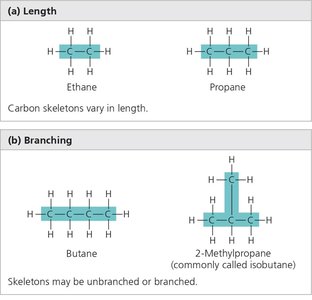
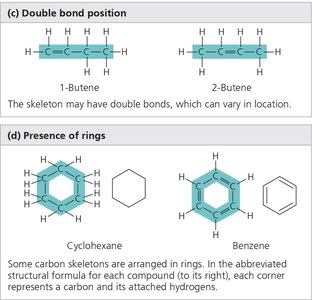
Carbon atoms form the backbone of organic molecules, creating complex shapes such as chains, rings, and branches.
Hydrocarbons: Molecules consisting only of carbon and hydrogen.
Isomers
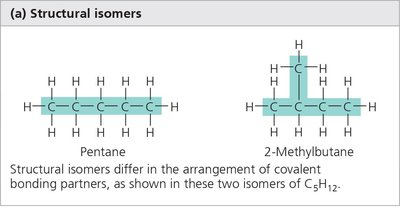
Isomers are compounds with the same molecular formula but different structures and properties.
Structural Isomers: Differ in the arrangement of covalent bonding partners.
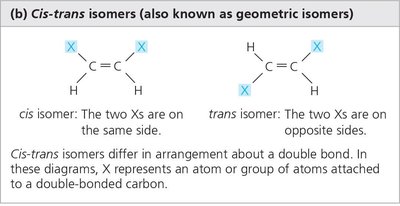
Cis-Trans Isomers: Differ in arrangement around a double bond.
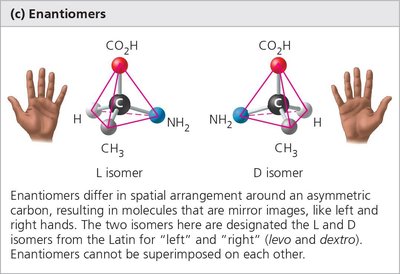
Enantiomers: Mirror images due to asymmetric carbon.
Functional Groups
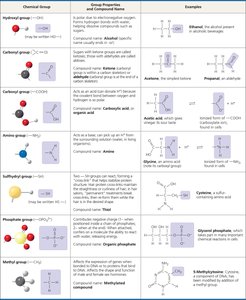
Functional groups are specific groups of atoms attached to carbon skeletons that determine the chemical behavior of organic molecules.
Examples include hydroxyl, carbonyl, carboxyl, amino, sulfhydryl, phosphate, and methyl groups.
Biomolecules
Carbohydrates
Carbohydrates are sugars and polymers of sugars, serving as energy sources and building materials.
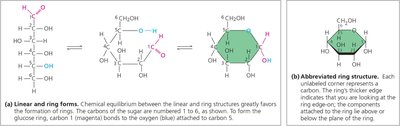
Monosaccharides: Simple sugars (e.g., glucose).
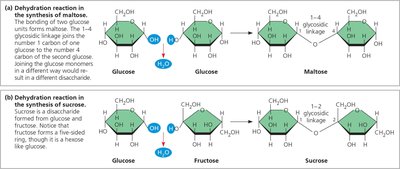
Disaccharides: Two monosaccharides covalently bonded.
Polysaccharides: Polymers composed of many sugars.
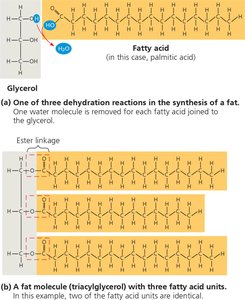
Lipids
Lipids are hydrophobic molecules, including fats, phospholipids, steroids, and waxes.
Fats (Triglycerides): Glycerol + 3 fatty acids; energy storage.
Phospholipids: Glycerol + 2 fatty acids + phosphate group; form cell membranes.
Steroids: Four fused carbon rings; cholesterol is a precursor for other steroids.
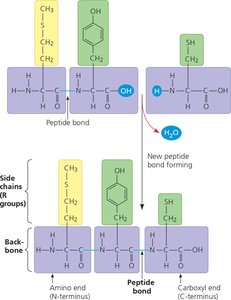
Proteins
Proteins are polymers of amino acids (polypeptides) with diverse functions.
Amino Acids: Organic molecules with amino and carboxyl groups; 20 types.
Peptide Bond: Covalent bond between amino acids formed by dehydration reaction.
Protein Structure:
Primary: Sequence of amino acids.
Secondary: Coils and folds (alpha helix, beta sheet).
Tertiary: 3D shape from side chain interactions.
Quaternary: Aggregation of multiple polypeptides.
Denaturation: Loss of protein shape due to environmental changes.
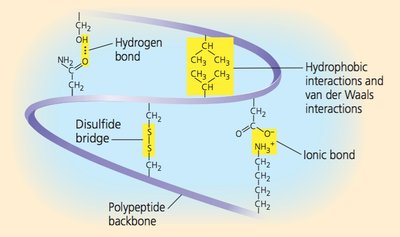
Nucleic Acids
Nucleic acids (DNA and RNA) are polymers of nucleotides, transmitting and expressing hereditary information.
DNA: Stores genetic information; double-stranded; located in the nucleus.
RNA: Carries out protein synthesis; single-stranded; located in cytoplasm or nucleus.
Nucleotide Structure: Nitrogenous base, pentose sugar, phosphate group.
Phosphodiester Linkage: Covalent bond between nucleotides, forming the sugar-phosphate backbone.
Gene Expression: DNA → RNA → Protein Types of Nitrogenous Bases:
Pyrimidines: Cytosine, Thymine (DNA), Uracil (RNA)
Purines: Adenine, Guanine
Types of Pentose:
Deoxyribose: DNA
Ribose: RNA
Polynucleotide Structure:
5' end: Free phosphate group attached to the 5th carbon of sugar.
3' end: Free phosphate group attached to the 3rd carbon of sugar.
Summary Table: Major Biomolecules
Biomolecule | Monomer | Polymer | Main Function |
|---|---|---|---|
Carbohydrates | Monosaccharide | Polysaccharide | Energy, structure |
Proteins | Amino acid | Polypeptide | Enzymes, structure, transport |
Lipids | Fatty acid, glycerol | Triglyceride, phospholipid | Energy storage, membranes |
Nucleic Acids | Nucleotide | DNA, RNA | Genetic information |
Additional info: This guide expands on brief notes with academic context, definitions, and examples to ensure completeness and clarity for General Biology students.
