 Back
Atoms, Molecules, and Chemical Bonds: Foundations for General Biology
Study Guide - Smart Notes
 Tailored notes based on your materials, expanded with key definitions, examples, and context.
Introduction to Chemistry in Biology
Atoms, Molecules, and Biological Relevance
Atoms are the fundamental units of matter, and their interactions form molecules essential for life. Biological systems are composed of a variety of elements, with a few key elements making up most of the body mass.
Atoms: Smallest unit of an element, consisting of protons, neutrons, and electrons.
Molecules: Groups of atoms bonded together, forming the chemical basis of life.
Elements: Pure substances consisting of only one type of atom.
Major Elements in Biological Systems
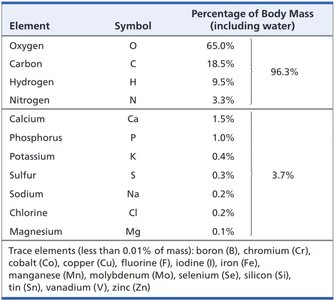
The human body is primarily composed of oxygen, carbon, hydrogen, and nitrogen, with other elements present in smaller amounts.
Oxygen (O): 65.0% of body mass
Carbon (C): 18.5%
Hydrogen (H): 9.5%
Nitrogen (N): 3.3%
Element | Symbol | Percentage of Body Mass |
|---|---|---|
Oxygen | O | 65.0% |
Carbon | C | 18.5% |
Hydrogen | H | 9.5% |
Nitrogen | N | 3.3% |
Calcium | Ca | 1.5% |
Phosphorus | P | 1.0% |
Potassium | K | 0.4% |
Sulfur | S | 0.3% |
Sodium | Na | 0.2% |
Chlorine | Cl | 0.2% |
Magnesium | Mg | 0.1% |
Atomic Structure and Properties
Subatomic Particles
Atoms are composed of three main subatomic particles:
Protons: Positively charged, located in the nucleus.
Neutrons: No charge, located in the nucleus.
Electrons: Negatively charged, orbiting the nucleus in electron shells.
Particle | Electric Charge | Atomic Mass Unit (AMU) | Location |
|---|---|---|---|
Proton | +1 | 1 | Nucleus |
Neutron | 0 | 1 | Nucleus |
Electron | -1 | 0 | Electron shell |

Atomic Number and Mass Number
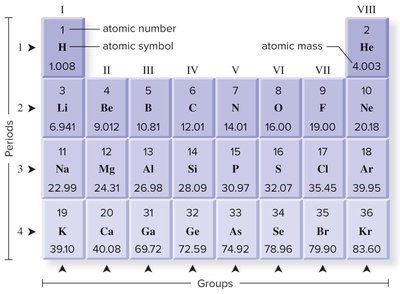
The atomic number is the number of protons in an atom and defines the element. The mass number is the sum of protons and neutrons.
Atomic Number: Determines the element's identity.
Mass Number: Determines the isotope of the element.
Electron Shells and Stability
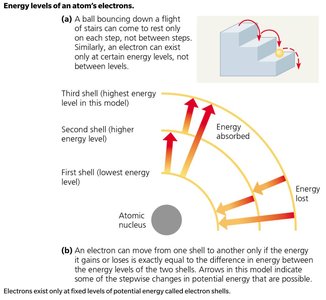
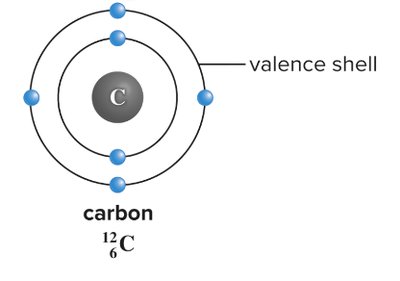
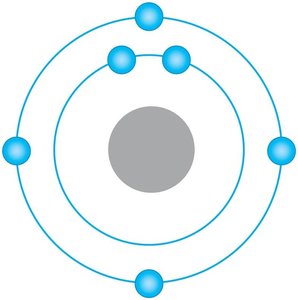
Electrons occupy specific energy levels called shells. The stability of an atom depends on the fullness of its outermost (valence) shell.
First shell: Holds up to 2 electrons
Second shell: Holds up to 8 electrons
Third shell: Holds up to 8 electrons
Atoms are most stable when their valence shell is full.
Chemical Bonds and Interactions
Ionic Bonds
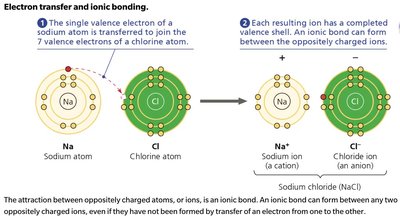
Ionic bonds are formed when electrons are transferred from one atom to another, resulting in oppositely charged ions that attract each other.
Cation: Positively charged ion (e.g., Na+)
Anion: Negatively charged ion (e.g., Cl-)
Example: Formation of sodium chloride (NaCl) from sodium and chlorine
Covalent Bonds
Covalent bonds are formed when atoms share pairs of electrons. These bonds can be polar or nonpolar depending on the sharing of electrons.
Nonpolar Covalent Bonds: Electrons are shared equally.
Polar Covalent Bonds: Electrons are shared unequally, resulting in partial charges (δ+ and δ-).
Example: Water (H2O) has polar covalent bonds.
Electronegativity and Bond Type
Electronegativity is the ability of an atom to attract shared electrons. The difference in electronegativity between two atoms determines the type of bond formed.
Large difference (>1.7): Ionic bond
Moderate difference: Polar covalent bond
Small or no difference: Nonpolar covalent bond
Biomolecules and Their Chemical Properties
Biomolecules: Composition and Function
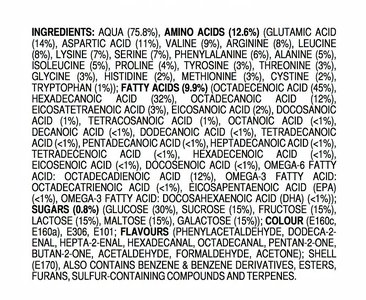
Biomolecules are organic compounds essential for life, including proteins, lipids, carbohydrates, and nucleic acids. Their structure and function are determined by the types of atoms and bonds present.
Proteins: Made of amino acids, perform structural and functional roles.
Lipids: Composed of fatty acids, important for energy storage and membrane structure.
Carbohydrates: Made of sugars, provide energy and structural support.
Nucleic Acids: DNA and RNA, store and transmit genetic information.
Cellular Organization and Chemical Foundations
Cell Structure and Organelles
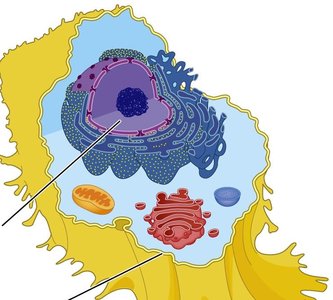
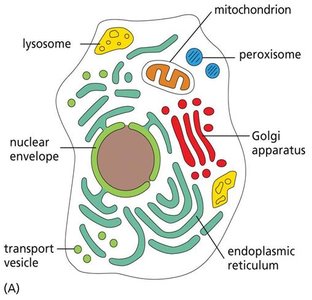
Cells are the basic units of life, composed of various organelles that perform specialized functions. The chemical properties of atoms and molecules underpin cellular structure and function.
Nucleus: Contains DNA (nucleic acids)
Mitochondria: Site of energy production (ATP)
Endoplasmic Reticulum: Synthesizes proteins and lipids
Golgi Apparatus: Modifies and packages proteins
Scale of Biological Organization
Biological systems are organized hierarchically, from atoms to molecules, organelles, cells, tissues, and organs.
Atoms → Molecules → Organelles → Cells → Tissues → Organs
Summary of Key Concepts
Atoms interact via chemical bonds to form molecules.
Bonds are crucial for the structure and function of biomolecules.
Biomolecules have polarity due to differences in electronegativity.
These chemical properties impart functional capabilities to biological systems.
