 Back
Atoms, Molecules, and Chemical Bonds: Foundations of Biological Structure
Study Guide - Smart Notes
 Tailored notes based on your materials, expanded with key definitions, examples, and context.
Introduction to Biological Chemistry
All living organisms are composed of atoms and molecules, which interact through chemical bonds to form the complex structures necessary for life. Understanding the properties of atoms, their organization into molecules, and the types of bonds they form is fundamental to the study of biology.
Levels of Biological Organization
Atoms to Organisms
Biological systems are organized hierarchically, from atoms to molecules, organelles, cells, tissues, organs, and ultimately, entire organisms. Each level builds upon the previous, with chemical interactions at the atomic and molecular levels underpinning all biological processes.
Atoms: The smallest units of matter, consisting of protons, neutrons, and electrons.
Molecules: Combinations of atoms held together by chemical bonds.
Organelles: Specialized structures within cells, composed of various molecules.
Cells: The basic units of life, containing organelles and surrounded by membranes.
Atoms: Structure and Properties
Subatomic Particles
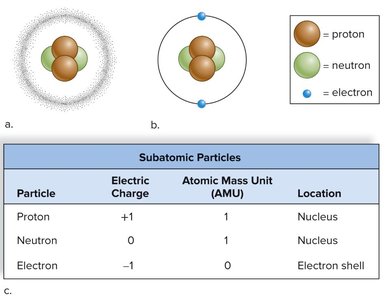
Atoms are composed of three main subatomic particles:
Protons: Positively charged particles found in the nucleus.
Neutrons: Neutral particles also located in the nucleus.
Electrons: Negatively charged particles that orbit the nucleus in electron shells.

Particle | Electric Charge | Atomic Mass Unit (AMU) | Location |
|---|---|---|---|
Proton | +1 | 1 | Nucleus |
Neutron | 0 | 1 | Nucleus |
Electron | -1 | 0 | Electron shell |
Atomic Number and Mass Number
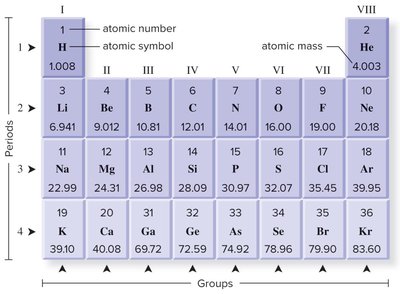
Atomic Number: The number of protons in an atom, which defines the element.
Mass Number: The sum of protons and neutrons in the nucleus.
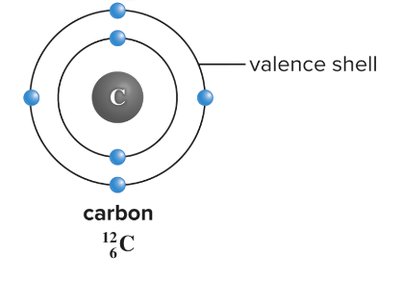
For example, carbon has an atomic number of 6 and a mass number of 12:
Electron Shells and Valence Electrons
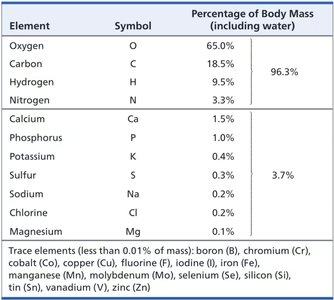
Electrons are arranged in shells around the nucleus. The chemical reactivity of an atom is determined by the electrons in its outermost shell, known as valence electrons.
The first shell holds up to 2 electrons.
The second shell holds up to 8 electrons.
The third shell also holds up to 8 electrons (for main group elements).
Elements Essential for Life
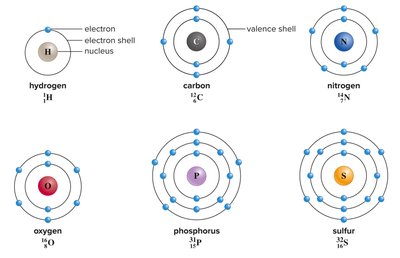
Living organisms are primarily composed of a few key elements, with oxygen, carbon, hydrogen, and nitrogen making up over 96% of body mass. Other elements, such as calcium, phosphorus, and potassium, are also essential in smaller amounts.
Element | Symbol | Percentage of Body Mass |
|---|---|---|
Oxygen | O | 65.0% |
Carbon | C | 18.5% |
Hydrogen | H | 9.5% |
Nitrogen | N | 3.3% |
Calcium | Ca | 1.5% |
Phosphorus | P | 1.0% |
Potassium | K | 0.4% |
Sulfur | S | 0.3% |
Sodium | Na | 0.2% |
Chlorine | Cl | 0.2% |
Magnesium | Mg | 0.1% |
Chemical Bonds and Molecular Structure
Stability and the Octet Rule
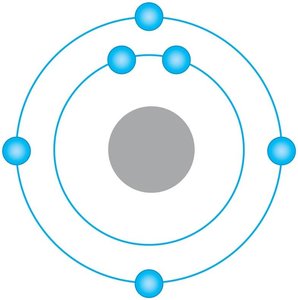
Atoms are most stable when their valence shell is full. The octet rule states that atoms tend to gain, lose, or share electrons to achieve a full outer shell (usually 8 electrons).
Shell 1: 2 electrons (stable)
Shell 2: 8 electrons (stable)
Shell 3: 8 electrons (stable for main group elements)
Types of Chemical Bonds
Ionic Bonds: Formed when electrons are transferred from one atom to another, resulting in oppositely charged ions that attract each other.
Covalent Bonds: Formed when two atoms share one or more pairs of electrons. Can be single, double, or triple bonds.
Ionic Bond Example: Sodium Chloride (NaCl)
Sodium (Na) donates an electron to chlorine (Cl), forming Na+ and Cl- ions, which are held together by ionic attraction.
Covalent Bond Example: Water (H2O)
Oxygen shares electrons with two hydrogen atoms, forming polar covalent bonds.
Electronegativity and Bond Polarity
Electronegativity is the ability of an atom to attract shared electrons. Differences in electronegativity between atoms determine bond polarity:
Non-polar covalent bonds: Electrons are shared equally (e.g., H2, O2).
Polar covalent bonds: Electrons are shared unequally, creating partial charges (e.g., H2O).
Ionic bonds: Electrons are transferred, resulting in full charges (e.g., NaCl).
Bond type can be predicted by the difference in electronegativity values:
Difference < 0.5: Non-polar covalent
Difference 0.5–1.7: Polar covalent
Difference > 1.7: Ionic
Biomolecules: Composition and Importance
Major Classes of Biomolecules
Lipids: Found primarily in cell membranes and used for energy storage.
Proteins: Composed of amino acids, serve as enzymes, structural components, and signaling molecules.
Nucleic Acids: DNA and RNA, store and transmit genetic information.
Example: Composition of an Egg
An egg contains water, amino acids (proteins), fatty acids (lipids), sugars (carbohydrates), and trace elements, illustrating the diversity of biomolecules in living systems.
Cell Structure and Organelles
Eukaryotic Cell Organization
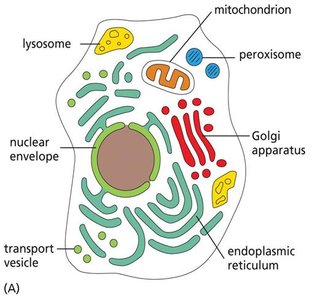
Eukaryotic cells contain membrane-bound organelles, including the nucleus, mitochondria, endoplasmic reticulum, and Golgi apparatus. These structures are composed of various biomolecules and are essential for cellular function.
Summary Table: Key Elements in Biomolecules
Element | Major Role in Biomolecules |
|---|---|
Carbon (C) | Backbone of organic molecules |
Hydrogen (H) | Part of water and organic molecules |
Oxygen (O) | Component of water, organic molecules, and involved in respiration |
Nitrogen (N) | Found in amino acids and nucleic acids |
Phosphorus (P) | Component of nucleic acids and ATP |
Sulfur (S) | Found in some amino acids |
Key Concepts
Atoms interact via chemical bonds to form molecules, which are the basis of all biological structures.
The properties of atoms, such as electronegativity and valence electrons, determine the types of bonds they form.
Biomolecules are composed of specific elements and have unique chemical properties that enable life.
