 Back
BackAtoms, Molecules, and Chemical Bonds in Biology
Study Guide - Smart Notes
 Tailored notes based on your materials, expanded with key definitions, examples, and context.
Atoms, Molecules, and Chemical Bonds
Introduction to Biological Chemistry
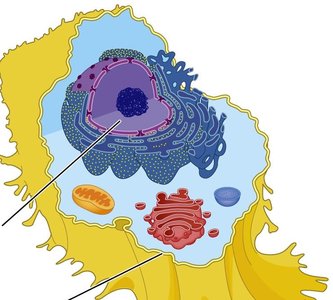
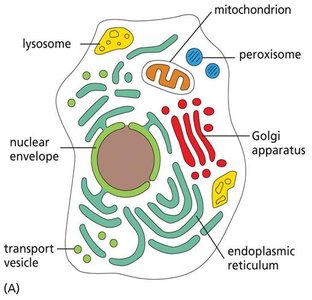
All living organisms are composed of chemicals, which are organized into atoms, molecules, organelles, and cells. Understanding the structure and behavior of atoms and molecules is fundamental to biology, as these principles underlie the structure and function of biomolecules essential for life.
Atoms are the basic units of matter, consisting of protons, neutrons, and electrons.
Molecules are formed when atoms bond together through chemical interactions.
Biological molecules, such as proteins, lipids, carbohydrates, and nucleic acids, are built from specific arrangements of atoms.
Atomic Structure and Elements
Subatomic Particles and Atomic Number
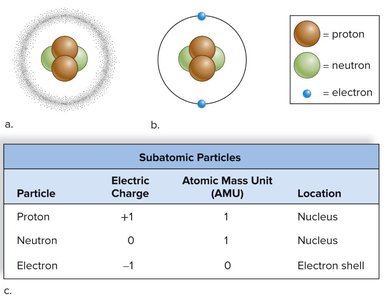
Atoms are composed of three main subatomic particles: protons, neutrons, and electrons. The number of protons in the nucleus defines the element and is called the atomic number.
Protons: Positively charged particles found in the nucleus.
Neutrons: Neutral particles also located in the nucleus.
Electrons: Negatively charged particles that orbit the nucleus in electron shells.
The atomic number equals the number of protons and determines the element's identity.
Major Elements in Living Organisms
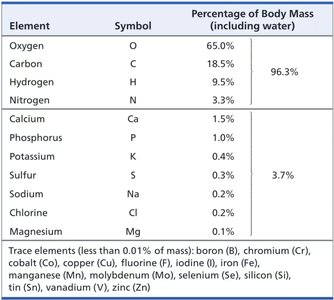
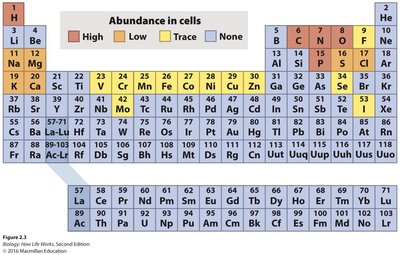
Four elements—oxygen, carbon, hydrogen, and nitrogen—make up over 96% of the human body mass. Other elements, such as calcium, phosphorus, and sulfur, are also essential in smaller amounts.
Element | Symbol | Percentage of Body Mass |
|---|---|---|
Oxygen | O | 65.0% |
Carbon | C | 18.5% |
Hydrogen | H | 9.5% |
Nitrogen | N | 3.3% |
Calcium | Ca | 1.5% |
Phosphorus | P | 1.0% |
Others | - | ~1.2% |
Electron Shells and Chemical Behavior
Electron Shells and Valence Electrons
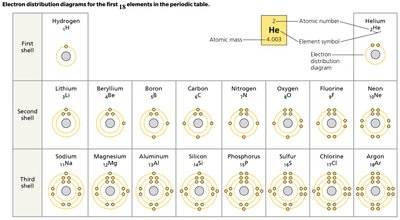
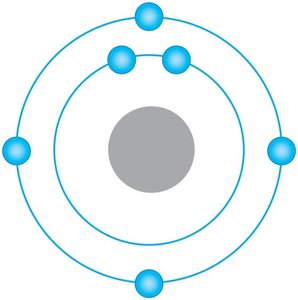
Electrons are arranged in shells around the nucleus. The chemical reactivity of an atom is determined by the number of electrons in its outermost shell, known as valence electrons.
The first shell holds up to 2 electrons.
The second shell holds up to 8 electrons.
The third shell also holds up to 8 electrons.
Atoms are most stable when their valence shell is full (the "octet rule").
Stability and the Octet Rule
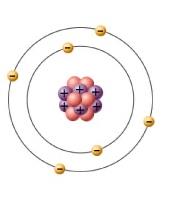
Atoms "strive" for stability by filling their valence shells. Atoms with incomplete outer shells are reactive and tend to form bonds to achieve a full shell.
Stable atoms: Full valence shell (2 or 8 electrons).
Unstable atoms: Incomplete valence shell; likely to form bonds.
Chemical Bonds
Ionic Bonds
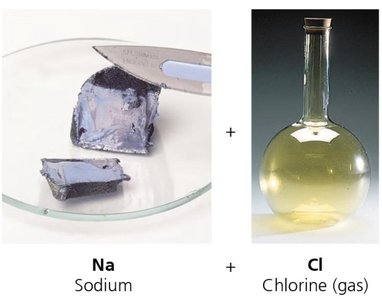
Ionic bonds are formed when one atom donates an electron to another, resulting in oppositely charged ions that attract each other. This typically occurs between atoms with large differences in electronegativity.
Cation: Positively charged ion (loses electron).
Anion: Negatively charged ion (gains electron).
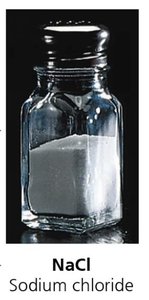
Example: Sodium (Na) donates an electron to chlorine (Cl), forming NaCl (table salt).
Covalent Bonds
Covalent bonds are formed when two atoms share one or more pairs of electrons. These bonds can be single, double, or triple, depending on the number of shared electron pairs.
Single bond: Sharing one pair of electrons (e.g., H-H).
Double bond: Sharing two pairs of electrons (e.g., O=O).
Triple bond: Sharing three pairs of electrons (e.g., N≡N).
Polarity and Electronegativity
Electronegativity is the ability of an atom to attract shared electrons. When atoms with different electronegativities form covalent bonds, the electrons are shared unequally, resulting in polar covalent bonds.
Non-polar covalent bond: Equal sharing of electrons; no charge difference.
Polar covalent bond: Unequal sharing; partial charges (δ+ and δ-) develop.
Ionic bond: Complete transfer of electrons; full charges on ions.
Determining Bond Types
The type of bond between two atoms can be predicted by the difference in their electronegativities:
Small difference (<0.5): Non-polar covalent
Moderate difference (0.5–1.7): Polar covalent
Large difference (>1.7): Ionic
Example: The bond in HCl (hydrogen chloride) is polar covalent because the difference in electronegativity is 0.9.
Biological Molecules and Their Components
Major Biomolecules
Cells are composed of four major classes of biomolecules: proteins, lipids, carbohydrates, and nucleic acids. Each class is built from specific elements and has unique functions in the cell.
Proteins: Made of amino acids; function as enzymes, structural components, and signaling molecules.
Lipids: Composed mainly of carbon and hydrogen; form membranes and store energy.
Carbohydrates: Made of sugars; provide energy and structural support.
Nucleic acids: DNA and RNA; store and transmit genetic information.
Ingredients of an Egg: A Model for Biomolecular Composition
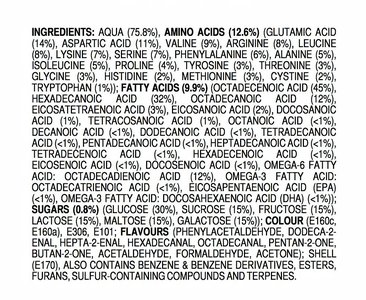
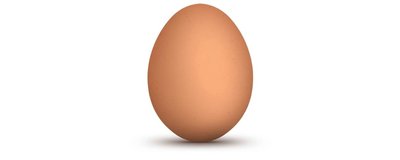
An egg contains water, amino acids (proteins), fatty acids (lipids), sugars (carbohydrates), and other trace compounds, illustrating the diversity of biomolecules in living systems.
Summary Table: Types of Chemical Bonds
Bond Type | Electron Sharing/Transfer | Polarity | Example |
|---|---|---|---|
Ionic | Transfer | Full charges | NaCl |
Non-polar Covalent | Equal sharing | No charge | O2, H2 |
Polar Covalent | Unequal sharing | Partial charges | H2O |
Key Concepts
Atoms interact via bonds to form molecules, which are essential for biological structure and function.
The chemical properties of biomolecules, including polarity and reactivity, are determined by atomic structure and bonding.
Understanding atomic and molecular interactions is foundational for studying cell biology, metabolism, genetics, and physiology.
