 Back
ATP and Energy Coupling in Cellular Work
Study Guide - Smart Notes
 Tailored notes based on your materials, expanded with key definitions, examples, and context.
ATP Powers Cellular Work by Coupling Exergonic and Endergonic Reactions
Types of Cellular Work
Cells perform three main types of work, each requiring energy input:
Chemical Work: Drives endergonic reactions, such as the synthesis of polymers from monomers.
Transport Work: Pumps substances across membranes against their concentration gradients.
Mechanical Work: Includes processes like cilia beating, muscle contraction, and chromosome movement during cell division.
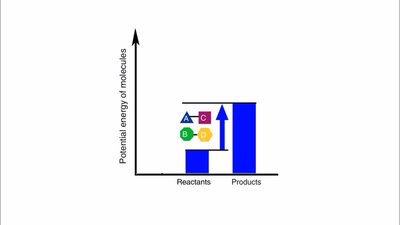
The cell manages its energy resources through energy coupling, using exergonic processes to drive endergonic ones. ATP (adenosine triphosphate) is the primary molecule responsible for mediating most energy coupling in cells.
The Structure and Hydrolysis of ATP
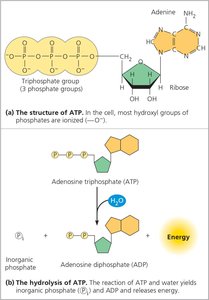
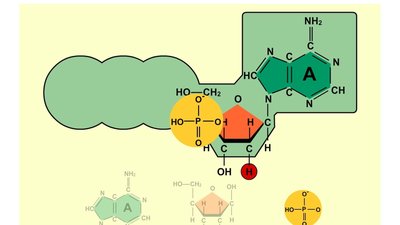
ATP consists of the sugar ribose, the nitrogenous base adenine, and three phosphate groups. The bonds between the phosphate groups can be broken by hydrolysis, releasing energy.
Hydrolysis Reaction: ATP + H2O → ADP + Pi (standard conditions)
Under cellular conditions, the actual is about -13 kcal/mol, due to differences in reactant and product concentrations.
The energy released comes from the transition to a state of lower free energy, not from unusually strong phosphate bonds.
The triphosphate tail of ATP is unstable due to the repulsion of negative charges, making it a "compressed spring" of chemical energy.
How ATP Provides Energy That Performs Work
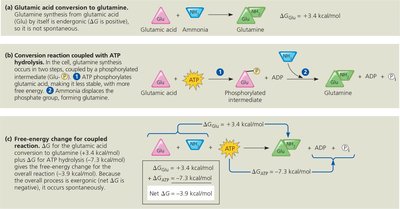
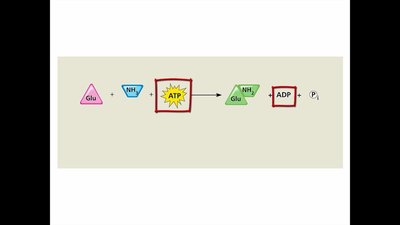
ATP hydrolysis releases free energy, which is harnessed by cellular proteins to perform work. The energy is used efficiently through phosphorylation, where a phosphate group is transferred from ATP to another molecule, creating a phosphorylated intermediate that is more reactive.
If the of an endergonic reaction is less than the energy released by ATP hydrolysis, the reactions can be coupled to become overall exergonic.
Phosphorylation increases the reactivity of the recipient molecule, facilitating the desired cellular reaction.
ATP in Transport and Mechanical Work
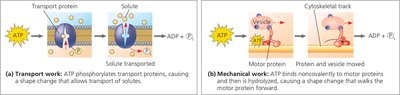
ATP hydrolysis powers transport and mechanical work by causing changes in protein shape and binding affinity:
Transport Work: ATP phosphorylates transport proteins, enabling active transport of solutes across membranes.
Mechanical Work: ATP binds to motor proteins, and its hydrolysis causes shape changes that move vesicles or organelles along cytoskeletal tracks.
Phosphorylation and dephosphorylation are crucial for protein shape changes in many cellular processes.
The Regeneration of ATP: The ATP Cycle
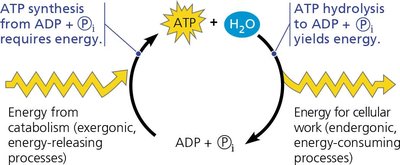
ATP is a renewable resource, regenerated by the addition of phosphate to ADP. The energy for this phosphorylation comes from exergonic breakdown reactions (catabolism), such as cellular respiration. This ATP cycle couples energy-yielding processes to energy-consuming ones.
A working muscle cell recycles its entire pool of ATP in less than a minute, consuming and regenerating about 10 million ATP molecules per second per cell.
Regeneration of ATP from ADP and Pi is endergonic: (standard conditions)
Catabolic pathways (especially cellular respiration) provide the energy for ATP synthesis; plants use light energy for ATP production.
Summary Table: ATP and Cellular Work
Type of Work | ATP Role | Example |
|---|---|---|
Chemical | Phosphorylation of reactants | Synthesis of glutamine from glutamic acid |
Transport | Phosphorylation of transport proteins | Active transport of ions across membranes |
Mechanical | Binding and hydrolysis by motor proteins | Movement of vesicles along cytoskeleton |
Key Terms and Concepts
ATP (Adenosine Triphosphate): The main energy currency of the cell.
Exergonic Reaction: Releases energy; spontaneous.
Endergonic Reaction: Requires energy input; non-spontaneous.
Phosphorylation: Transfer of a phosphate group to a molecule, increasing its reactivity.
Phosphorylated Intermediate: A molecule with a covalently bonded phosphate group, making it more reactive.
ATP Cycle: The continuous regeneration and consumption of ATP in cells.
Example: Coupling ATP Hydrolysis to Glutamine Synthesis
Glutamic acid + ammonia → glutamine (endergonic, kcal/mol)
ATP hydrolysis ( kcal/mol) is coupled to this reaction, making the overall process exergonic and spontaneous.
Additional info:
ATP is also a nucleoside triphosphate used in RNA synthesis.
Phosphorylation is a common regulatory mechanism in cell signaling and metabolism.
