 Back
Bacterial Transformation and the pGLO Plasmid: Principles and Laboratory Procedure
Study Guide - Smart Notes
 Tailored notes based on your materials, expanded with key definitions, examples, and context.
Bacterial Transformation
Introduction to Bacterial Transformation
Bacterial transformation is a fundamental technique in molecular biology that involves introducing foreign DNA into bacterial cells, resulting in the expression of new traits. This process is widely used for genetic engineering, research, and biotechnology applications.
Transformation: The process of introducing exogenous DNA (such as a plasmid) into bacteria, leading to genetic modification.
Plasmid: A small, circular DNA molecule that replicates independently of the bacterial chromosome and can carry genes of interest.
Gene Expression: The process by which information from a gene is used to synthesize a functional gene product, typically a protein.
Selection: The use of antibiotics or other agents to ensure only transformed cells survive and grow.
Example: GFP Expression in Transformed Organisms
The Green Fluorescent Protein (GFP) gene, originally isolated from the jellyfish Aequorea victoria, is commonly used as a reporter gene in transformation experiments. Organisms expressing GFP can be visually identified by their green fluorescence under UV light.
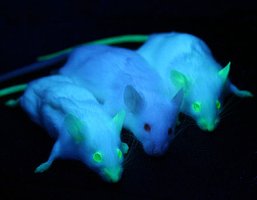
Example: The image above shows mice that have been genetically modified to express GFP, resulting in visible fluorescence under UV illumination. The control mouse in the center does not fluoresce, demonstrating the specificity of gene expression.
The pGLO Plasmid
Structure and Function of pGLO
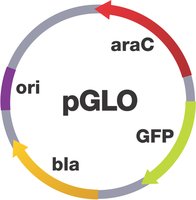
The pGLO plasmid is a genetically engineered DNA molecule used to transform bacteria. It contains several key genes that confer new traits to the host cell:
GFP gene: Encodes the Green Fluorescent Protein, allowing transformed cells to fluoresce under UV light.
bla gene: Encodes beta-lactamase, an enzyme that provides resistance to the antibiotic ampicillin.
araC gene: Encodes the AraC protein, a transcription factor that regulates the expression of the GFP gene in response to the sugar arabinose.
ori (origin of replication): Allows the plasmid to replicate independently within the bacterial cell.
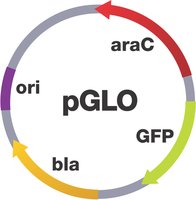
Additional info: The bla gene is constitutively expressed, meaning it is always active, while the GFP gene is under the control of the araC regulatory system and is only expressed in the presence of arabinose.
Gene Regulation in pGLO
Gene expression in bacteria is tightly regulated to conserve resources and respond to environmental changes. In the pGLO system:
When arabinose is present, AraC binds arabinose and activates transcription of the GFP gene, resulting in fluorescence.
In the absence of arabinose, GFP is not produced, and colonies appear white (non-fluorescent).
The bla gene is always expressed, providing ampicillin resistance regardless of arabinose presence.
Laboratory Procedure: Bacterial Transformation with pGLO
Overview of the Transformation Protocol
The transformation procedure involves several key steps to introduce the pGLO plasmid into bacteria and select for transformed cells:
Label microfuge tubes for (+)pGLO (with plasmid) and (–)pGLO (without plasmid).
Add transformation solution (CaCl2) to each tube to facilitate DNA uptake.
Transfer bacterial colonies into the transformation solution.
Add pGLO plasmid DNA to the (+)pGLO tube only.
Incubate tubes on ice, then subject them to a brief heat shock at 42°C to increase membrane permeability.
Return tubes to ice, then add LB nutrient broth to allow recovery.
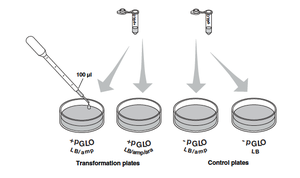
Plate samples on selective media containing ampicillin and/or arabinose to distinguish transformed from non-transformed cells.
Additional info: Only bacteria that have taken up the pGLO plasmid will survive on ampicillin-containing plates. GFP expression (fluorescence) will only be observed on plates containing both ampicillin and arabinose.
Plating and Selection
After transformation, bacteria are plated on different types of agar media to analyze the results:
LB/amp plate: Selects for bacteria with ampicillin resistance (transformed with pGLO).
LB/amp/ara plate: Selects for transformed bacteria and induces GFP expression (fluorescence) in the presence of arabinose.
LB plate: Serves as a control to show normal bacterial growth without selection pressure.
Summary Table: Genes and Their Functions in pGLO
Gene | Protein Product | Function | Regulation |
|---|---|---|---|
GFP | Green Fluorescent Protein | Fluorescence under UV light | Inducible (arabinose-dependent) |
bla | Beta-lactamase | Ampicillin resistance | Constitutive |
araC | AraC protein | Regulates GFP expression | Inducible (arabinose-dependent) |
Key Concepts and Applications
Transformation efficiency: Only a small fraction of bacteria take up the plasmid and are transformed.
Selection and screening: Antibiotic resistance and fluorescence allow for easy identification of transformed cells.
Gene regulation: The use of inducible promoters (such as the arabinose promoter) allows for controlled expression of target genes.
Example Application: The pGLO system is widely used in teaching laboratories to demonstrate principles of gene transfer, selection, and gene regulation in prokaryotes.
Additional info: The heat shock method is a standard technique for making bacterial membranes permeable to DNA, and the use of selective media is essential for distinguishing transformed from non-transformed cells.
