 Back
Bacterial Transformation and the pGLO Plasmid: Principles and Laboratory Protocol
Study Guide - Smart Notes
 Tailored notes based on your materials, expanded with key definitions, examples, and context.
Bacterial Transformation
Principle of Bacterial Transformation
Bacterial transformation is a process by which foreign DNA is introduced into a bacterial cell, resulting in a genetic change. This technique is fundamental in molecular biology for studying gene function and protein expression. In this lab, the transformation involves the uptake of a plasmid carrying specific genes, allowing the bacteria to express new traits.
Transformation: Introduction of exogenous DNA (plasmid) into bacteria, altering their genotype and phenotype.
Plasmid: A small, circular DNA molecule separate from the bacterial chromosome, often used as a vector for gene cloning.
Selection: Only bacteria that successfully take up the plasmid survive under selective conditions (e.g., antibiotic presence).
Application: Commonly used to produce proteins, study gene regulation, and create genetically modified organisms.
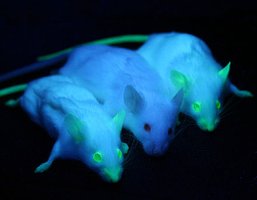
Example: In this experiment, bacteria are transformed with the pGLO plasmid, which carries the gene for Green Fluorescent Protein (GFP), allowing transformed cells to fluoresce under UV light.
The pGLO Plasmid
Genetic Components and Their Functions
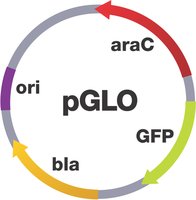
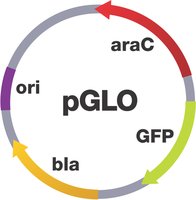
The pGLO plasmid is engineered to contain three key genes, each with a specific function in the transformation experiment:
GFP (Green Fluorescent Protein): Encodes a protein that fluoresces green under UV light, originally derived from the jellyfish Aequorea victoria.
bla (Beta-lactamase): Encodes an enzyme that provides resistance to the antibiotic ampicillin, allowing for selection of transformed cells.
araC: Encodes a regulatory protein that controls the expression of the GFP gene in response to the sugar arabinose.
ori (Origin of replication): Allows the plasmid to replicate independently within the bacterial cell.
Gene Regulation: The araC gene product acts as a transcription factor, activating GFP expression only in the presence of arabinose. In contrast, bla is constitutively expressed, conferring ampicillin resistance at all times.
Mechanism of Gene Regulation in pGLO
Inducible vs. Constitutive Expression
Gene expression in bacteria can be tightly regulated to respond to environmental changes. In the pGLO system:
Inducible Expression (GFP): The GFP gene is only transcribed when arabinose is present, due to the action of the araC protein bound to arabinose.
Constitutive Expression (bla): The beta-lactamase gene is always expressed, providing continuous ampicillin resistance.
Example: Bacteria transformed with pGLO will only glow green under UV light if arabinose is present in the growth medium.
Laboratory Protocol for Bacterial Transformation
Step-by-Step Procedure
The transformation protocol involves several key steps to ensure successful uptake of the pGLO plasmid by bacteria:
Label two microfuge tubes: one as (+)pGLO (with plasmid) and one as (–)pGLO (without plasmid).
Add 250 μl of transformation solution (CaCl2) to each tube.
Transfer a single bacterial colony into each tube using a sterile loop.
Add 10 μl of pGLO plasmid to the (+)pGLO tube only.
Incubate both tubes on ice for 10 minutes.
Heat shock both tubes at 42°C for 50 seconds to facilitate DNA uptake.
Return tubes to ice for 2 minutes.
Add 250 μl of LB nutrient broth to each tube and incubate at room temperature for 10 minutes.
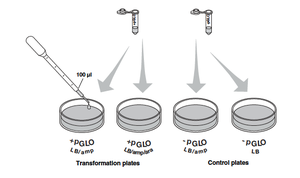
Plate 100 μl from each tube onto selective and control agar plates as follows:
(+)pGLO: LB/amp, LB/amp/ara
(–)pGLO: LB/amp, LB
Spread the suspension evenly on the agar surface using a sterile loop.
Incubate plates upside down at 37°C overnight.
Observe and document colony growth and fluorescence the next day.
Expected Results and Analysis
Selection and Screening
After incubation, the following outcomes are expected:
(+)pGLO on LB/amp: Growth of ampicillin-resistant colonies (transformed).
(+)pGLO on LB/amp/ara: Growth of ampicillin-resistant colonies that fluoresce green under UV light (GFP expression induced by arabinose).
(–)pGLO on LB/amp: No growth (no ampicillin resistance).
(–)pGLO on LB: Growth of non-transformed colonies (no selection pressure).
Summary Table: Plate Outcomes
Plate | Plasmid | Ampicillin | Arabinose | Growth | Fluorescence |
|---|---|---|---|---|---|
LB/amp | + | Yes | No | Yes | No |
LB/amp/ara | + | Yes | Yes | Yes | Yes |
LB/amp | – | Yes | No | No | No |
LB | – | No | No | Yes | No |
Key Terms and Concepts
Transformation Solution (CaCl2): Facilitates the uptake of plasmid DNA by making bacterial membranes more permeable.
Heat Shock: A brief increase in temperature that helps drive plasmid DNA into bacterial cells.
Selection Marker: A gene (e.g., bla) that allows for identification of transformed cells.
Reporter Gene: A gene (e.g., GFP) whose expression is easily observed, used to monitor gene expression and transformation success.
Applications of Bacterial Transformation
Production of recombinant proteins (e.g., insulin, enzymes).
Genetic engineering of organisms for research, agriculture, and medicine.
Study of gene regulation and function using reporter genes like GFP.
Additional info: The pGLO system is a classic example of how gene expression can be regulated in response to environmental signals, and how selectable and screenable markers are used in molecular biology.
