 Back
Balancing Chemical Equations: Atoms Count Table Guidance
Study Guide - Smart Notes
 Tailored notes based on your materials, expanded with key definitions, examples, and context.
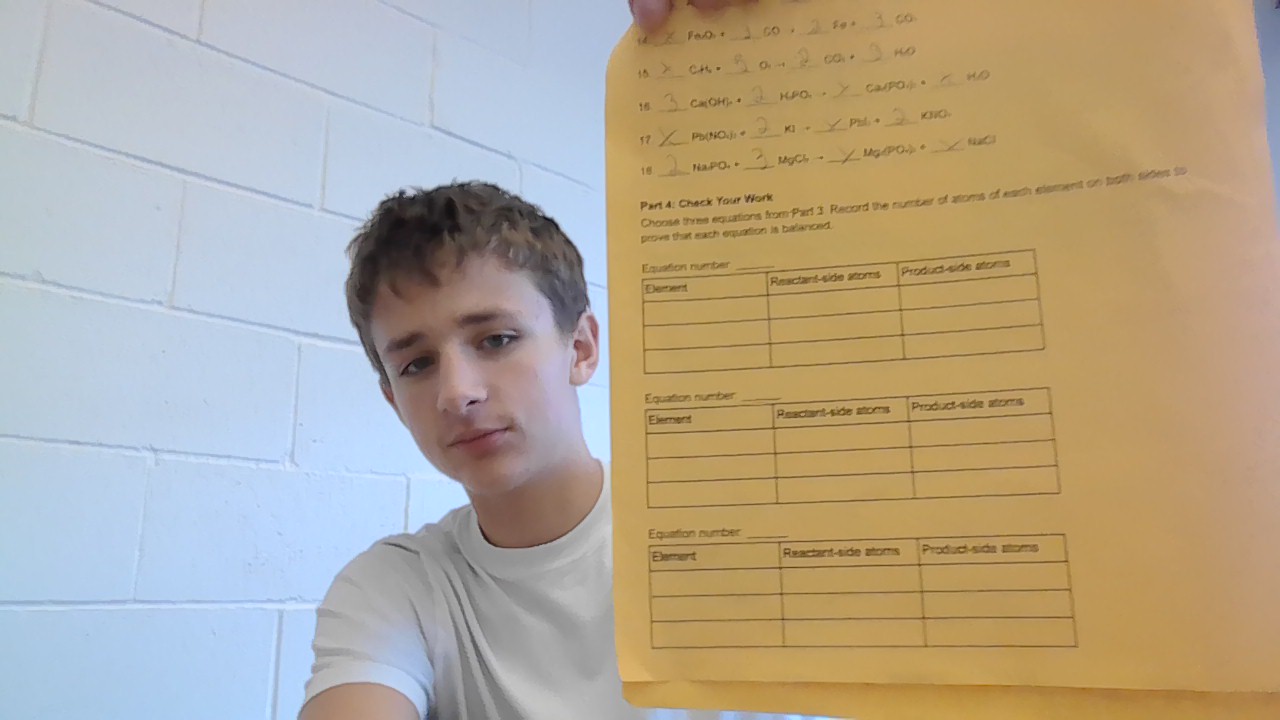
Q1. For each selected equation, record the number of atoms of each element on both sides to prove the equation is balanced.
Background
Topic: Balancing Chemical Equations
This question tests your understanding of the Law of Conservation of Mass, which states that matter cannot be created or destroyed in a chemical reaction. To demonstrate this, you must show that the number of atoms for each element is the same on both the reactant and product sides of the equation.
Key Terms and Formulas:
Reactant: The starting substances in a chemical reaction.
Product: The substances formed as a result of the reaction.
Balanced Equation: An equation where the number of atoms for each element is equal on both sides.
Law of Conservation of Mass:
Step-by-Step Guidance
Choose a chemical equation from your worksheet. Write it out clearly, identifying the reactants and products.
List each element present in the equation. For example, if your equation is , the elements are Fe, O, and C.
Count the number of atoms of each element on the reactant side. For example, in , there are 2 Fe and 3 O atoms.
Count the number of atoms of each element on the product side. For example, in , there are 2 Fe atoms.
Record your counts in the table provided: one column for reactant-side atoms, one for product-side atoms.
Check if the counts for each element match on both sides. If not, revisit the equation and adjust coefficients as needed to balance it.
Try solving on your own before revealing the answer!
Final Answer Example:
For the equation :
Fe: Reactant-side = 2, Product-side = 2
O: Reactant-side = 3 (from FeO) + 3 (from CO) = 6, Product-side = 6 (from 3 CO$_2$)
C: Reactant-side = 3 (from CO), Product-side = 3 (from 3 CO)
All elements are balanced, so the equation is correctly balanced.
