Back
BackBasic Chemistry and Atomic Structure for Biology
Study Guide - Smart Notes
 Tailored notes based on your materials, expanded with key definitions, examples, and context.
Basic Chemistry in Biology
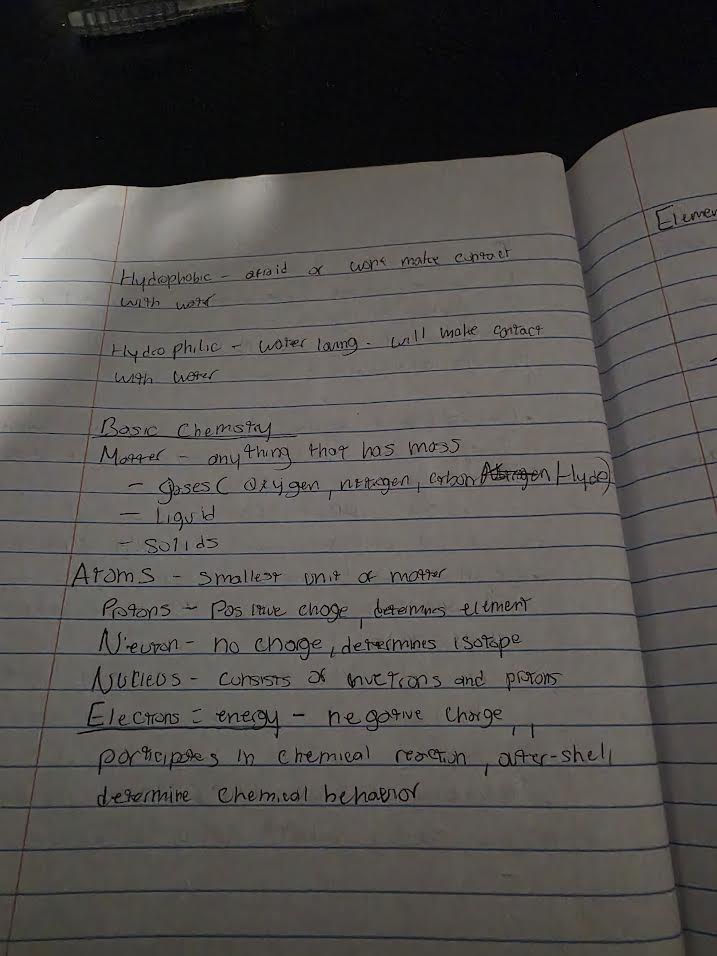
Hydrophobic and Hydrophilic Substances
Understanding how substances interact with water is fundamental in biology, as it influences cell structure, membrane formation, and biochemical reactions.
Hydrophobic: Substances that avoid or do not make contact with water. These molecules are typically nonpolar and do not dissolve in water (e.g., oils, fats).
Hydrophilic: Substances that are water-loving and will make contact with water. These molecules are usually polar or charged and dissolve easily in water (e.g., salts, sugars).
Example: Cell membranes are composed of phospholipids with hydrophobic tails and hydrophilic heads, allowing them to form bilayers in aqueous environments.
Matter and Its States
Matter is anything that has mass and occupies space. In biological systems, matter exists in different states, each with unique properties and relevance to life processes.
Gases: Examples include oxygen (O2), nitrogen (N2), carbon dioxide (CO2), and hydrogen (H2).
Liquids: Water is the most biologically important liquid.
Solids: Many biological molecules and structures (e.g., bones, cell walls) are solid at physiological conditions.
Atomic Structure
Atoms: The Building Blocks of Matter
An atom is the smallest unit of matter that retains the properties of an element. Atoms are composed of subatomic particles with distinct properties and roles in chemical behavior.
Protons: Positively charged particles found in the nucleus. The number of protons determines the element's identity (atomic number).
Neutrons: Neutral particles (no charge) also located in the nucleus. The number of neutrons determines the isotope of an element.
Nucleus: The dense central core of the atom, consisting of protons and neutrons.
Electrons: Negatively charged particles that orbit the nucleus in electron shells. Electrons possess energy and their arrangement determines how atoms interact in chemical reactions.
Chemical Behavior: The distribution of electrons, especially in the outermost shell (valence shell), determines an atom's chemical properties and reactivity.
Example: Carbon has 6 protons, 6 neutrons (in its most common isotope), and 6 electrons. Its four valence electrons allow it to form stable covalent bonds with other atoms, making it essential for organic molecules.
Summary Table: Subatomic Particles
Particle | Charge | Location | Role |
|---|---|---|---|
Proton | +1 | Nucleus | Determines element |
Neutron | 0 | Nucleus | Determines isotope |
Electron | -1 | Electron shells | Determines chemical behavior |
Key Equations
Atomic Number (Z):
Mass Number (A):
*Additional info: Expanded explanations and examples were added for clarity and completeness based on standard introductory biology and chemistry content.*