 Back
Basic Chemistry and the Molecules of Life: Foundations for Biology
Study Guide - Smart Notes
 Tailored notes based on your materials, expanded with key definitions, examples, and context.
Atoms, Elements, and the Periodic Table
Structure of Atoms
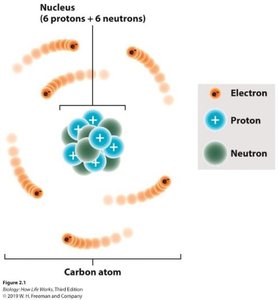
Atoms are the fundamental units of matter, composed of three types of subatomic particles: protons, neutrons, and electrons. The nucleus contains protons (positively charged) and neutrons (neutral), while electrons (negatively charged) orbit the nucleus in defined shells.
Atomic Number: The number of protons in the nucleus, which defines the element.
Atomic Mass: The sum of protons and neutrons in the nucleus.
Electron Shells: Electrons occupy energy levels (shells) around the nucleus; the outermost shell is called the valence shell.
Elements and Their Abundance in Biology
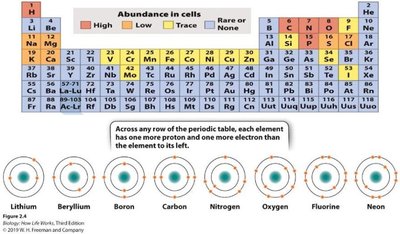
Elements are pure substances consisting of only one type of atom. Of the 118 known elements, only a handful are abundant in living organisms. The most common biological elements are carbon (C), hydrogen (H), oxygen (O), nitrogen (N), phosphorus (P), and sulfur (S).
Biological Abundance: C, H, O, N, P, and S make up 99% of the mass of most organisms.
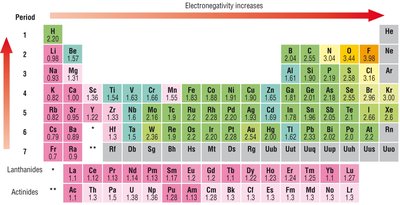
Periodic Table Organization: Elements in the same row have the same number of electron shells; elements in the same column have similar chemical properties.
Valence Electrons and Chemical Bonding
Valence Electrons
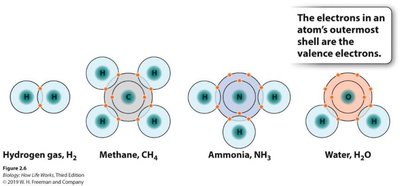
Valence electrons are the electrons in the outermost shell of an atom. These electrons determine the chemical reactivity and bonding behavior of the atom. Atoms are most stable when their valence shells are full, often containing eight electrons (the octet rule).
Examples: Hydrogen (1 valence electron), Carbon (4), Nitrogen (5), Oxygen (6).
Bond Formation: Atoms form chemical bonds to achieve full valence shells, resulting in stable molecules.
Types of Chemical Bonds
Strong Chemical Bonds: Covalent and Ionic
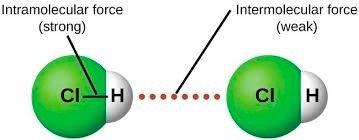
Chemical bonds are classified as strong (covalent and ionic) or weak (non-covalent). Strong bonds hold atoms together within molecules.
Covalent Bonds: Atoms share pairs of electrons. Can be nonpolar (equal sharing) or polar (unequal sharing).
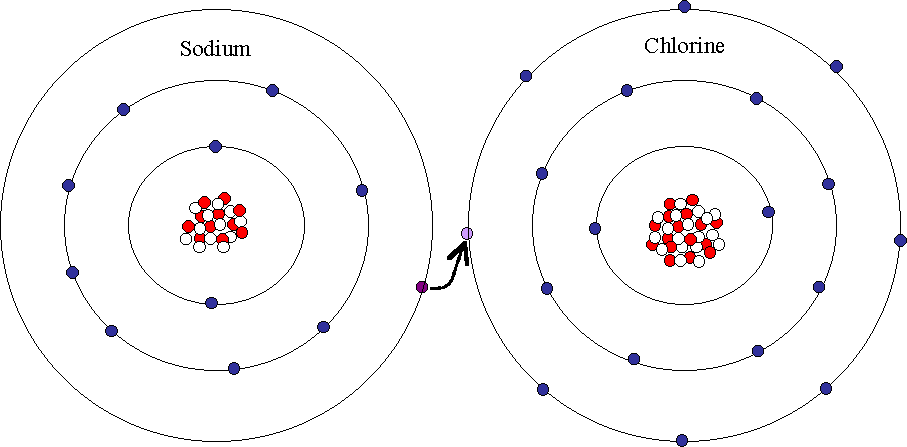
Ionic Bonds: One atom donates an electron to another, resulting in oppositely charged ions that attract each other.
Electronegativity and Bond Polarity
Electronegativity is the tendency of an atom to attract shared electrons in a chemical bond. The difference in electronegativity between two atoms determines the type of bond formed:
Nonpolar Covalent: Electrons are shared equally (e.g., H2).
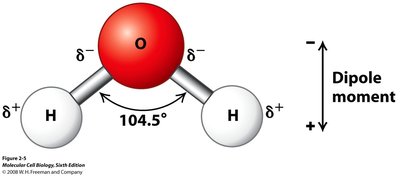
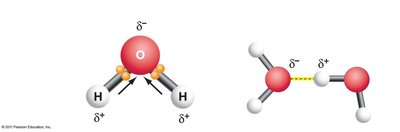
Polar Covalent: Electrons are shared unequally, creating partial charges (e.g., H2O).
Ionic: Electrons are transferred, forming ions (e.g., NaCl).
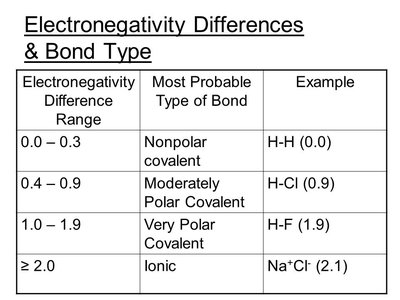
Electronegativity Difference Range | Most Probable Type of Bond | Example |
|---|---|---|
0.0 – 0.3 | Nonpolar covalent | H–H (0.0) |
0.4 – 0.9 | Moderately Polar Covalent | H–Cl (0.9) |
1.0 – 1.9 | Very Polar Covalent | H–F (1.9) |
≥ 2.0 | Ionic | Na+Cl– (2.1) |
Examples of Bonding in Biological Molecules
Methane (CH4): Nonpolar covalent bonds between carbon and hydrogen.
Water (H2O): Polar covalent bonds, resulting in a dipole moment.
Sodium Chloride (NaCl): Ionic bond between Na+ and Cl–.
Macromolecules and Covalent Bonds
Types of Covalent Bonds in Biomolecules
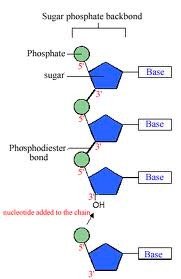
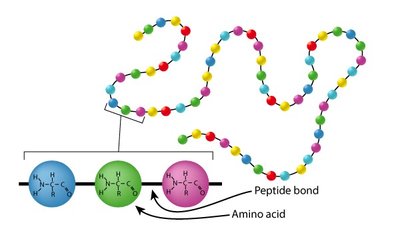
Macromolecules are large biological molecules made by linking smaller units (monomers) via covalent bonds:
Macromolecule | Monomer Unit | Covalent Bond |
|---|---|---|
Nucleic Acids | Nucleotide | Phosphodiester Bond |
Proteins | Amino Acid | Peptide Bond |
Carbohydrates | Monosaccharide | Glycosidic Bond |
Lipids | Fatty Acid + Glycerol | Ester Bond |
Weak Chemical Bonds: Noncovalent Interactions
Types of Noncovalent Bonds
Noncovalent interactions are weaker than covalent bonds but are essential for the structure and function of biomolecules. They allow for transient and reversible interactions.
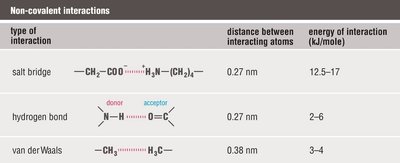
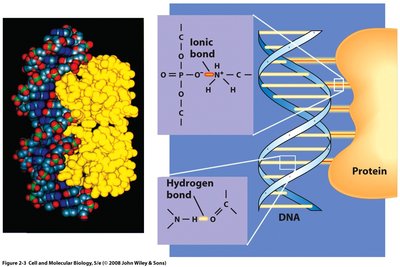
Salt Bridges: Ionic interactions between charged groups.
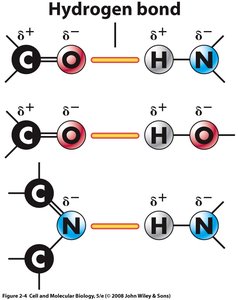
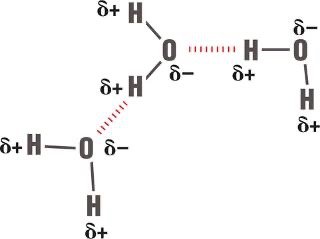
Hydrogen Bonds: Attraction between a hydrogen atom covalently bonded to an electronegative atom (like O or N) and another electronegative atom.
Van der Waals/Hydrophobic Interactions: Weak attractions due to transient dipoles; nonpolar molecules cluster together to avoid water.
Type of Interaction | Distance (nm) | Energy (kJ/mol) |
|---|---|---|
Salt bridge | 0.27 | 12.5–17 |
Hydrogen bond | 0.27 | 2–6 |
Van der Waals | 0.38 | 3–4 |
Examples and Importance in Biology
Protein-DNA Binding: Noncovalent bonds allow proteins to bind DNA transiently.
Cell Membrane Formation: Hydrophobic interactions drive the assembly of lipid bilayers.
Protein Folding: Noncovalent bonds stabilize protein structure.
Hydrophobic and Hydrophilic Interactions
Hydrogen Bonds and Water
Water is a polar molecule capable of forming hydrogen bonds. These interactions are responsible for many of water's unique properties, such as high cohesion, surface tension, and its role as a universal solvent.
Hydrophilic: Molecules that are charged or polar interact well with water.
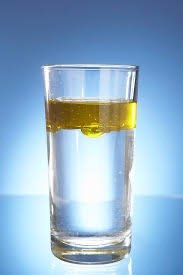
Hydrophobic: Nonpolar molecules cluster together to minimize contact with water.
Hydrophobic Effect and Membrane Formation
Hydrophobic interactions are critical for the formation of biological membranes. Nonpolar molecules, such as lipids, aggregate in aqueous environments, forming structures like micelles and bilayers that are fundamental to cell membranes.
Summary Table: Covalent and Noncovalent Interactions in Biomolecules
Bond Type | Example in Biomolecule |
|---|---|
Covalent (Strong) | Phosphodiester (DNA/RNA), Peptide (Proteins), Glycosidic (Carbohydrates), Ester (Lipids) |
Noncovalent (Weak) | Hydrogen bonds (DNA base pairing), Ionic interactions (protein-DNA binding), Hydrophobic interactions (membrane formation), Van der Waals (protein folding) |
Key Takeaways
Atoms and elements are the building blocks of matter; their properties are determined by subatomic particles and electron configuration.
Chemical bonds (covalent and ionic) form stable molecules essential for life.
Electronegativity differences dictate bond polarity and molecular interactions.
Noncovalent interactions are crucial for the dynamic structure and function of biological macromolecules.
Hydrophobic and hydrophilic interactions drive the organization of cellular structures, such as membranes.
