 Back
Basic Chemistry for Biology: Atoms, Bonds, and Water
Study Guide - Smart Notes
 Tailored notes based on your materials, expanded with key definitions, examples, and context.
Importance of Chemistry to Life
Atoms: The Basic Building Blocks
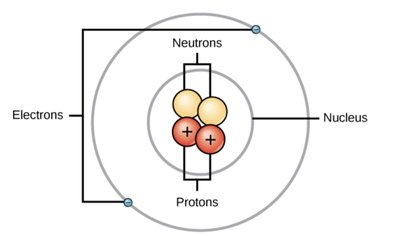
Atoms are the fundamental units of matter, forming the basis of all substances in biology. Each atom consists of a nucleus containing protons and neutrons, surrounded by electrons in orbitals.
Protons: Positively charged particles found in the nucleus.
Neutrons: Neutral particles also located in the nucleus.
Electrons: Negatively charged particles that orbit the nucleus.
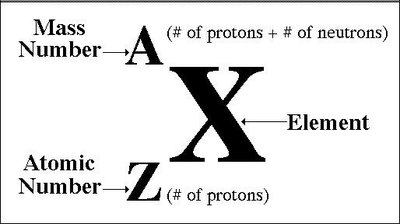
Element Identity: Determined by the number of protons (atomic number).
Elements of Life
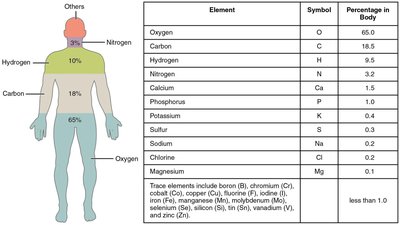
Living organisms require certain elements to survive and reproduce. These are classified as essential elements and trace elements.
Essential elements: Needed in large amounts (e.g., oxygen, carbon, hydrogen, nitrogen).
Trace elements: Required in minute quantities (e.g., iron, zinc).
Electron Distribution and the Periodic Table
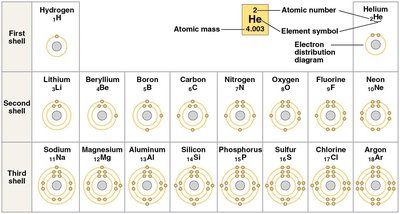
The arrangement of electrons in shells determines how atoms interact and bond with each other. The first 18 elements show distinct electron distribution patterns.
Chemical Bonds and Molecular Structure
Types of Chemical Bonds
Atoms with incomplete outer shells can share or transfer electrons, resulting in chemical bonds. The main types are:
Covalent Bonds: Sharing of electron pairs between atoms.
Ionic Bonds: Transfer of electrons, creating oppositely charged ions.
Hydrogen Bonds: Attraction between a hydrogen atom and an electronegative atom.
Covalent Bonds
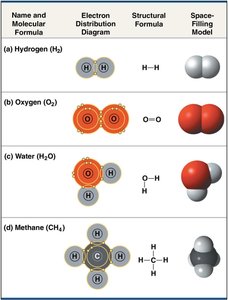
Covalent bonds involve the sharing of electrons. They can be single, double, or triple bonds, depending on the number of shared electron pairs.
Single bond: One pair of electrons shared.
Double bond: Two pairs of electrons shared.
Molecule: Two or more atoms held together by covalent bonds.
Electronegativity and Bond Polarity
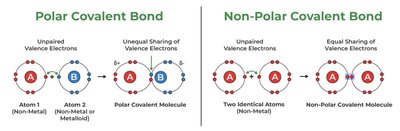
Electronegativity is an atom's ability to attract electrons in a covalent bond. If atoms have different electronegativities, the bond is polar; if they are equal, the bond is nonpolar.
Polar covalent bond: Unequal sharing of electrons, resulting in partial charges.
Nonpolar covalent bond: Equal sharing of electrons.
Ionic Bonds
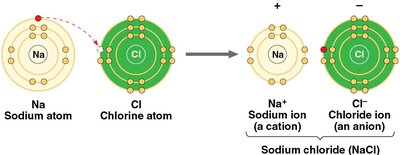
Ionic bonds form when electrons are transferred from one atom to another, creating ions. The attraction between oppositely charged ions forms the bond.
Cation: Positively charged ion.
Anion: Negatively charged ion.
Solubility of Ionic Compounds
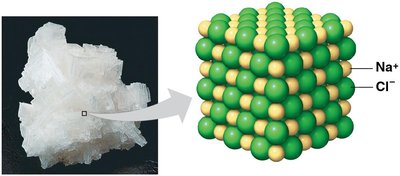
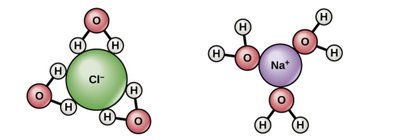
Ionic compounds like NaCl are soluble in water due to the formation of hydration spheres around the ions.
Weak Chemical Interactions
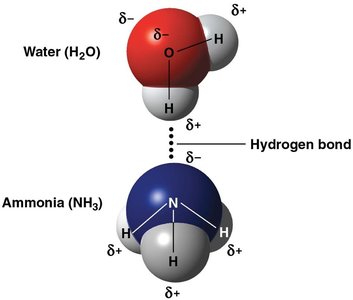
Weak bonds, such as hydrogen bonds and van der Waals interactions, play crucial roles in maintaining the structure and function of biological molecules.
Hydrogen bonds: Form between hydrogen and electronegative atoms (usually oxygen or nitrogen).
Van der Waals interactions: Weak, temporary attractions due to fluctuating charges.
Chemical Reactions
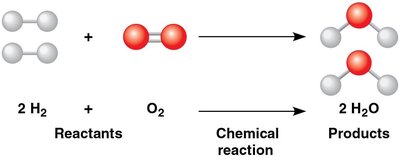
Chemical reactions involve making and breaking chemical bonds. Reactants are transformed into products, and reactions are often reversible.
Reactants: Starting molecules.
Products: Final molecules.
Water: Unique Properties and Biological Importance
Structure and Polarity of Water
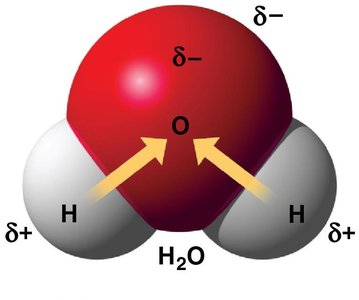
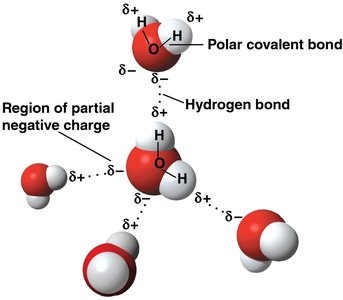
Water molecules are polar, with the oxygen atom carrying a partial negative charge and the hydrogen atoms carrying partial positive charges. This polarity allows water molecules to form hydrogen bonds with each other.
Emergent Properties of Water
Hydrogen bonding gives water several unique properties essential for life:
Cohesive behavior: Water molecules stick together, enabling surface tension.
Ability to moderate temperature: Water absorbs and releases heat slowly.
Expansion upon freezing: Ice is less dense than liquid water.
Versatility as a solvent: Water dissolves many substances, making it the universal solvent.
Hydrophilic and Hydrophobic Substances
Substances interact with water based on their polarity:
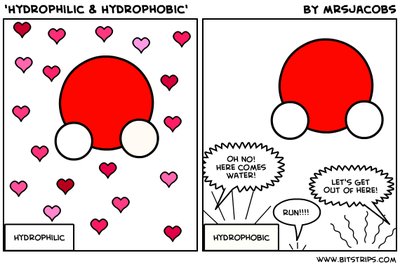
Hydrophilic: Affinity for water; typically polar or ionic.
Hydrophobic: Repelled by water; typically nonpolar.
Water-Soluble Proteins
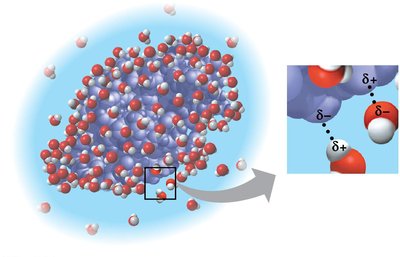
Proteins that dissolve in water are often hydrophilic, interacting with water molecules through hydrogen bonds.
Case Study: Gecko Adhesion and Van der Waals Forces
Gecko Climbing Mechanism
Geckos can climb smooth surfaces due to millions of microscopic hairs (setae) on their toes. These hairs interact with surfaces through van der Waals forces, which are weak, temporary electrical attractions.
Van der Waals forces: Arise from temporary charge fluctuations in atoms and molecules.
Gecko adhesion: Effective only on surfaces with charge; fails on neutral, nonpolar surfaces.

Environmental Effects on Gecko Adhesion
Acidic environments disrupt gecko adhesion by covering surfaces with uniform positive charges, preventing the formation of van der Waals interactions.

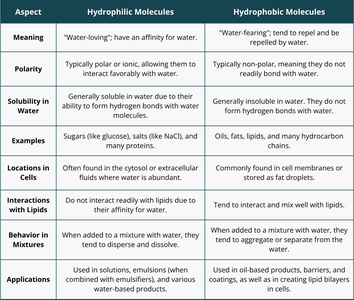
Summary Table: Hydrophilic vs. Hydrophobic Molecules
Aspect | Hydrophilic Molecules | Hydrophobic Molecules |
|---|---|---|
Meaning | "Water-loving"; have an affinity for water | "Water-fearing"; tend to repel and be repelled by water |
Polarity | Typically polar or ionic | Typically non-polar |
Solubility in Water | Generally soluble | Generally insoluble |
Examples | Sugars, salts, many proteins | Oils, fats, hydrocarbons |
Locations in Cells | Cytosol, extracellular fluids | Cell membranes, droplets |
Interactions with Lipids | Do not interact readily | Tend to interact and mix |
Behavior in Mixtures | Disperse and dissolve | Aggregate and separate |
Applications | Solutions, emulsions | Barriers, coatings |
Additional info: Context and explanations have been expanded for clarity and completeness, including definitions, examples, and applications relevant to General Biology.
