 Back
BackBasic Chemistry for Biology: Atoms, Elements, and Chemical Bonds
Study Guide - Smart Notes
 Tailored notes based on your materials, expanded with key definitions, examples, and context.
Atoms and Subatomic Particles
Structure of the Atom
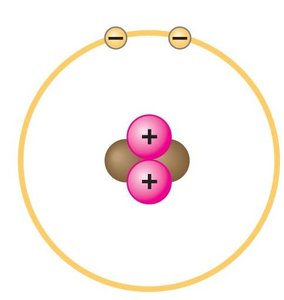
Atoms are the fundamental units of matter, composed of three main subatomic particles: protons, neutrons, and electrons. The arrangement and properties of these particles determine the chemical behavior of each element.
Protons: Positively charged particles found in the atomic nucleus. The number of protons defines the atomic number and determines the element.
Neutrons: Neutral particles also located in the nucleus. The number of neutrons determines the isotope of an element.
Electrons: Negatively charged particles that orbit the nucleus in electron shells. Electrons are responsible for chemical reactivity.
Atomic Number and Isotopes
Atomic Number: The number of protons in the nucleus; unique for each element.
Isotopes: Variants of elements with different numbers of neutrons, affecting atomic mass. Stable isotopes do not decay, while radioactive isotopes emit particles and energy.
Electron Shells and Orbitals
Organization of Electrons
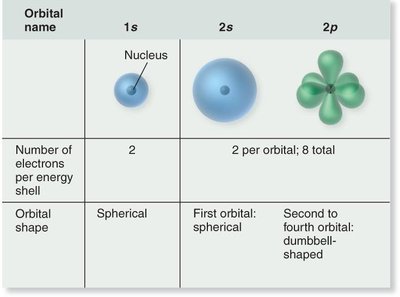
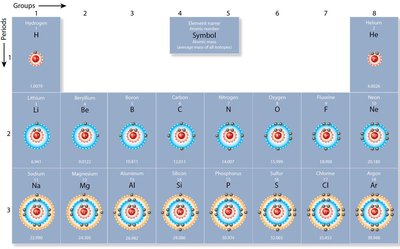
Electrons are arranged in shells around the nucleus, each with a specific energy level. Shells contain orbitals, which are regions where electrons are likely to be found.
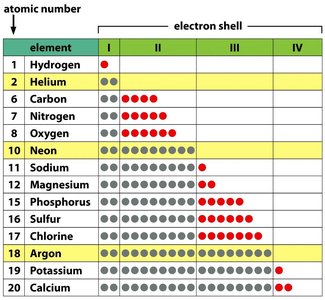
Shells: The first shell holds up to 2 electrons, the second up to 8, and the third up to 18.
Orbitals: Each orbital can hold a maximum of 2 electrons. The shape of orbitals (spherical or dumbbell) affects electron distribution.
Electron Configuration Examples
Helium: One shell, two electrons in a single spherical orbital.
Neon: Two shells; first shell (2 electrons), second shell (8 electrons: 2 in 2s, 6 in three 2p orbitals).
Argon: Three shells; first shell (2 electrons), second shell (8 electrons), third shell (8 electrons).
Valence Electrons and Reactivity
Valence Shells
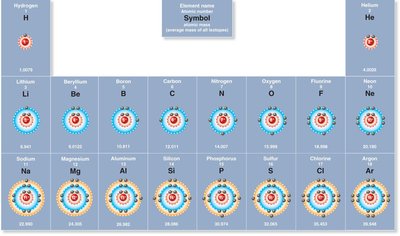
The chemical behavior of an atom is determined by the configuration of its valence electrons—those in the outermost shell.
Inert Atoms: Atoms with complete valence shells (e.g., noble gases) are chemically unreactive.
Reactive Atoms: Atoms with incomplete valence shells tend to react to achieve stability, often by forming chemical bonds.
Elements Essential for Life
Major Elements in Living Cells
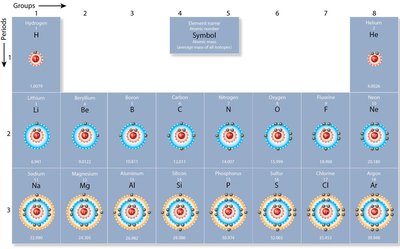
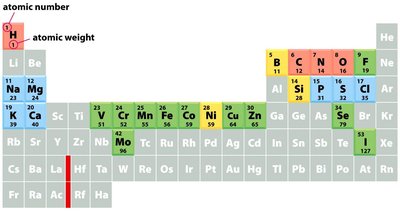
About 25 elements are required for life, but four elements make up 99% of the matter in living cells:
Carbon (C)
Hydrogen (H)
Oxygen (O)
Nitrogen (N)
Chemical Bonds and Molecules
Types of Chemical Bonds
Atoms with incomplete valence shells can share or transfer electrons to form molecules. The main types of chemical bonds are:
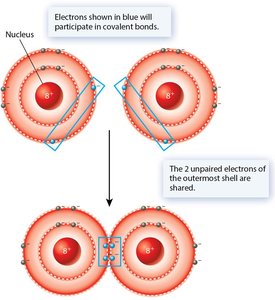
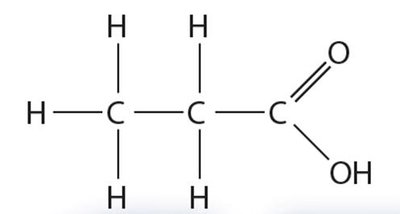
Covalent Bonds: Strong bonds formed when two atoms share one or more pairs of electrons. Can be single, double, or triple bonds.
Polar Covalent Bonds: Electrons are shared unequally, resulting in partial charges (e.g., water molecules).
Nonpolar Covalent Bonds: Electrons are shared equally between atoms with similar electronegativities.
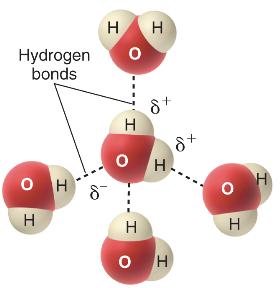
Hydrogen Bonds: Weak, noncovalent bonds formed between a hydrogen atom in one molecule and an electronegative atom in another.
Ionic Bonds: Formed by the attraction between oppositely charged ions (cations and anions).
Covalent Bond Examples
Single Covalent Bond: Two atoms share one pair of electrons (e.g., H2).
Double Covalent Bond: Two atoms share two pairs of electrons (e.g., O2).
Polar and Nonpolar Covalent Bonds
Polar Covalent: Unequal sharing leads to partial positive and negative charges (e.g., H2O).
Nonpolar Covalent: Equal sharing, no charge separation (e.g., C-H bonds).
Hydrogen Bonds
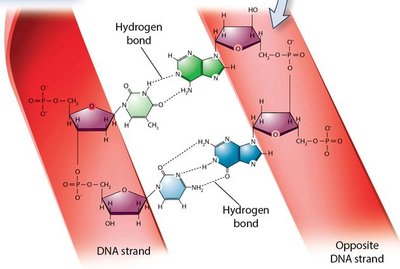
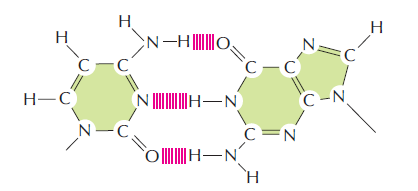
Hydrogen bonds are critical for the structure and function of biological molecules, such as DNA and proteins.
Form between a hydrogen atom covalently bonded to an electronegative atom and another electronegative atom.
Can be intermolecular (between molecules) or intramolecular (within a molecule).
Ionic Bonds
Ionic bonds result from the electrostatic attraction between oppositely charged ions.
Cations: Positively charged ions (e.g., Na+).
Anions: Negatively charged ions (e.g., Cl-).
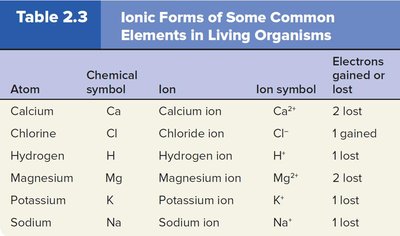
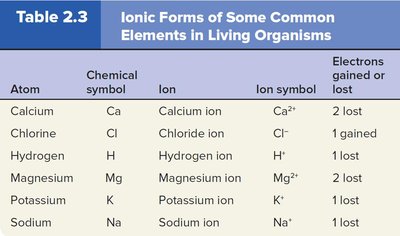
Table: Ionic Forms of Common Elements in Living Organisms
Atom | Chemical Symbol | Ion | Ion Symbol | Electrons Gained or Lost |
|---|---|---|---|---|
Calcium | Ca | Calcium ion | Ca2+ | 2 lost |
Chlorine | Cl | Chloride ion | Cl- | 1 gained |
Hydrogen | H | Hydrogen ion | H+ | 1 lost |
Magnesium | Mg | Magnesium ion | Mg2+ | 2 lost |
Potassium | K | Potassium ion | K+ | 1 lost |
Sodium | Na | Sodium ion | Na+ | 1 lost |
Noncovalent Interactions and Molecular Structure
Importance in Biology
Noncovalent bonds, including hydrogen bonds, ionic bonds, and hydrophobic interactions, are essential for stabilizing the three-dimensional structure of biological molecules.
Critical for protein folding, enzyme-substrate interactions, and DNA structure.
Allow for dynamic and reversible interactions necessary for biological function.
Summary Table: Subatomic Particles and Their Functions
Particle | Charge | Location | Function |
|---|---|---|---|
Proton | +1 | Nucleus | Determines element |
Neutron | 0 | Nucleus | Determines isotope |
Electron | -1 | Electron shells | Determines reactivity |
Key Equations
Atomic Mass:
Electron Capacity per Shell: (where n = shell number)
Conclusion
Understanding the structure of atoms, the arrangement of electrons, and the types of chemical bonds is fundamental to biology. These principles explain how elements interact to form the molecules essential for life. Additional info: Expanded explanations and context were added to clarify electron shell filling, orbital shapes, and the biological importance of chemical bonds.
