 Back
lecture 1 Chapter 40 Basic Principles of Animal Form and Function
Study Guide - Smart Notes
 Tailored notes based on your materials, expanded with key definitions, examples, and context.
lecture 1 Chapter 40 Basic Principles of Animal Form and Function
Overview: Anatomy and Physiology
Animal biology explores the relationship between anatomy (biological form) and physiology (biological function). The comparative study of animals reveals that form and function are closely linked, shaped by evolutionary pressures and physical constraints. Understanding these principles is essential for grasping how animals survive and thrive in diverse environments.
Anatomy: The study of the structure of organisms and their parts.
Physiology: The study of the functions and processes of living organisms.
Form and Function: Animal structures are optimized for their functions, influenced by resources and physical laws.
Correlation of Form and Function at All Levels of Organization
Physical and Evolutionary Constraints
Animal size and shape affect interactions with the environment. Physical laws, such as gravity and diffusion, set limits on possible forms. Evolutionary convergence leads to similar adaptations in unrelated species facing similar challenges.
Gravity: Larger animals require proportionally larger skeletons for support and movement.
Diffusion: The rate of exchange of materials is proportional to surface area, while the amount needed is proportional to volume (surface area-to-volume ratio is critical).
Evolutionary Convergence: Different species may evolve similar body shapes when adapting to similar environments.

Exchange with the Environment
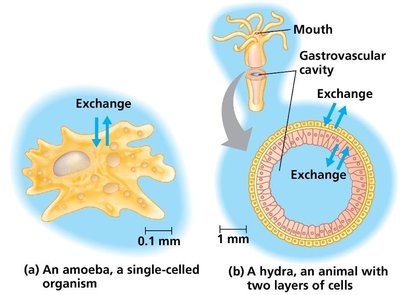
Animals must exchange nutrients, gases, and wastes with their environment. The efficiency of this exchange depends on the organism's structure.
Single-celled organisms: Have sufficient surface area for exchange.
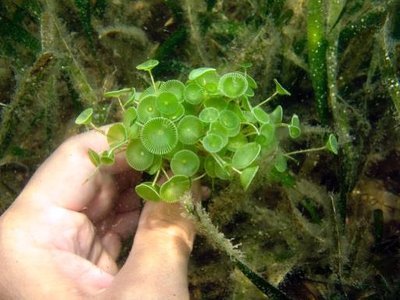
Simple multicellular organisms: Sac-like bodies or flat shapes allow direct exchange with the environment.
Complex multicellular organisms: Require specialized, branched, or folded internal surfaces for efficient exchange.
Hierarchical Organization of Body Plans
Animals are organized into a hierarchy: cells form tissues, tissues form organs, and organs form organ systems. Some organs, like the pancreas, serve multiple systems.
Tissues: Groups of cells with a common structure and function.
Organs: Structures composed of multiple tissue types.
Organ Systems: Groups of organs that work together to perform major functions.
Organ System | Main Components | Main Functions |
|---|---|---|
Digestive | Mouth, esophagus, stomach, intestines, liver, pancreas, anus | Food processing (ingestion, digestion, absorption, elimination) |
Circulatory | Heart, blood vessels, blood | Internal distribution of materials |
Respiratory | Lungs, trachea, other tubes | Gas exchange (O2:CO2) |
Immune & Lymphatic | Bone marrow, lymph nodes, thymus, spleen, lymph vessels, white blood cells | Body defense |
Excretory | Kidneys, urinary bladder, urethra | Disposal of metabolic wastes |
Endocrine | Pituitary, thyroid, pancreas, adrenal, and other hormone-secreting glands | Coordination of body activities (digestion, metabolism) |
Reproductive | Ovaries or testes and associated organs | Reproduction |
Nervous | Brain, spinal cord, nerves, sensory organs | Coordination of body activities; detection of stimuli and responses |
Integumentary | Skin and derivatives (hair, claws, glands) | Protection, thermoregulation |
Skeletal | Bones, tendons, ligaments, cartilage | Support, protection, movement |
Muscular | Skeletal muscles | Locomotion, movement |
Animal Tissues
Epithelial Tissue
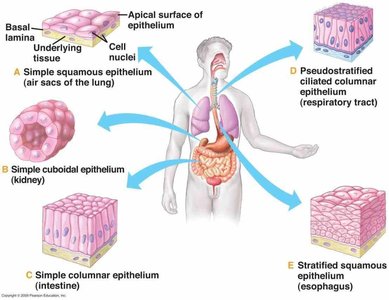
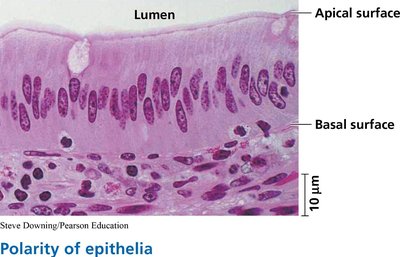
Epithelial tissue covers the body and lines organs and cavities. It is classified by cell shape and arrangement.
Shapes: Cuboidal (dice-shaped), columnar (brick-shaped), squamous (flat).
Arrangements: Simple (single layer), stratified (multiple layers), pseudostratified (single layer of varying length).
Connective Tissue
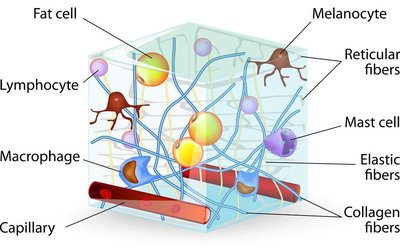
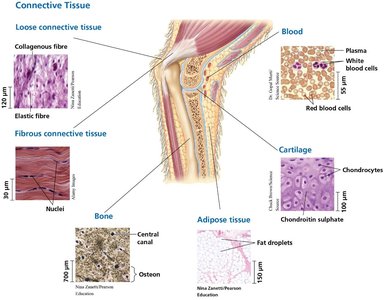
Connective tissue consists of scattered cells in an extracellular matrix of fibers and ground substance. It supports, binds, and protects other tissues and organs.
Cells: Fibroblasts, macrophages, mast cells, plasma cells, lymphocytes, leukocytes, adipose cells.
Fibers: Collagen (strength, flexibility), elastic (stretch), reticular (connects tissues).
Ground substance: Liquid, jellylike, or solid matrix holding everything together.
Muscle Tissue
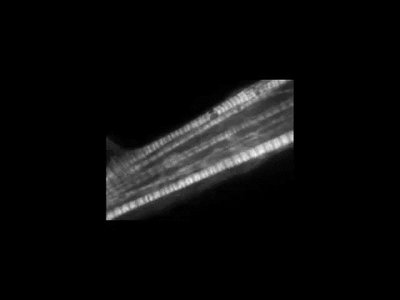
Muscle tissue is responsible for movement. It contains actin and myosin filaments that contract in response to nerve signals. There are three types:
Skeletal muscle: Voluntary movement, striated appearance.
Smooth muscle: Involuntary activities (e.g., digestive tract).
Cardiac muscle: Contraction of the heart, striated but involuntary.
Nervous Tissue
Nervous tissue functions in the receipt, processing, and transmission of information. It consists of neurons and glial cells.
Neurons: Transmit nerve impulses (action potentials).
Glia: Nourish, insulate, and regulate neuronal activity.

Communication: Endocrine and Nervous Systems
Signaling Mechanisms
Animals use the endocrine and nervous systems for internal communication.
Endocrine system: Transmits hormones via blood; effects are slow but long-lasting.
Nervous system: Transmits electrical signals along neurons; effects are rapid and targeted.

Homeostasis
Maintaining Internal Balance
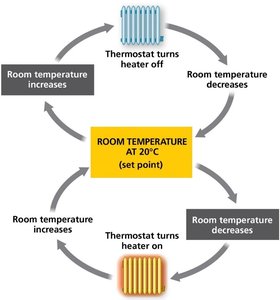
Homeostasis is the maintenance of a stable internal environment. Mechanisms moderate changes in variables such as temperature, pH, and glucose concentration.
Set point: The target value for a physiological variable.
Sensor: Detects deviations from the set point.
Response: Returns the variable to the set point.
Alterations in Homeostasis
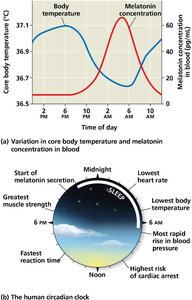
Set points and normal ranges can change with age or show cyclic variation (circadian rhythms). Acclimation and acclimatization allow animals to adjust to environmental changes.
Feedback Mechanisms
Negative feedback: Reduces the stimulus, returning the variable to normal (e.g., temperature regulation).
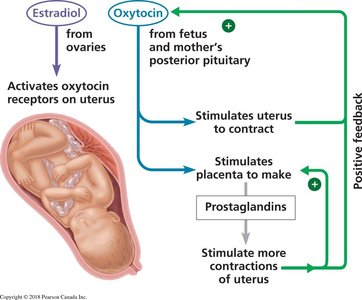
Positive feedback: Amplifies the stimulus (e.g., childbirth contractions).
Thermoregulation
Thermoregulatory Strategies
Animals regulate body temperature through various strategies. Terms used to describe these strategies include:
Term | Definition | Example |
|---|---|---|
Endothermic | Generates heat internally | Mammals, birds |
Ectothermic | Relies on external heat sources | Fish, reptiles, amphibians |
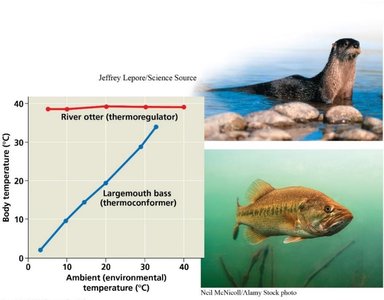
Thermoregulator | Maintains stable body temperature | Humans, basking reptiles |
Thermoconformer | Body temperature matches environment | Many fish, invertebrates |
Homeotherm | Constant body temperature | Mammals, birds |
Poikilotherm | Body temperature fluctuates | Reptiles, amphibians |
Heat Exchange Mechanisms
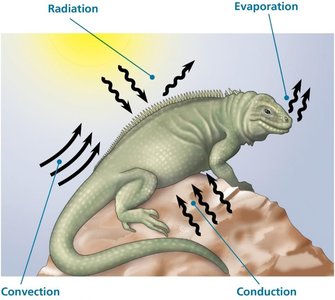
Organisms exchange heat with their environment by:
Radiation: Emission of heat from all objects above absolute zero.
Evaporation: Loss of heat as water evaporates from surfaces.
Convection: Transfer of heat by movement of air or liquid past a surface.
Conduction: Direct transfer of heat between objects in contact.
Thermoregulatory Adaptations
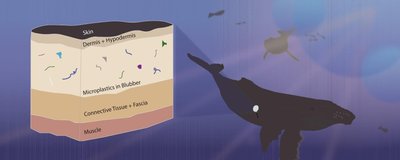
Insulation: Skin, feathers, fur, and blubber reduce heat loss.
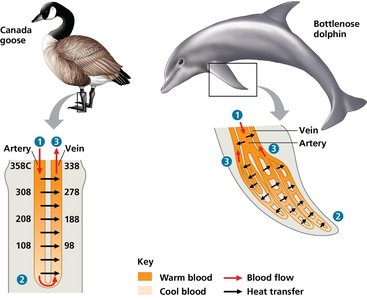
Circulatory adaptations: Vasodilation and vasoconstriction regulate blood flow; countercurrent heat exchangers minimize heat loss.
Evaporative cooling: Sweating, panting, and bathing increase heat loss.
Behavioral responses: Postures, huddling, and seeking shade or sun.
Metabolic heat production: Shivering and nonshivering thermogenesis (e.g., brown adipose tissue).

Thermoregulation Control
In mammals, thermoregulation is controlled by the hypothalamus, which acts as a thermostat. Fever is a regulated rise in the set point in response to infection.
Bioenergetics and Energy Requirements
Energy Flow and Metabolic Rate
Bioenergetics is the study of energy flow and transformation in animals. It determines food requirements and is influenced by size, activity, and environment.
Autotrophs: Obtain energy from light (e.g., plants).
Heterotrophs: Obtain energy from food (e.g., animals).
ATP: The main energy currency for cellular work.
Measuring Metabolic Rate
Basal metabolic rate (BMR): Energy use of an endotherm at rest at a comfortable temperature.
Standard metabolic rate (SMR): Energy use of an ectotherm at rest at a specific temperature.
Factors affecting metabolic rate: Age, sex, size, activity, temperature, nutrition.
BMR is proportional to body mass3/4 ().
Energy Conservation: Torpor and Hibernation
Animals use torpor, hibernation, and estivation to conserve energy during periods of low food or extreme temperatures.
Aspect | Sleep | Torpor |
|---|---|---|
Purpose | Brain and body restoration | Energy conservation |
Metabolic Rate | Slightly reduced | Drastically reduced (up to 95%) |
Body Temperature | Stable (homeothermic) | Drops significantly (heterothermic) |
Duration | Daily, several hours | Hours to weeks |
Reversibility | Quick and easy | Slow, requires warming |
Brain Activity | Active, with distinct stages | Minimal activity |
Example: Hummingbirds enter torpor at night, reducing metabolic rate and body temperature to conserve energy.
