 Back
BackBehavioral Ecology and Animal Behavior
Study Guide - Smart Notes
 Tailored notes based on your materials, expanded with key definitions, examples, and context.
Ecology: Biotic and Abiotic Interactions
Introduction to Ecology
Ecology is the scientific study of interactions among organisms and their environment, encompassing both biotic (living) and abiotic (non-living) factors. Understanding these interactions is fundamental to biology, as they shape the distribution, abundance, and behavior of organisms.
Biotic factors: Living components such as plants, animals, fungi, and microorganisms.
Abiotic factors: Non-living components including temperature, water, sunlight, soil, and climate.
Physiology and Ecology: Physiological adaptations allow organisms to survive and thrive in dynamic environments.
Scale of Ecology
Ecological studies are organized by scale, from individual organisms to entire ecosystems.
Organismal ecology: Focuses on individual organisms, including physiological and behavioral adaptations.
Population ecology: Examines groups of individuals of the same species and their dynamics.
Community ecology: Studies interactions among different species within a community.
Ecosystem ecology: Investigates energy flow and nutrient cycling among biotic and abiotic components.
Behavioral Biology and Ecology
Behavioral Ecology
Behavioral ecology explores how animal behavior contributes to survival and reproductive success. It integrates evolutionary theory with ecological context.
Behavior: Observable responses of organisms to internal or external stimuli.
Adaptive behavior: Behaviors that increase fitness by enhancing survival or reproduction.
Example: Eggshell removal by gulls reduces predation risk for hatchlings.
Types of Behavior: Nature vs. Nurture
Animal behavior is shaped by both genetic (innate) and environmental (learned) influences.
Innate behavior: Instinctive actions determined by genetics; does not require learning.
Learned behavior: Acquired through experience and environmental interaction.
Innate Behaviors and Ethology
Ethology and Fixed Action Patterns (FAP)
Ethology is the study of the genetic and physiological causes of behavior. Innate behaviors often manifest as fixed action patterns (FAP), which are automatic, unchangeable sequences triggered by specific stimuli.
Fixed Action Pattern: A sequence of behaviors that, once initiated, is carried to completion.
Sign stimulus: The external cue that triggers a FAP.
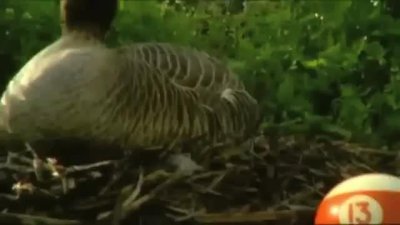
Example: Egg retrieval in geese is a classic FAP.

Examples of Fixed Action Patterns
Egg Retrieval in Geese: Geese instinctively roll eggs back into the nest when displaced.
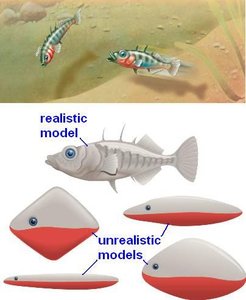
Stickleback Fish Territoriality: Male sticklebacks respond aggressively to models with red undersides, a sign stimulus for territorial defense.
Neuroethology: Nervous and Endocrine Systems
Internal Signals and Behavioral Regulation
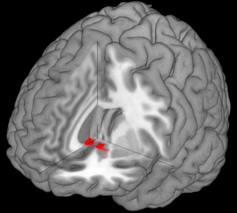
Neuroethology investigates how nervous and endocrine systems mediate behavior. Internal signals such as hormones and neurotransmitters drive responses to stimuli.
Endocrine hormones: Cortisol, norepinephrine, epinephrine regulate stress and arousal.
Neurotransmitters: Dopamine, serotonin influence mood and motivation.
Techniques: Mapping neurons, studying neurochemical regulation of behavior.
Behavioral Genetics
Genetic Basis of Behavior
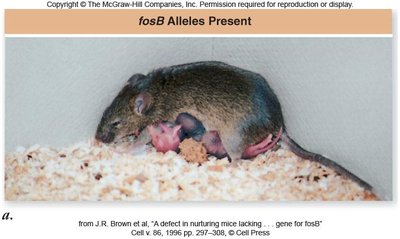
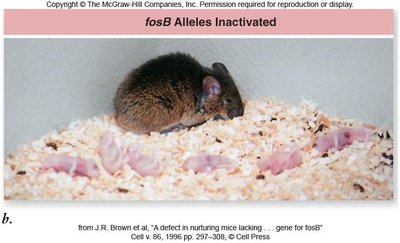
Some behaviors are directly influenced by specific genes. The fosB gene in mice is a well-studied example.
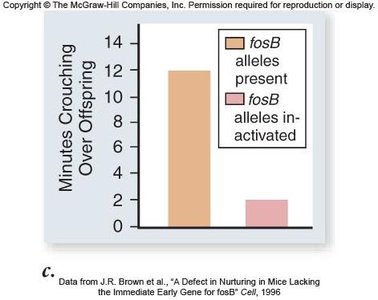
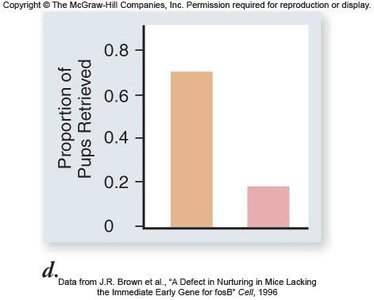
fosB gene: Determines maternal nurturing behavior in mice.
Experimental evidence: Mice with both fosB alleles disabled ignore their young, while normal mothers exhibit protective behavior.
Genotype | Maternal Behavior |
|---|---|
fosB alleles present | Protective, nurturing |
fosB alleles inactivated | Ignore young |
Learned Behavior
Nonassociative Learning
Nonassociative learning involves changes in behavior without forming associations between stimuli. Habituation is a common form.
Habituation: Decreased response to a repeated, non-threatening stimulus.
Associative Learning
Associative learning involves forming connections between stimuli or between a stimulus and a response. Two main types are classical and operant conditioning.
Classical conditioning: An involuntary response becomes associated with a new stimulus (e.g., Pavlov's dogs).
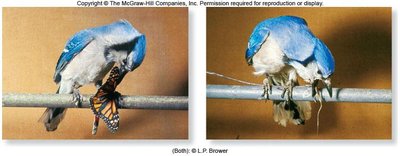
Operant conditioning: Behavior is reinforced by consequences (reward or punishment); also called trial-and-error learning.
Animal Cognition
Cognitive Learning and Problem Solving
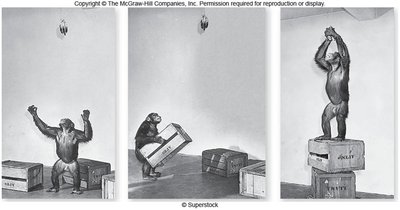
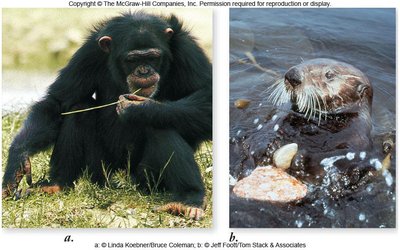
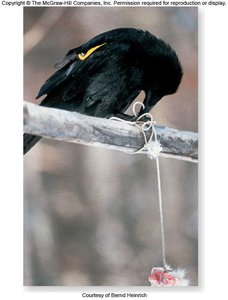
Cognitive learning is the ability to solve problems with conscious thought, often without direct environmental feedback. Examples include tool use and complex problem solving in primates and birds.
Chimpanzees: Stack boxes to reach bananas, use sticks to extract termites.
Japanese macaques: Wash sand off potatoes before eating.
Birds: Use string to retrieve food.
Learning Augments Behavior
Interaction of Innate and Learned Factors
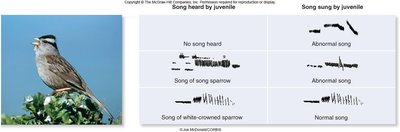
Many behaviors are a combination of innate programming and learned experience. For example, birds are genetically programmed to learn songs, but will only sing the correct song if exposed to it during development.
Song heard by juvenile | Song sung by juvenile |
|---|---|
No song heard | Abnormal song |
Song of song sparrow | Abnormal song |
Song of white-crowned sparrow | Normal song |
Optimality Theory and Foraging Behavior
Optimality Theory
Optimality theory predicts that animals behave in ways that maximize the benefits of a behavior minus its costs. This is especially relevant in foraging behavior.
Optimal foraging theory: Animals seek to obtain the most energy possible with the least expenditure of energy.
Example: Shore crabs prefer intermediate-sized mussels that provide the highest rate of energy return.
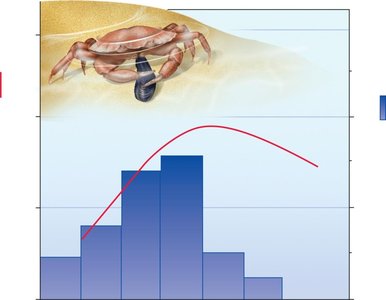
Mussel Size | Energy Yield | Ease of Opening |
|---|---|---|
Small | Low | Easy |
Intermediate | High | Moderate |
Large | Highest | Difficult |
Summary
These study notes cover key concepts in behavioral ecology, including the genetic and environmental basis of behavior, neuroethology, learning mechanisms, animal cognition, and optimal foraging theory. Understanding these principles is essential for analyzing how organisms interact with their environment and maximize their fitness.
