 Back
Chapter 50: Behavioral Ecology: Mechanisms, Adaptations, and Fitness Trade-Offs
Study Guide - Smart Notes
 Tailored notes based on your materials, expanded with key definitions, examples, and context.
Behavioral Ecology: An Overview
Introduction to Behavioral Ecology
Behavioral ecology is a subfield of organismal ecology that examines how animal behaviors evolve in response to ecological selection pressures. It integrates genetics, development, anatomy, physiology, evolution, and ecology to understand the causes and consequences of behavior.
Behavior is an action or response to a stimulus.
Behavioral ecologists study adaptations that increase fitness in specific environments.
Behaviors are shaped by both proximate (mechanistic) and ultimate (evolutionary) causes.
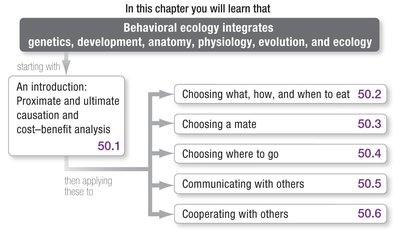
Proximate and Ultimate Causes of Behavior
Understanding Why and How Behaviors Occur
Behaviors are produced by complex interactions between genetic, neurological, hormonal, and skeletal-muscular mechanisms (proximate causes), and are shaped by evolutionary consequences (ultimate causes).
Proximate causation: Explains how a behavior occurs (mechanisms).
Ultimate causation: Explains why a behavior occurs (evolutionary purpose).
Example: Consolation behavior in primates—proximate cause is hormonal response to distress; ultimate cause is increased fitness through strong social bonds.
Types of Behavior: Innate vs. Learned
Inherited and Acquired Behaviors
Behaviors can be classified as innate (inherited and inflexible) or learned (acquired and flexible). Both types have adaptive significance depending on environmental context.
Innate behavior: Fixed, stereotyped, low variation, little environmental influence. Example: Jump-back reflex in rodents.
Fixed action pattern (FAP): A sequence of behaviors that occurs the same way every time.
Learned behavior: Flexible, high variation, highly influenced by environment. Example: Tool use in chimpanzees.
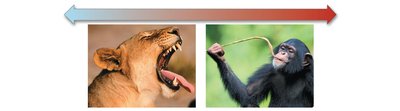
Behavioral Variation and Fitness Trade-Offs
Costs and Benefits of Behavioral Choices
Behavioral traits vary within populations and are subject to fitness trade-offs. Cost-benefit analysis is a common tool in behavioral ecology to evaluate the adaptive value of behaviors.
Behaviors are not usually conscious decisions in nonhuman animals.
Neural and hormonal processes direct behavioral responses.
Fitness trade-offs: Compromises between traits that cannot be optimized simultaneously (e.g., finding food vs. finding mates).
Foraging Behavior
Choosing What, How, and When to Eat
Foraging behavior is influenced by genetic variation and environmental conditions. Optimal foraging theory predicts that animals maximize feeding efficiency to increase fitness.
Example: Fruit fly larvae exhibit roving or sitting behavior based on alleles of the for gene.
Rover allele favored in high-density, low-food environments; sitter allele favored in low-density, plentiful-food environments.
Most animals exhibit flexible, learned foraging behaviors.
Optimal foraging theory: Fitness is highest when benefits of feeding efficiency outweigh costs.
Key equation:
Benefits: Survival, size, number, and quality of food.
Costs: Time, energy, risk of injury, exposure to predation.
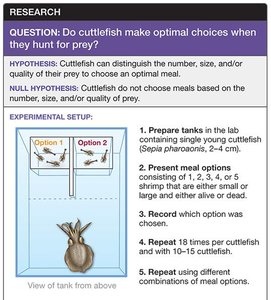
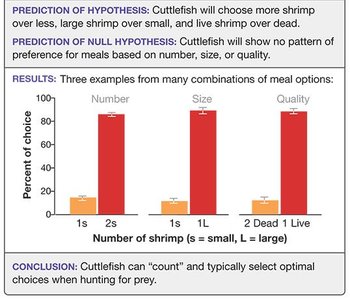
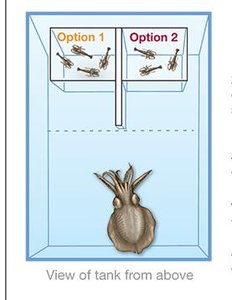
Experimental studies (e.g., cuttlefish) show that animals can "count" and select optimal choices based on number, size, and quality of prey.
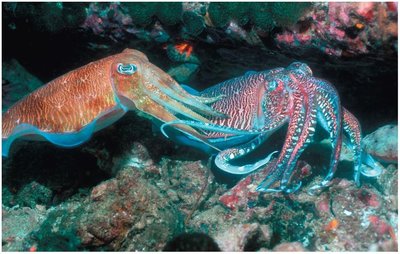
Mating Behavior and Systems
Choosing a Mate
Mating systems are highly variable among and within species. They are organized by the number of males and females that mate during a given season and can serve functions beyond reproduction.
Asexual reproduction: No mate required.
Sexual reproduction: Requires male and female gametes.
Some species are hermaphrodites or change sex during their lifetime.
Mating systems: Monogamy (1:1), Polygyny (1 male: multiple females), Polyandry (1 female: multiple males), Polygynandry (multiple males and females).
Mating behavior can strengthen social bonds.
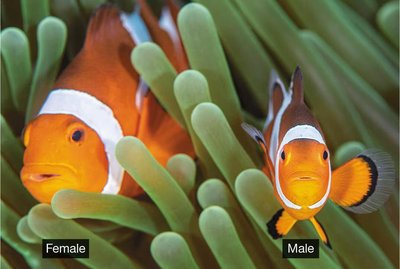
Proximate causes of mate choice include abiotic (daylength, temperature) and biotic (sight, sound, scent, touch) cues. Ultimate causes involve natural and sexual selection for traits that increase mating success.
Migration Behavior
Choosing Where to Go
Migration is a dramatic example of animal behavior involving long-distance, seasonal movement. Navigation mechanisms include piloting, compass orientation, and true navigation.
Piloting: Using visual landmarks.
Compass orientation: Using celestial cues or Earth's magnetic field.
True navigation: Locating a specific position on Earth.
Ultimate cause: Migratory individuals often have higher fitness due to access to food or favorable reproductive sites.
Migration patterns can be disrupted by climate change.
Communication Behavior
Communicating with Others
Communication involves signals that modify the behavior of recipient individuals. Modes include visual, auditory, olfactory, and tactile signals, each with advantages and disadvantages.
Examples: Lizard pushups, bird song, honeybee waggle dance.
Signals must be sent and received to constitute communication.
Natural selection can favor misleading communication (e.g., mimicry, playing dead).
Cooperation and Altruism
Cooperating with Others
Altruism is a behavior that benefits another individual at a cost to the actor. Several mechanisms explain altruistic and cooperative behaviors.
Kin selection: Natural selection favors behaviors that increase the fitness of relatives, leading to increased inclusive fitness.
Inclusive fitness:
Reciprocal altruism: Exchange of fitness benefits between nonrelatives, separated by time.
Cooperation: Behaviors that benefit both actor and recipient within a species.
Mutualism: Behaviors that benefit both actor and recipient between species.
Natural selection does not produce self-sacrificing alleles; individuals act to increase their own direct or inclusive fitness.
Summary of Behavioral Ecology
Key Concepts
All behaviors have proximate and ultimate causes, and involve fitness trade-offs.
Behavioral decisions are shaped by unconscious neural and hormonal processes.
Cost-benefit analysis is central to understanding behavioral adaptations.
