 Back
Bio 1010 Exam 1 Study Guide – Functional Groups, Chemical Behavior, and Biomolecules
Study Guide - Smart Notes
 Tailored notes based on your materials, expanded with key definitions, examples, and context.
Q1. The chemical behavior of an atom depends primarily upon which of the following?
Background
Topic: Atomic Structure and Chemical Properties
This question tests your understanding of what determines how an atom interacts with other atoms, which is foundational for understanding chemical bonding and reactivity in biology.
Key Terms:
Valence shell: The outermost electron shell of an atom.
Electrons: Negatively charged particles that orbit the nucleus and are involved in chemical bonding.
Chemical behavior: How an atom reacts or bonds with other atoms.
Step-by-Step Guidance
Recall that atoms are made of protons, neutrons, and electrons. The electrons are arranged in shells around the nucleus.
Consider which part of the atom is directly involved in forming chemical bonds with other atoms.
Think about the importance of the outermost (valence) electrons in determining how an atom will interact with others.
Review the answer choices and identify which one focuses on the electrons in the valence shell.
Try solving on your own before revealing the answer!
Final Answer: C) the number of electrons in the valence shell
The chemical behavior of an atom is determined primarily by the electrons in its valence shell, as these are the electrons involved in chemical bonding and reactions.
Q2. Which of the following chemical equations best describes a dehydration reaction?
Background
Topic: Biological Reactions – Dehydration and Hydrolysis
This question tests your understanding of how biological macromolecules are synthesized and broken down, specifically through dehydration (condensation) and hydrolysis reactions.
Key Terms:
Dehydration reaction: A chemical reaction in which two molecules are joined together by removing a molecule of water.
Hydrolysis: A reaction in which a molecule is split into two by adding water.
Monosaccharide: Simple sugar molecule.
Disaccharide: Two monosaccharides joined together.
Step-by-Step Guidance
Recall that a dehydration reaction forms a larger molecule (like a disaccharide) from smaller ones (monosaccharides) and releases water.
Look for the equation where two monosaccharides combine and water is produced as a byproduct.
Compare the answer choices to see which one fits this description.
Try solving on your own before revealing the answer!
Final Answer: A) monosaccharide + monosaccharide = disaccharide + H2O
A dehydration reaction joins two monosaccharides to form a disaccharide, releasing water in the process.
Q3. A molecule with the formula C16H32O2 is most likely which of the following molecules?
Background
Topic: Biomolecule Structure and Function
This question tests your ability to recognize the chemical formula of different classes of biological molecules, such as fatty acids, carbohydrates, steroids, and polysaccharides.
Key Terms:
Fatty acid: Long hydrocarbon chain with a carboxyl group (COOH).
Carbohydrate: Molecule with a general formula (CH2O)n.
Steroid: Four-ring structure, not typically with this formula.
Polysaccharide: Many monosaccharides joined together.
Step-by-Step Guidance
Analyze the ratio of carbon, hydrogen, and oxygen in the formula C16H32O2.
Recall the typical formulas for fatty acids and carbohydrates.
Compare the formula to the options given and consider which biomolecule matches this structure.
Try solving on your own before revealing the answer!
Final Answer: A) fatty acid
The formula C16H32O2 is characteristic of a fatty acid, which has a long hydrocarbon chain and a carboxyl group.
Q4. If a DNA sample were composed of 20% adenine, what would be the percentage of guanine?
Background
Topic: Nucleic Acid Structure – Chargaff's Rules
This question tests your understanding of the base pairing rules in DNA and how the proportions of the four bases relate to each other.
Key Terms and Formula:
Chargaff's Rule: In DNA, the amount of adenine (A) equals thymine (T), and the amount of guanine (G) equals cytosine (C).
Base pairing: A pairs with T, G pairs with C.
Total percentage of all four bases = 100%
Step-by-Step Guidance
Recall that A = T and G = C in DNA.
If adenine is 20%, then thymine must also be 20%.
Subtract the combined percentage of A and T from 100% to find the combined percentage of G and C.
Divide the remaining percentage equally between G and C.
Try solving on your own before revealing the answer!
Final Answer: B) 30%
If A = 20% and T = 20%, then G + C = 60%. Since G = C, guanine is 30%.
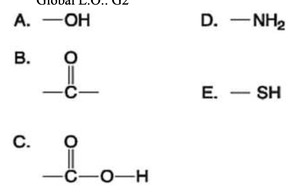
Q5. Which two functional groups shown in the figure above are present in all amino acids?
Background
Topic: Amino Acid Structure – Functional Groups
This question tests your ability to identify the functional groups that are common to all amino acids, which are the building blocks of proteins.
Key Terms:
Amino group:
Carboxyl group:
Functional group: Specific group of atoms within a molecule responsible for characteristic reactions.
Step-by-Step Guidance
Examine the diagram and identify the structures of each functional group labeled A–E.
Recall that all amino acids have both an amino group () and a carboxyl group ().
Match these groups to the labels in the diagram.
Review the answer choices to see which pair includes both the amino and carboxyl groups.
Try solving on your own before revealing the answer!
Final Answer: D) C and D
All amino acids contain both a carboxyl group (C) and an amino group (D), as shown in the diagram.
